From the free course AP World History: Modern on Lykke
9.9 Continuity and Change in a Globalized World
Key concepts: Globalization and international interactions · International organizations · United Nations · World peace and international cooperation · Continuity and change over time · Argumentation · Skill 6.D: corroborating, qualifying, or modifying an argument · Complex historical arguments · Analyzing multiple variables · Explaining continuity and change, causes and effects, and similarities and differences
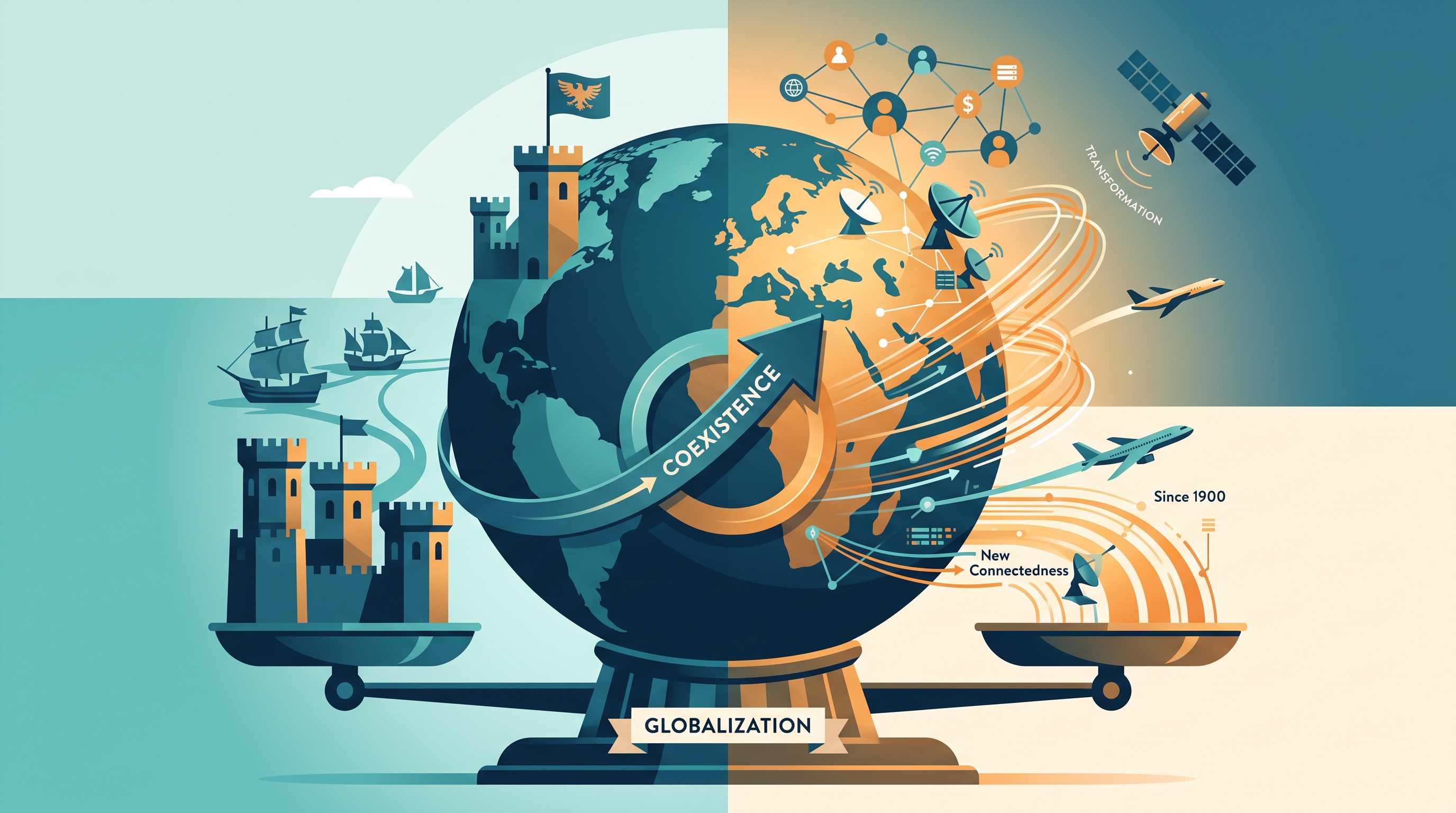
Globalization changed international interactions among states, but greater connection did not automatically produce agreement, equality, or peace. The central historical problem is therefore one of continuity and change over time: what changed in global relationships after 1900, what persisted, and how far did new…
9.9 Continuity and Change in a Globalized World
Globalization changed international interactions among states, but greater connection did not automatically produce agreement, equality, or peace. The central historical problem is therefore one of continuity and change over time: what changed in global relationships after 1900, what persisted, and how far did new institutions accomplish their stated purposes?
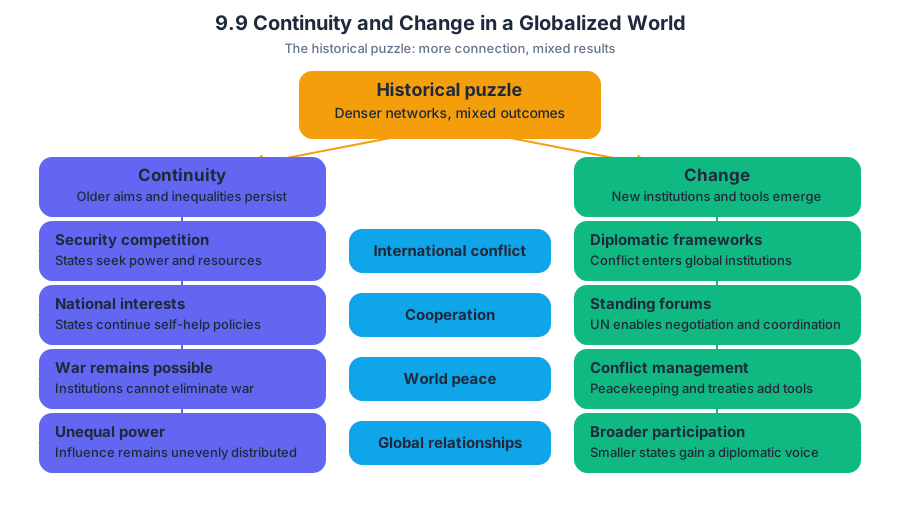
The historical puzzle: more connection, mixed results
By the twentieth century, states interacted through denser networks of trade, communication, diplomacy, migration, warfare, and international law. International organizations, including the United Nations, formed with the stated goal of maintaining world peace and facilitating international cooperation. The historical question is not simply whether these institutions existed, but whether their existence changed the behavior and outcomes of international politics.
A strong argument separates intended purpose from historical effect:
| Dimension | Continuity | Change |
|---|---|---|
| International conflict | States continued to compete for security, influence, and resources | Conflict increasingly operated within global diplomatic and institutional frameworks |
| Cooperation | States still pursued national interests | States gained standing forums for negotiation and coordinated action |
| World peace | International institutions could not eliminate war | Collective diplomacy, peacekeeping, and international agreements created new tools for managing conflict |
| Global relationships | Power remained unequal | Smaller or newly independent states gained more opportunities to make claims in international settings |
This comparison avoids two opposite errors. One error is declaring globalization a complete transformation that erased older rivalries. The other is treating international institutions as meaningless because they did not end every conflict. A complex historical argument explains how both continuity and change operated at the same time.
Skill 6.D: building a complex argument
Skill 6.D — “Corroborate, qualify, or modify an argument using diverse and alternative evidence in order to develop a complex argument” — asks the writer to do more than list examples. The writer must test an initial claim against evidence from different perspectives, regions, or outcomes, then make the claim more precise.
A complex argument does not merely say that globalization caused change; it explains the extent, limits, conditions, and consequences of that change.
Three moves are especially important:
- Corroborate: use separate evidence that supports the same interpretation.
- Qualify: show that an argument is broadly valid but limited by time, place, or circumstance.
- Modify: revise the original argument because alternative evidence changes its meaning.
A complex argument may explain nuance through multiple variables, make relevant and insightful connections across periods, assess the significance and limitations of evidence, or explain why a historical claim is effective or incomplete. In practice, this means connecting political institutions to power relationships, economic interests, technological change, and the experiences of different states rather than treating “globalization” as a single force with one predictable result.
Worked argument: evaluating the United Nations
Prompt: Evaluate the extent to which globalization changed international interactions among states from 1900 to the present.
Step 1 — Initial claim: Globalization changed international interactions to a significant extent because states increasingly used international institutions to pursue peace and cooperation.
Step 2 — Corroborating evidence: The United Nations provides evidence that states developed permanent structures for diplomacy and collective action. Its stated goals of maintaining world peace and facilitating international cooperation demonstrate a change from relying only on separate national diplomacy.
Step 3 — Qualifying evidence: The creation of the United Nations did not remove national competition or guarantee successful peace. States could continue to prioritize sovereignty, security, and strategic interests, meaning that institutional cooperation operated within older power struggles.
Step 4 — Modified conclusion: Globalization changed the mechanisms of international interaction more consistently than it changed the underlying interests of states. The United Nations created new forums and expectations for cooperation, but its effectiveness depended on whether powerful states accepted collective limits and whether member states shared compatible goals.
This argument earns complexity because it explains both change and continuity, uses the United Nations as evidence without assuming automatic success, and distinguishes institutional innovation from actual political outcomes. It also analyzes multiple variables: global connectivity, institutional design, state power, and national interest.
Making continuity and change persuasive
When organizing a response, use a before-and-after structure, but do not force history into a simple “old versus new” story. Ask four questions: What changed? What persisted? Why did both occur? What were the consequences?
A useful thesis pattern is:
Globalization significantly changed international interactions by expanding institutional cooperation and diplomatic coordination; however, it did not eliminate competition among states, so the transformation was greater in the methods of interaction than in the persistence of power politics.
Common misconception — “The existence of the United Nations proves that world peace was achieved.” Institutions reveal changing ambitions and methods, not guaranteed results. To evaluate effectiveness, compare the organization’s stated goals with actual outcomes and explain the conditions that enabled or limited success.
Retrieval check
A response claims, “Globalization transformed international relations after 1900.” Strengthen it using Skill 6.D: name one piece of evidence that corroborates the claim, one that qualifies it, and one variable—such as state power or national interest—that explains why continuity and change existed together.
Source Materials
- AP World History: Modern Course and Exam Description
- AP World History: Modern Course and Exam Description Clarifications and Corrections
- AP World History: Modern Course Overview
- AP World History: Modern Course at a Glance
- AP World History: Modern Course at a Glance Poster
- AP World History: Modern
- AP World History: Modern
- AP World History: Modern Sample Syllabus 1