From the free course AP World History: Modern on Lykke
2.5 Cultural Consequences of Connectivity · 2.6 Environmental Consequences of Connectivity
Key concepts: Cultural consequences of connectivity · Environmental consequences of connectivity · Authorial audience · Neighbors · Tatar ruler · Audience identification (Skill 2)
A trade route does more than move silk, salt, or gold: it moves habits of thought. When merchants, pilgrims, soldiers, and migrants cross long distances, they carry religions, languages, artistic styles, technologies, crops, and diseases with them.
2.5 Cultural Consequences of Connectivity · 2.6 Environmental Consequences of Connectivity
A trade route does more than move silk, salt, or gold: it moves habits of thought. When merchants, pilgrims, soldiers, and migrants cross long distances, they carry religions, languages, artistic styles, technologies, crops, and diseases with them. Between $c. 1200$ and $c. 1450$, expanding networks of exchange therefore changed both human culture and the natural environment.
Investigative question: When societies become more connected, what changes first—people’s ideas, their environments, or both?
Cultural consequences of connectivity
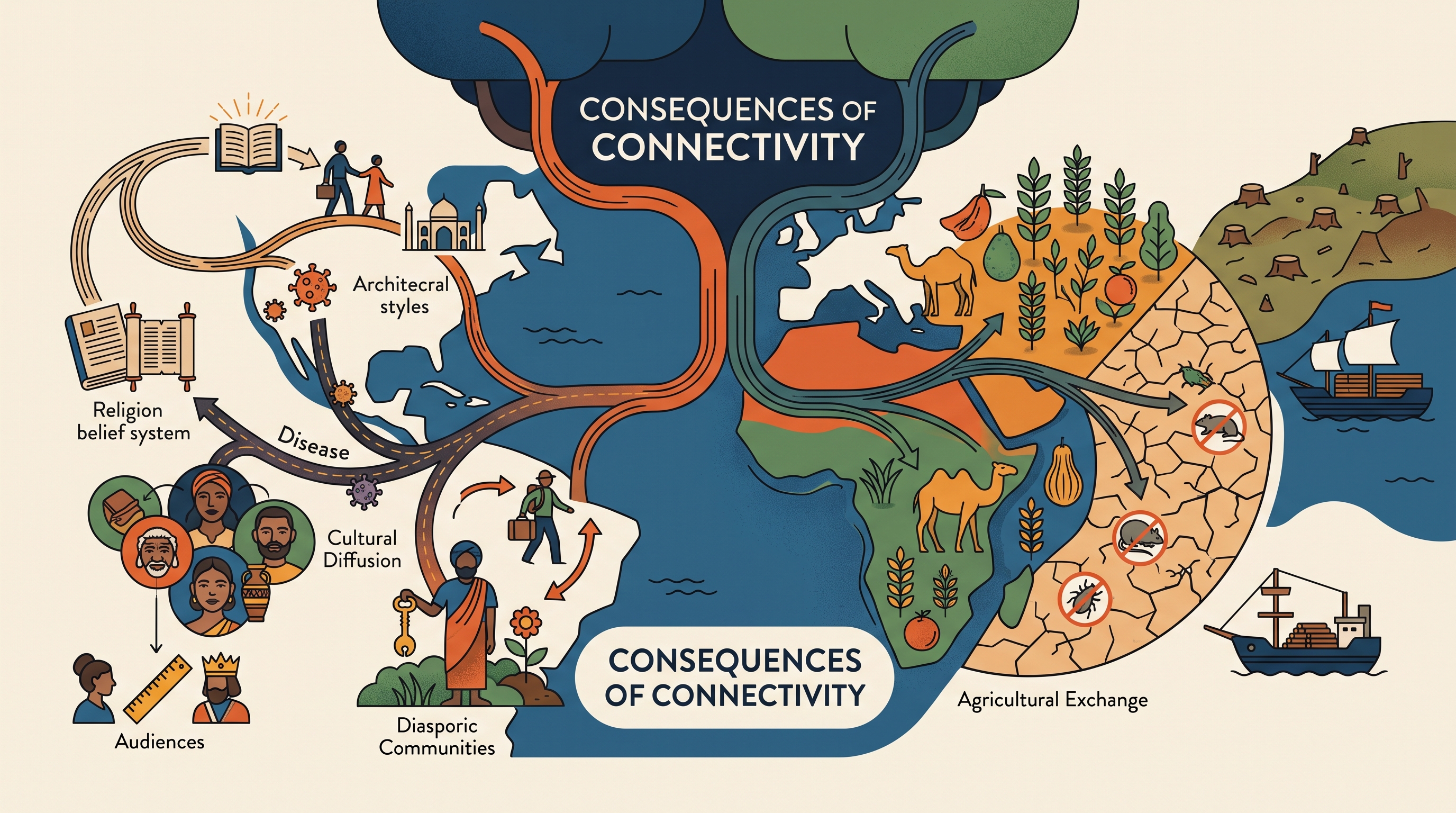
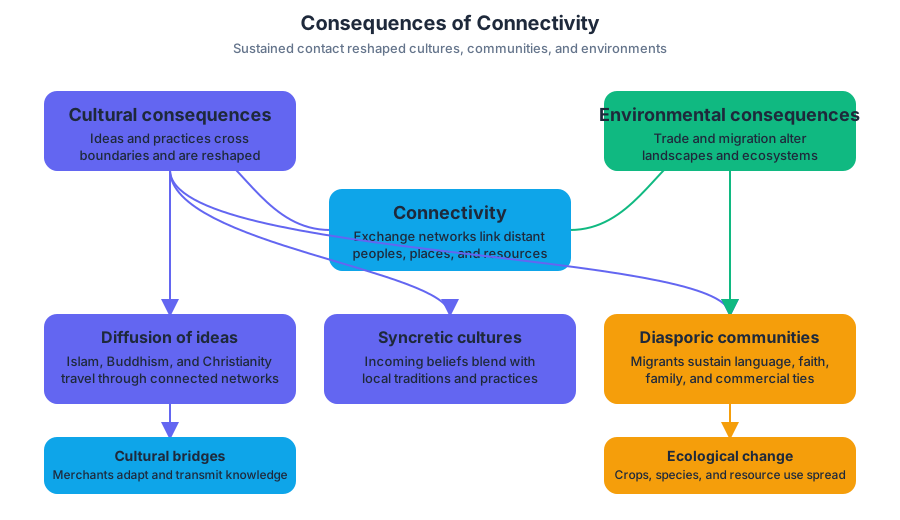
The cultural consequences of connectivity are the changes produced when sustained contact spreads beliefs, practices, knowledge, and communities across regions. These consequences were not always simple “adoption.” Local societies often blended incoming ideas with existing traditions, creating syncretic—or combined—belief systems and cultural forms.
Under CED 2.5.A, the expansion of networks of exchange influenced the diffusion of cultural practices and ideas. Islam spread through merchants, scholars, and rulers across parts of Africa and Asia; Buddhism traveled through Central and East Asian networks; and Christian communities remained connected across Europe and the Mediterranean. Literary traditions, artistic techniques, mathematical knowledge, navigational skills, and technologies also crossed cultural boundaries.
Under CED 2.5.B, these networks helped create diasporic communities—groups living outside an ancestral homeland while maintaining connections through religion, language, family, or commerce. Merchant communities could serve as cultural bridges: they introduced foreign practices to local societies but also adapted themselves to local political and social conditions.
Worked example: tracing one cultural change
Imagine a Muslim merchant settling in a port city far from his birthplace. The reasoning chain is:
- Connectivity: A regular trade route brings merchants into repeated contact with the port.
- Community: Other merchants establish a diasporic neighborhood, mosque, or commercial network.
- Cultural transmission: Religious practices, legal customs, writing systems, and architectural styles become visible locally.
- Adaptation: Local rulers and residents selectively adopt or reinterpret these practices.
- Historical consequence: The port becomes culturally plural rather than simply replacing one culture with another.
This example shows why historians should avoid the misconception that cultural diffusion means one civilization passively copying another. Exchange created interaction, but power, local choice, and existing traditions shaped the result.
Environmental consequences of connectivity
The environmental consequences of connectivity were equally significant. Under CED 2.6.A, expanding networks of exchange facilitated the movement of crops, animals, and pathogens. These transfers could increase food supplies and support population growth, but they could also produce ecological stress and devastating epidemics.
The movement of crops changed diets and agricultural systems. New crops could support people in regions with different climates, while the increased movement of animals and human populations altered landscapes. The most destructive example was the spread of the bubonic plague, or Black Death, along connected routes from Central Asia toward the Middle East, North Africa, and Europe during the fourteenth century. Trade did not “cause” the disease in isolation; connectivity accelerated its movement among densely populated settlements.
A useful cause-and-effect chain is:
$$ \text{expanded exchange} \rightarrow \text{more movement} \rightarrow \text{greater biological contact} \rightarrow \text{new opportunities and new risks} $$
The key misconception is that connectivity was automatically beneficial. Networks could spread knowledge and food, yet the same routes could spread pathogens faster than communities could respond.
Skill 2: Sourcing and Situation
Skill 2: Sourcing and Situation asks students to analyze a source’s point of view, purpose, historical situation, and audience. Audience identification means determining who the author expected to read, hear, or act upon the source—not merely naming a group that might have encountered it.
For a source connected to cultural exchange, ask: Who do you think was the author’s audience—his neighbors, the Tatar ruler, or someone else? Test each possibility against the source’s language, level of explanation, subject matter, and political purpose.
- The author’s neighbors: likely if the source explains unfamiliar customs, describes distant places for local readers, or uses shared local assumptions.
- The Tatar ruler: more likely if the source requests patronage, reports conditions, praises authority, or offers information useful for governance.
- Someone else: possible if the work addresses merchants, religious scholars, travelers, or a broad literary audience.
A strong Skill 2 response does not stop at “the audience was his neighbors.” It explains why: “The author likely addressed his neighbors because he explains distant practices in accessible terms and emphasizes information that would interest people who had not personally traveled.” Audience is an argument supported by source evidence.
Retrieval check
- How could the same network spread both a religion and a disease?
- What makes a diasporic community different from a temporary group of travelers?
- Which clues would distinguish an audience of neighbors from an audience of a Tatar ruler?
- Why is cultural diffusion not the same as simple cultural replacement?
Interpretation check: If a text praises a ruler’s protection of merchants and reports the wealth of distant cities, which audience is most plausible? Explain your answer using one feature of the author’s purpose or language.
Source Materials
- AP World History: Modern Course and Exam Description
- AP World History: Modern Course and Exam Description Clarifications and Corrections
- AP World History: Modern Course Overview
- AP World History: Modern Course at a Glance
- AP World History: Modern Course at a Glance Poster
- AP World History: Modern
- AP World History: Modern
- AP World History: Modern Sample Syllabus 1
- 2.6 Environmental Consequences of Connectivity 5.A