From the free course AP World History: Modern on Lykke
6.7 Effects of Migration · 6.8 Causation in the Imperial Age
Key concepts: Effects of migration · Causation in the Imperial Age · Historical reasoning · Explaining multiple themes or perspectives to explore complexity · Imperial examination system · Mandate of Heaven · Confucian scholars · Buddhist monks · Neo-Confucianism · Social prestige of scholars
Migration transforms more than population maps: it creates diasporas, rearranges labor systems, and produces new political and racial hierarchies. In the imperial age, the central historical question is not simply who moved, but how movement changed both the migrants’ lives and the societies that recruited, ruled,…
6.7 Effects of Migration · 6.8 Causation in the Imperial Age
Migration transforms more than population maps: it creates diasporas, rearranges labor systems, and produces new political and racial hierarchies. In the imperial age, the central historical question is not simply who moved, but how movement changed both the migrants’ lives and the societies that recruited, ruled, or resisted them.
6.7 Effects of Migration
A diaspora is a community living outside its place of origin while maintaining cultural, family, or economic connections across regions. During the nineteenth century, colonial labor demand helped produce large diasporas through indentured labor, a contract system in which workers agreed to labor for a specified period in exchange for wages, transportation, or eventual freedom.
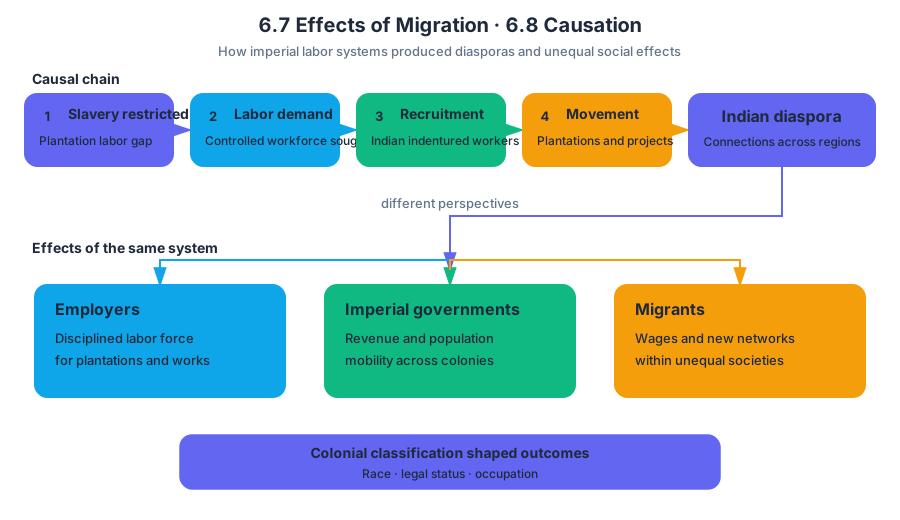
A useful causal chain is:
For example, the abolition or restriction of slavery increased plantation owners’ demand for controlled labor. Colonial governments and private employers recruited Indian workers for plantations and infrastructure projects in places such as the Caribbean, southern Africa, and Southeast Asia. The workers’ movement created Indian diasporas, but it also placed migrants into unequal societies where colonial authorities often classified them by race, legal status, and occupation.
The effects differed by perspective. Employers gained a disciplined labor force; imperial governments gained revenue and population mobility; migrants gained wages and sometimes opportunities unavailable at home, but they also faced coercive contracts, harsh working conditions, family separation, and discrimination. Indigenous workers could experience competition for employment, while colonial authorities used racial categories to divide laborers and weaken collective resistance. A strong historical explanation therefore connects migration’s economic effects to its social and political consequences.
Key distinction: Migration may be voluntary, forced, or constrained by economic necessity. Calling all contract labor “free migration” hides the unequal power relationship built into the contract.
6.8 Causation in the Imperial Age
Causation means explaining how and why one historical development contributed to another. It requires more than placing events in chronological order. A causal argument identifies a mechanism—the process linking cause to effect—and considers whether other causes, limits, or perspectives modify the explanation.
Worked causal example: Colonial labor demand encouraged indentured recruitment because plantation economies required large workforces after slavery declined. Indentured migration then created permanent diasporas because many workers remained after their contracts ended, established families, or built businesses. These diasporas altered local societies because colonial governments assigned groups different legal and racial positions. The result was not only labor replacement but also new political identities, ethnic tensions, and demands for rights.
Notice the reasoning: each arrow explains why the next development followed. A weak answer says, “Indentured workers moved and discrimination occurred.” A stronger answer explains the connection between labor demand, imperial regulation, settlement, and hierarchy.
Belief Systems and Political Systems
Belief systems could legitimize political authority while also giving rulers tools for administration. In China, the imperial examination system selected officials through tests based heavily on Confucian learning. This strengthened the state by creating a class of educated administrators who shared a political language, valued hierarchy, and could serve a centralized bureaucracy.
The Mandate of Heaven held that a ruler governed legitimately only while maintaining moral order and effective rule. Natural disasters, rebellion, or political disorder could be interpreted as evidence that the ruler had lost Heaven’s support. This idea both reinforced authority and placed conditions on it: emperors claimed legitimacy, but subjects could explain dynastic change as justified when rulers failed.
Confucian scholars therefore occupied an ambiguous position. Their education gave them rising prestige and access to government, yet their role also depended on serving the imperial system. Buddhist monks offered another source of authority through monasteries, learning, charity, and spiritual influence. The Yuan emperors supported both Confucian scholars and Buddhist monks, using multiple traditions to portray Mongol rule as legitimate in China.
Neo-Confucianism, a renewed form of Confucian thought that incorporated ideas responding to Buddhism and Daoism, further elevated the social prestige of the Confucian scholarly class. It connected personal morality, family hierarchy, education, and good government. The relationship was reciprocal: political systems promoted beliefs that supported order, while belief systems supplied rulers with claims about why obedience and hierarchy were proper.
Historical Reasoning: Explaining Complexity
For historical reasoning, especially Skill 5: Making Connections and Skill 6: Argumentation, complexity comes from explaining more than one valid dimension. A sophisticated claim might argue that belief systems reinforced political hierarchies through examinations, filial piety, and the Mandate of Heaven, while also limiting rulers by defining standards of moral conduct. Likewise, migration could create opportunity for some groups while producing exploitation and exclusion for others.
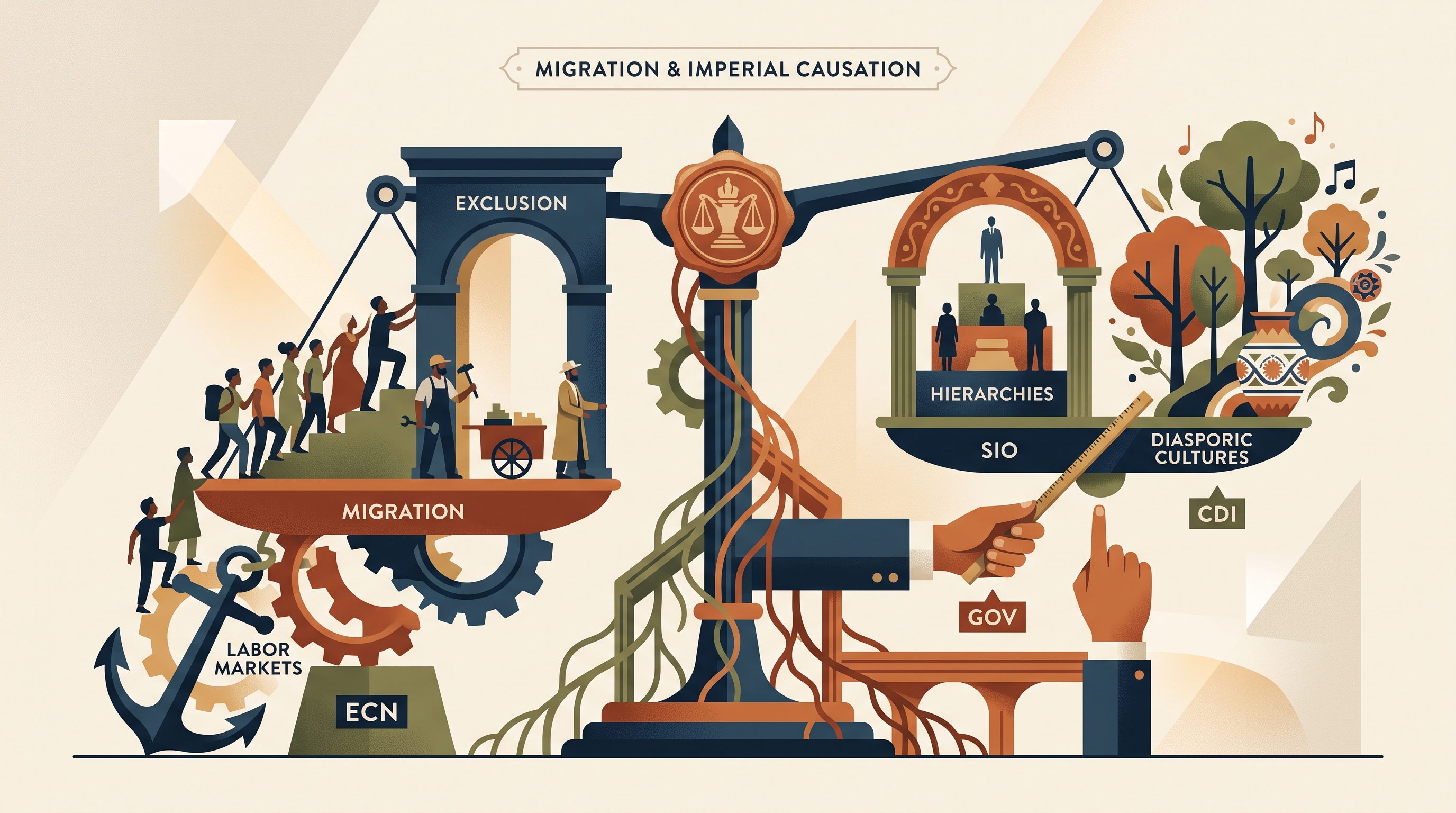
When exploring multiple themes or perspectives, combine categories rather than listing them: migration affected ECN through labor markets, SIO through racial and ethnic hierarchies, GOV through colonial regulation, and CDI through diasporic cultures. The goal is a connected explanation, not a catalogue of facts.
Complexity formula: claim + specific evidence + causal mechanism + qualification or alternate perspective.
Misconception check: “The Mandate of Heaven was simply a religious version of divine-right monarchy.” Not exactly. Both could legitimize rulers, but the Mandate of Heaven made legitimacy conditional on competent and moral governance, allowing rebellion and dynastic replacement to be explained as historically justified.
Retrieval check: Explain one causal chain linking colonial labor demand to a new social hierarchy. Then explain how the imperial examination system both strengthened Chinese political authority and increased the prestige of Confucian scholars. Finally, add one qualification showing how migrants or subjects could experience the same system differently from rulers.
Source Materials
- AP World History: Modern Course and Exam Description
- AP World History: Modern Course and Exam Description Clarifications and Corrections
- AP World History: Modern Course Overview
- AP World History: Modern Course at a Glance
- AP World History: Modern Course at a Glance Poster
- AP World History: Modern
- AP World History: Modern
- AP World History: Modern Sample Syllabus 1