From the free course AP World History: Modern on Lykke
6.1 Rationales for Imperialism from 1750 to 1900 · 6.2 State Expansion from 1750 to 1900
Key concepts: Rationales for imperialism from 1750 to 1900 · State expansion from 1750 to 1900 · Ideologies contributing to imperialism · Governance and the exercise of political power · Religious ideas used to legitimize rule · Art and monumental architecture as tools of political legitimacy · Mughal zamindar tax collection · Ottoman tax farming · Cultural developments and interactions under imperialism · Ashanti resistance to imperial expansion in West Africa
Imperialism was not driven by one motive. From $1750$ to $1900$, states expanded through a combination of political competition, economic goals, strategic calculation, and ideologies that presented domination as justified or even beneficial.
6.1 Rationales for Imperialism from 1750 to 1900 · 6.2 State Expansion from 1750 to 1900
Imperialism was not driven by one motive. From $1750$ to $1900$, states expanded through a combination of political competition, economic goals, strategic calculation, and ideologies that presented domination as justified or even beneficial. The central historical problem is therefore not “Which single cause created imperialism?” but “How did ideas and institutions make expansion possible and defensible?”
Imperialism: power backed by ideology
Imperialism means extending a state’s authority over other peoples or territories, often without granting those populations equal political power. During this period, European states increasingly connected overseas expansion to rivalry among nation-states, access to resources and markets, military advantage, and claims about cultural or racial superiority.
Under Unit 6: Learning Objective A, students should explain how ideologies contributed to the development of imperialism. The required knowledge identifier KC-5.2.III emphasizes that cultural, religious, and racial ideologies—including Social Darwinism and nationalism—were used to justify imperialism.
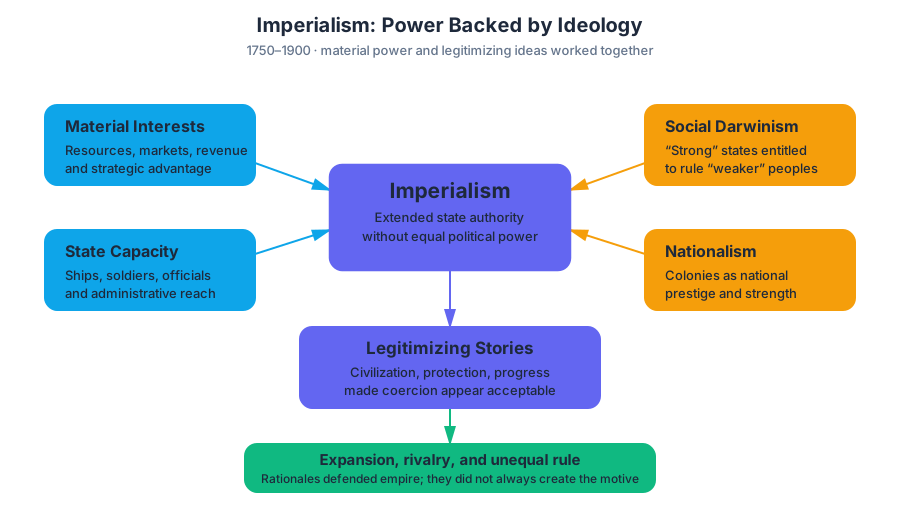
Social Darwinism misapplied the language of biological competition to human societies. Imperial powers portrayed stronger states as naturally entitled to rule weaker ones, transforming conquest into an allegedly scientific process. Nationalism added another motive: governments competed for colonies because overseas possessions could symbolize national greatness, strategic strength, and international prestige.
These arguments were rationales, not neutral explanations. Economic or strategic interests might encourage expansion, but racial and cultural ideologies helped governments represent coercion as civilization, protection, or progress. This distinction matters: an ideology can explain how imperialism was defended even when it did not create the original economic or political motive.
Key insight: Imperialism grew from the interaction of material power and legitimizing ideas. A state needed ships, soldiers, administrators, and revenue; it also needed a story explaining why its rule was acceptable.
State expansion and the machinery of rule
State expansion involved more than conquering territory. Governments had to collect revenue, maintain order, communicate with officials, and convert distant populations into subjects of a political system. Administrative institutions, policies, and procedures made authority durable after military force had opened the way.
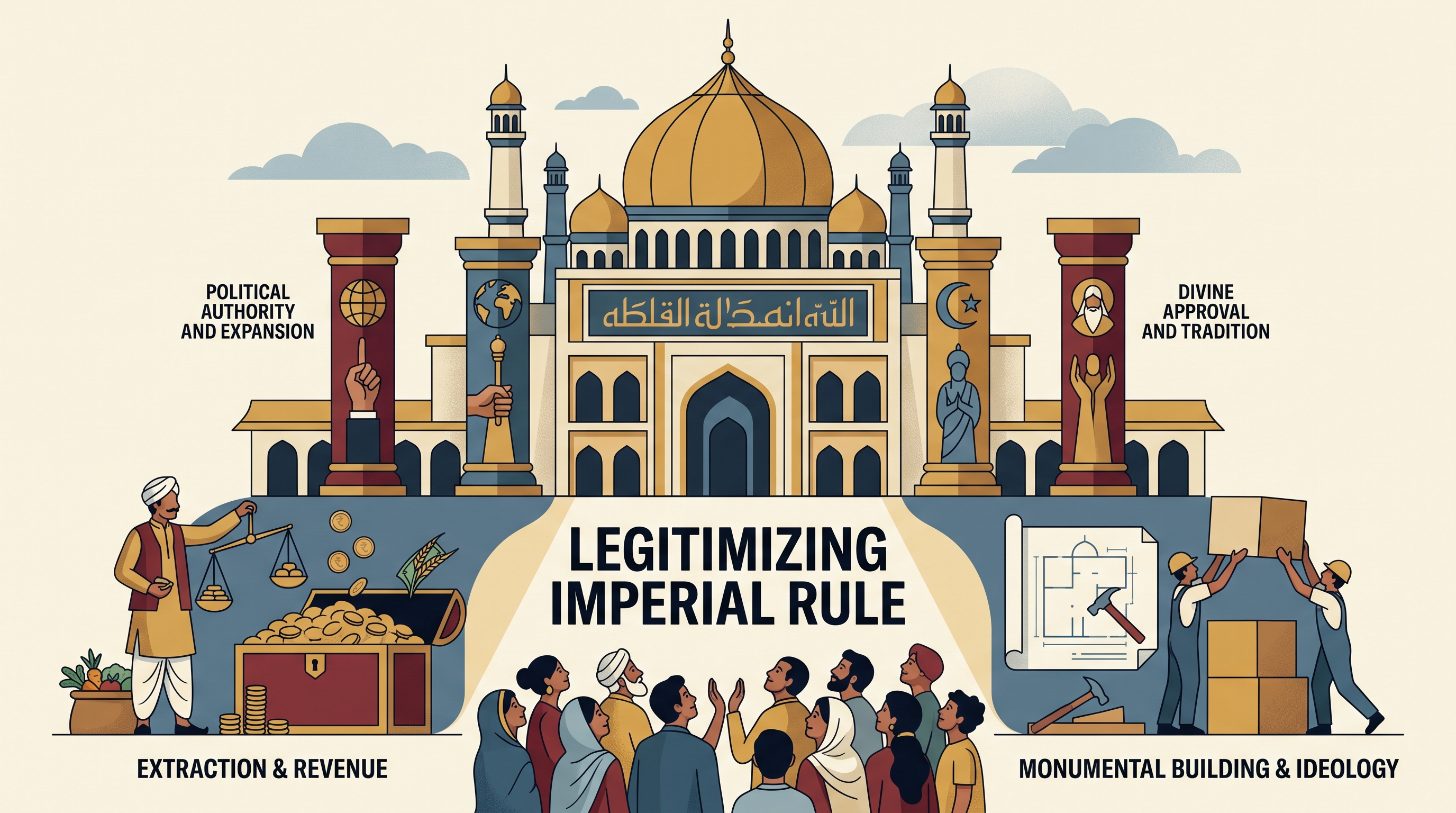
Revenue systems illustrate this process. The Mughal Empire used zamindars, local landholders or intermediaries, in systems of tax collection. The Ottoman Empire used tax farming, in which the state granted individuals the right to collect taxes in return for an agreed payment. These arrangements allowed rulers to draw income across large territories without personally supervising every village or market.
Other governments used different mechanisms. Mexica rulers organized tribute lists, while Ming authorities emphasized collecting taxes in hard currency. The systems varied, but their purpose was comparable: transform political control into predictable revenue that could support armies, officials, and further expansion.
| Administrative mechanism | How it worked | Political purpose |
|---|---|---|
| Mughal zamindars | Local intermediaries helped collect taxes | Connected imperial authority to local society |
| Ottoman tax farming | Tax-collection rights were assigned in exchange for payment | Generated revenue while reducing direct administrative costs |
| Mexica tribute lists | Subject communities were assessed obligations | Recorded and organized imperial extraction |
| Ming hard-currency taxes | Taxes were collected in monetary form | Linked state revenue to wider markets |
Legitimizing political power
Governments also used religion, art, and monumental architecture to make rule appear rightful. Religious legitimation means presenting political authority as supported by sacred tradition, divine approval, or the ruler’s responsibility to defend a religious order. This could strengthen loyalty, distinguish legitimate authority from rebellion, and connect imperial government to familiar beliefs.
Art and monumental architecture performed a similar political function in visible form. Palaces, mosques, tombs, courts, inscriptions, and ceremonial images communicated that the ruler possessed wealth, order, and access to sacred or universal authority. Such projects were not merely decorative: they displayed the state’s capacity to command labor and resources while shaping how subjects understood political power.
Worked example—expansion requires both extraction and legitimacy: imagine a ruler extending authority over a region with established local elites. First, the government incorporates intermediaries—such as Mughal zamindars—to collect taxes. The resulting revenue funds officials and military power. Next, the ruler uses religious language and monumental building to portray the expanded empire as ordered and legitimate. Administration supplies the resources of rule; ideology and spectacle help justify it.
Applying historical reasoning
The most directly assessed skill here is Skill 4: Contextualization, especially the prompt language “Explain how a specific historical development or process is situated within a broader historical context.” A strong response places imperialism within nineteenth-century state rivalry and ideological change rather than treating a colony as an isolated event.
Also use Skill 1: Developments and Processes to explain how expansion unfolded through institutions, Skill 5: Making Connections to connect ideology with governance and revenue, and Skill 6: Argumentation to defend a claim about relative importance. For example, a defensible argument might state that ideology was especially important because it converted conquest and extraction into publicly acceptable claims of racial, national, or religious entitlement.
A brief reminder of limits belongs here: expansion was never frictionless. In the Ashanti region near Kumasi, resistance disrupted imperial communications when forces severed telegraph lines, attacked a telegraph clerk, and blockaded the main road, prompting troops from Lagos in Nigeria to move toward Kumasi. The example shows that administrative networks and military occupation depended on practical control of territory—but the larger analysis of Indigenous responses belongs with Topic 6.3.
Misconception check: “Imperialism was purely economic.”
Correction: Economic interests mattered, but political rivalry, nationalism, Social Darwinism, racial theories, religious claims, and administrative capacity all shaped imperial expansion and its justification.
Retrieval check
Explain, in two sentences, why tax collection and monumental architecture belonged to the same imperial project. A strong answer should connect revenue to the practical exercise of power and connect religion, art, or architecture to the legitimacy of that power.
Source Materials
- AP World History: Modern Course and Exam Description
- AP World History: Modern Course and Exam Description Clarifications and Corrections
- AP World History: Modern Course Overview
- AP World History: Modern Course at a Glance
- AP World History: Modern Course at a Glance Poster
- AP World History: Modern
- AP World History: Modern
- AP World History: Modern Sample Syllabus 1
- Private Collection Stefano Bianchetti / Bridgeman Images
- AP World History Past Exam Questions — AP Central
- Khan Academy — AP World History: Modern
- Freeman-pedia — AP World History: Modern