From the free course AP World History: Modern on Lykke
1.3 Developments in South and Southeast Asia · 1.4 State Building in the Americas
Key concepts: State building · Governance · Continuity and change · Causation · South and Southeast Asian states · Song Dynasty of China · Confucianism · Imperial bureaucracy · State systems in the Americas · State systems in Africa
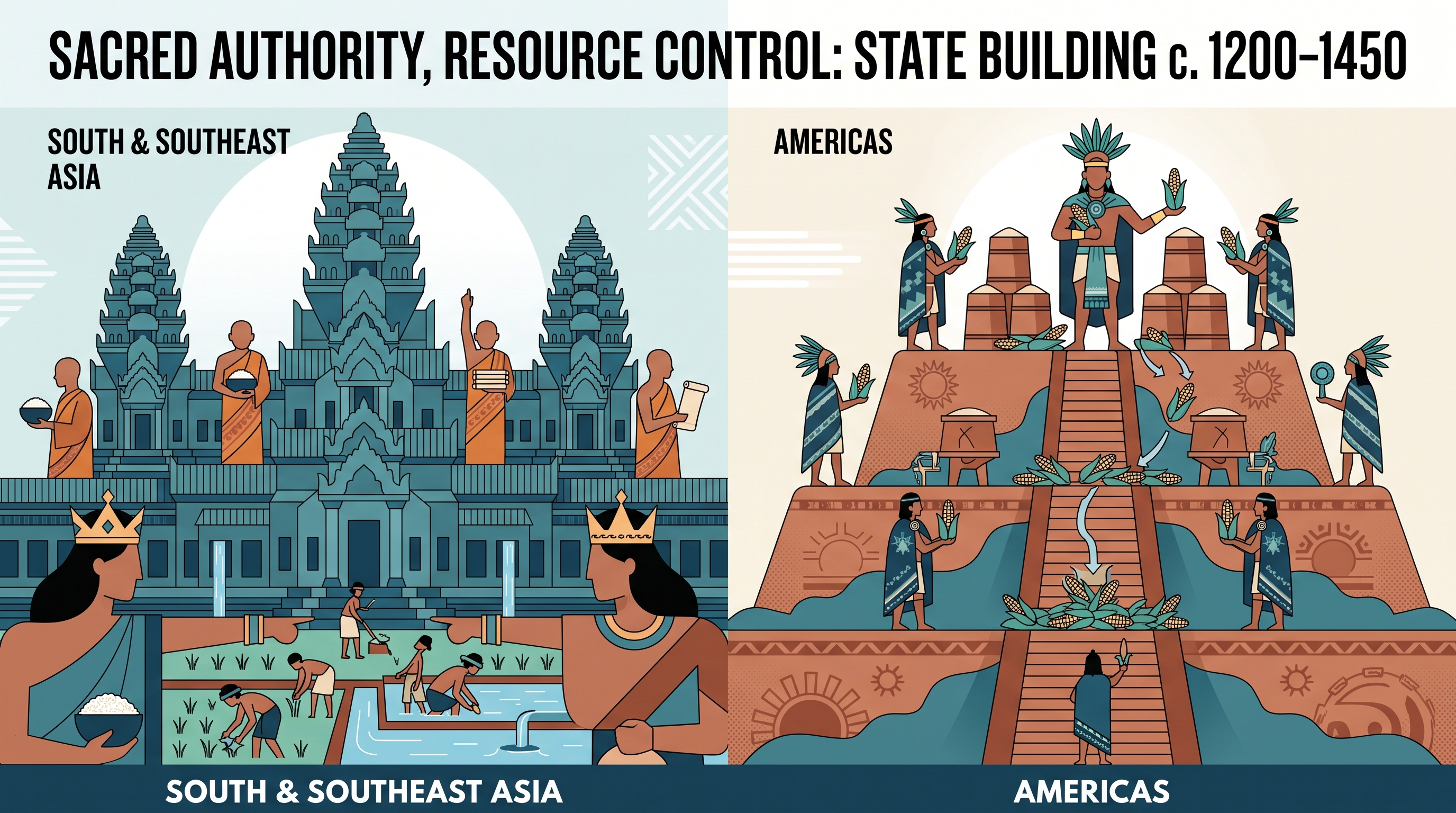
Between c. 1200 and c. 1450, states in South and Southeast Asia built power by adapting older religious traditions to new political circumstances, while American societies created powerful urban and regional systems without reproducing Eurasian models.
1.3 Developments in South and Southeast Asia · 1.4 State Building in the Americas
Between c. 1200 and c. 1450, states in South and Southeast Asia built power by adapting older religious traditions to new political circumstances, while American societies created powerful urban and regional systems without reproducing Eurasian models. The key question is not whether one region was “more advanced,” but how different societies obtained, retained, and exercised authority.
State building is the process by which a political community creates institutions, organizes people and resources, and establishes authority over territory.
Hindu and Buddhist states: adaptation rather than simple replacement
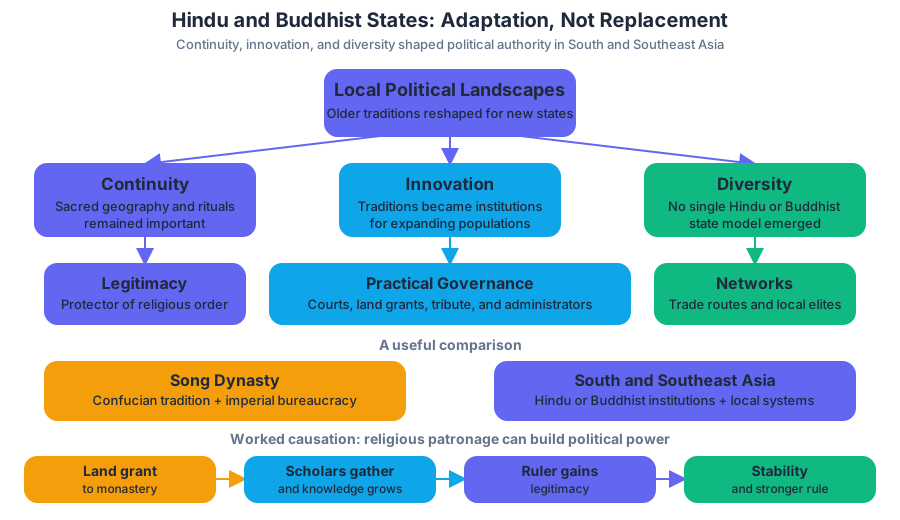
New Hindu and Buddhist states emerged in South and Southeast Asia, demonstrating the CED theme of continuity, innovation, and diversity (KC-3.2.I.B.i). Continuity appeared when rulers drew on established religious ideas, rituals, sacred geography, and social practices. Innovation appeared when leaders reshaped those traditions into institutions that could govern expanding populations. Diversity appeared because Hindu and Buddhist political systems did not produce one uniform state model.
Rulers used religion as one source of political legitimacy—the perceived right to rule—but legitimacy depended on more than belief alone. Temples, monasteries, courts, land grants, tribute, military power, and control of trade routes connected spiritual authority to practical governance. A ruler could present himself as a protector of religious order while also using administrators and local elites to collect revenue and maintain stability.
A useful comparison is with the Song Dynasty: the Song maintained authority by combining inherited Confucian traditions with an imperial bureaucracy, whereas South and Southeast Asian rulers adapted Hindu or Buddhist institutions to local political landscapes. The comparison shows continuity in the use of older traditions, but also innovation in the institutions built around them.
Worked example — explaining causation: Suppose a ruler patronizes a major Buddhist monastery and grants it land. The immediate action is religious patronage, but its political effects may include attracting scholars, legitimizing the ruler, organizing agricultural production, and linking the state to regional networks. A strong historical explanation therefore connects belief system → institution → political result, rather than merely stating that the ruler was Buddhist.
State systems in the Americas
American societies also demonstrated continuity, innovation, and diversity in state formation (KC-3.2.I.B.ii). Their political systems developed through local environmental conditions, agricultural production, warfare, trade, religious authority, and relationships among cities and surrounding communities. They should not be treated as isolated “exceptions” to world history: like states elsewhere, they created mechanisms for organizing labor, distributing resources, and exercising power.
Cahokia illustrates this process. Located near present-day St. Louis, Cahokia was a large Mississippian urban center whose monumental earthen mounds, population concentration, agricultural base, and regional influence reveal organized authority. Its power did not depend on copying a Chinese-style bureaucracy or a European monarchy; it rested on institutions and cultural practices suited to its own environment and society.
This example clarifies the difference between a state system and a familiar state form. A state system may govern through cities, tribute, religious centers, kinship networks, military alliances, or administrative officials. The important historical evidence is what the system could do: mobilize labor, support food production, construct monumental works, regulate exchange, and maintain hierarchy.
Governance across regions: the analytical pattern
States obtained, retained, and exercised power for different purposes. Some rulers emphasized religious legitimacy; others prioritized taxation, military expansion, commercial control, or social order. Imperial expansion required more than conquest: rulers had to incorporate diverse populations through institutions and policies such as tribute systems, local administration, religious patronage, law, and cultural accommodation.
African state systems, like those in Eurasia and the Americas, likewise demonstrated continuity, innovation, and diversity. This comparison prevents a common error: treating “state building” as a single path that all societies supposedly followed. The broader pattern is variation in methods, not absence of political organization.
Change across the period
The arrival of European domesticated animals—including horses, pigs, and cattle—in the Americas, and the movement of foods by African enslaved persons, belong primarily to the later era of transoceanic interconnection. They are important because they show how state systems and societies could be transformed by external biological and economic exchanges: animals altered transportation, warfare, agriculture, and labor, while food transfers reshaped diets and environments.
Misconception check — “religion alone explains political power.” Religious traditions could strengthen legitimacy, but states also required resources, institutions, labor, and enforcement. A better claim explains how a belief system interacted with governance—for example, how religious centers could support authority by organizing land, knowledge, or loyalty.
Skill application: 4.A Contextualization places Hindu, Buddhist, and American state formation within the wider period of intensified state development from c. 1200 to c. 1450. 5.A Identify patterns of continuity and change distinguishes the continued use of older religious traditions from new political institutions. 5.B Explain patterns of continuity and change shows why those traditions remained useful while states adapted them. 5.C Explain how historical developments relate to one another connects religious legitimacy, administration, economic resources, and imperial expansion. For an argument, 6.A Develop a thesis and 6.B Support an argument require a defensible comparison supported by specific evidence such as Cahokia, Hindu and Buddhist states, and Song governance.
Retrieval check: Which claim is more historically defensible, and why?
A. “Hindu and Buddhist states were religious states, while Cahokia was not.”
B. “South and Southeast Asian states and Cahokia used different institutions, but both connected cultural legitimacy and resource organization to political authority.”
Choose one, then support it with two specific pieces of evidence and explain the causal link between each piece of evidence and the state’s ability to retain power.
Source Materials
- AP World History: Modern Course and Exam Description
- AP World History: Modern Course and Exam Description Clarifications and Corrections
- AP World History: Modern Course Overview
- AP World History: Modern Course at a Glance
- AP World History: Modern Course at a Glance Poster
- AP World History: Modern
- AP World History: Modern
- AP World History: Modern Sample Syllabus 1
- A Identify one claim that the author makes in the first paragraph about the effect of the discovery of the Americas on Africa.
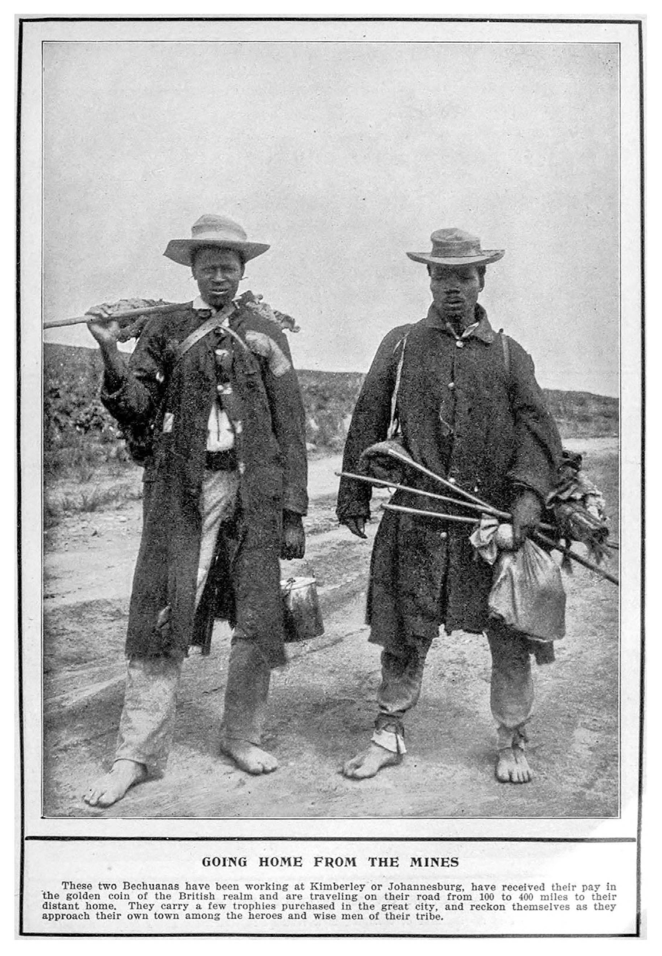
- The photograph shows two African employees of the Kimberley Diamond mines in South Africa. The caption reads: “GOING HOME FROM THE MINES. These two Bechuanas [members of the Tswana people of southern
- A Identify one claim that the author makes in the first paragraph about the effect of the discovery of the Americas on Africa.