From the free course AP World History: Modern on Lykke
AP Practice 2
Key concepts: Historical argumentation · Sourcing and analysis of historical evidence · Complexity in historical reasoning · Effects of migration · African colonial soldiers in World War I · Imperialism and colonial rule · Nationalism and patriotism · Anti-colonial resistance and independence movements · Cultural diffusion and technology · Coerced labor systems and agricultural change
An African soldier who fought for France during World War I could return to his village with new dignity, courage, and respect—yet also with a sharper understanding of the violence and inequality built into colonial rule.
AP Practice 2
An African soldier who fought for France during World War I could return to his village with new dignity, courage, and respect—yet also with a sharper understanding of the violence and inequality built into colonial rule. That tension is the historical problem at the center of this original, unofficial Document-Based Question (DBQ) practice.
The task
Topic connection: AP World History Topic 6.7, “Effects of Migration.” African colonial soldiers were mobile migrants within imperial systems: they crossed regions, encountered European institutions, and returned with experiences that could strengthen both cooperation with and resistance to colonial governments.
Prompt: Evaluate the extent to which World War I changed the relationship between European imperial powers and colonized peoples in Africa from approximately 1914 to 1930.
Your response should make a historically defensible claim, establish broader context, use the documents as evidence, add relevant evidence beyond the documents, analyze sourcing, and demonstrate complexity where possible.
Document set
| Document | Source description | Historical use |
|---|---|---|
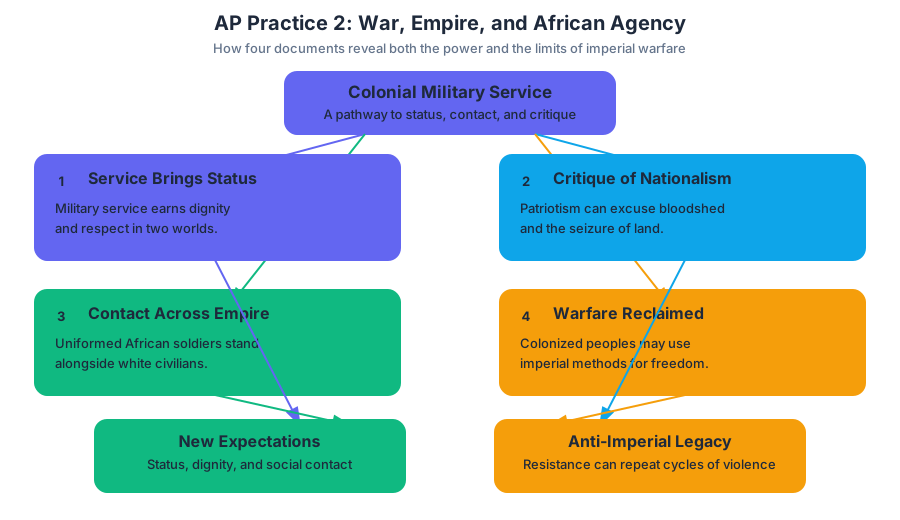
| 1 | A West African veteran of a French regiment recalled that military service gave him dignity, courage, and respect from both his village and the French colonial government. | Shows how wartime service could increase African status and create new expectations. |
| 2 | The same veteran criticized patriotism and nationalism as ideas that encouraged bloodshed and allowed one country to justify taking another country’s land. | Reveals an anti-imperial interpretation of European warfare. |
| 3 | A photograph shows African soldiers in French military uniforms standing alongside white civilians. | Suggests contact, cooperation, and limited social interaction within the French imperial system. |
| 4 | The passage warns that colonized peoples could adopt imperial warfare as a model for independence struggles, producing cycles of violence. | Shows that colonial subjects could appropriate European methods while rejecting European domination. |
Worked argument: from evidence to thesis
A weak thesis merely repeats one side: “World War I changed colonial relationships because Africans served in European armies.” This identifies a development but does not explain its significance.
A stronger thesis establishes a line of reasoning—a connected explanation of how and why change occurred:
World War I changed imperial relationships to a significant but limited extent: African military service challenged European claims of racial superiority and encouraged veterans and colonial leaders to demand greater respect or autonomy, but European governments generally preserved colonial rule, causing some anticolonial activists to turn toward nationalism and armed resistance.
This claim earns the Row A Thesis/Claim point because it answers the prompt, identifies a relevant development, and qualifies the argument. The words “significant but limited” create an analytical structure: wartime service produced change in ideas and expectations, while political power remained largely imperial.
Sourcing: do more than identify the author
For Skill 2: Sourcing and Situation and Skill 3: Claims and Evidence in Sources, explain why a source’s position, purpose, audience, or historical situation matters.
Worked sourcing analysis for Document 1: Because the speaker was an African veteran describing his own experience, he had reason to emphasize the dignity and courage gained through service. His perspective is valuable because it shows that military migration could alter status within an African community; however, it may not represent civilians who experienced recruitment, taxation, or wartime disruption negatively.
Worked sourcing analysis for Document 2: The veteran’s criticism of patriotism and nationalism reflects the historical situation of a colonized person who had witnessed Europeans use those ideals to justify territorial conquest. His purpose appears critical rather than celebratory, making the document useful for showing how imperial war could produce anticolonial ideas.
Contextualization and evidence beyond the documents
For Skill 4: Contextualization, place the argument inside a larger development. Before World War I, European imperialism had expanded through military conquest, economic extraction, and racial ideologies that portrayed Europeans as entitled to rule others. Colonial governments also relied on coerced labor. For example, the mit’a system required male household labor in the Andes for state agricultural and mining projects; although earlier and geographically distinct, it illustrates a wider historical pattern in which states organized production through forced labor.
A relevant piece of evidence beyond the documents is the growth of African and Asian nationalism after World War I. Some colonial leaders hoped that wartime contributions would persuade imperial governments to grant autonomy. When those hopes were disappointed, anticolonial movements increasingly used nationalism to demand self-rule. This evidence supports the argument that wartime participation changed political expectations even when it did not immediately dismantle empire.
Do not confuse this context with the Agricultural Revolution, which involved improved fertilizer use, crop rotation, and increased cultivation of crops such as the potato. Those developments help explain broader changes in production and society, but they are not direct evidence for the effects of African military migration unless explicitly connected to the argument.
Complexity: the point many responses leave unused
The Row D Analysis and Reasoning: Complex Understanding point requires more than adding extra facts. It rewards an argument that qualifies, corroborates, or modifies its central claim through sophisticated reasoning.
A complex paragraph might argue that wartime experience worked in opposite directions:
Military service sometimes challenged European assumptions of cultural superiority because African soldiers demonstrated discipline, courage, and military competence, as the veteran’s account suggests. Yet the same war reinforced imperial control by allowing European governments to mobilize colonial manpower without granting equal political rights. The photograph’s apparent camaraderie therefore should not be mistaken for racial equality; cooperation within the army could coexist with colonial hierarchy.
This earns complexity because it analyzes multiple variables rather than treating the photograph as proof that imperialism became humane. It also connects military service to later nationalism: veterans and colonial leaders could use wartime sacrifice as evidence that imperial subjects deserved autonomy, while the violence of imperial warfare supplied a model for future independence struggles.
Timing and error review
Use the current DBQ pacing guidance: approximately 15 minutes for reading and planning and 45 minutes for writing. Spend the planning period grouping documents, identifying a defensible qualification, and choosing at least one source for purposeful sourcing analysis.
After writing, run this error check:
- Did the thesis answer how much change occurred?
- Did the context precede or surround World War I rather than merely repeat the prompt?
- Did each document support an argument instead of appearing as a summary?
- Did at least one sourcing explanation connect author, purpose, audience, or situation to meaning?
- Did outside evidence directly support the claim?
- Did the conclusion or body qualify the argument through tension, contradiction, or change over time?

Source Materials
- AP World History: Modern Course and Exam Description
- AP World History: Modern Course and Exam Description Clarifications and Corrections
- AP World History: Modern Course Overview
- AP World History: Modern Course at a Glance
- AP World History: Modern Course at a Glance Poster
- AP World History: Modern
- AP World History: Modern
- AP World History: Modern Sample Syllabus 1
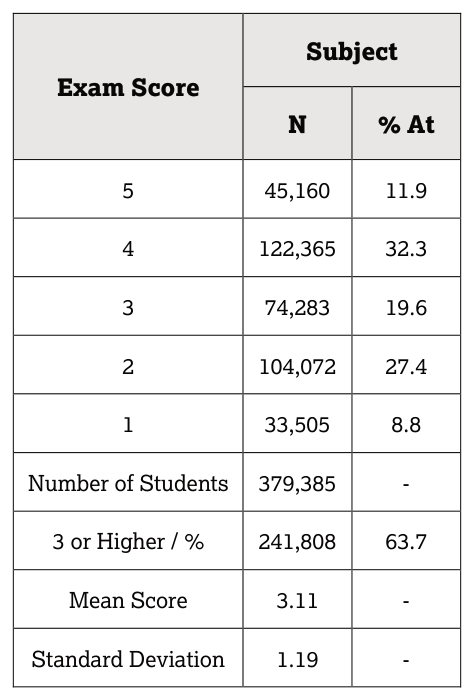
- Figure — Score Distributions (p. 1)
- AP World History Past Exam Questions — AP Central
- Khan Academy — AP World History: Modern
- Freeman-pedia — AP World History: Modern