From the free course AP World History: Modern on Lykke
4.3 Columbian Exchange · 4.4 Maritime Empires Established
Key concepts: Columbian Exchange · Maritime empires · European maritime expansion · Navigation and maritime technology · Christopher Columbus and Spanish voyages · Atlantic demographic, cultural, and social change · Exchange of pathogens, people, and plants · Mercantilism · Colonial raw-material extraction and manufacturing · Plantation economies and the development of a global economy
A voyage intended to reach India instead connected two previously separated biological worlds. When Spain sent Christopher Columbus westward in 1492, the expedition reached the Americas rather than Asia; the resulting movement of plants, animals, people, diseases, and cultural practices became known as the…
4.3 Columbian Exchange · 4.4 Maritime Empires Established
A voyage intended to reach India instead connected two previously separated biological worlds. When Spain sent Christopher Columbus westward in 1492, the expedition reached the Americas rather than Asia; the resulting movement of plants, animals, people, diseases, and cultural practices became known as the Columbian Exchange. It transformed the Atlantic region and helped create the first truly global economy.
Columbian Exchange: the transfer of plants, animals, people, pathogens, and cultural practices between the Americas and Afro-Eurasia after sustained European contact.
From ocean voyages to maritime empires
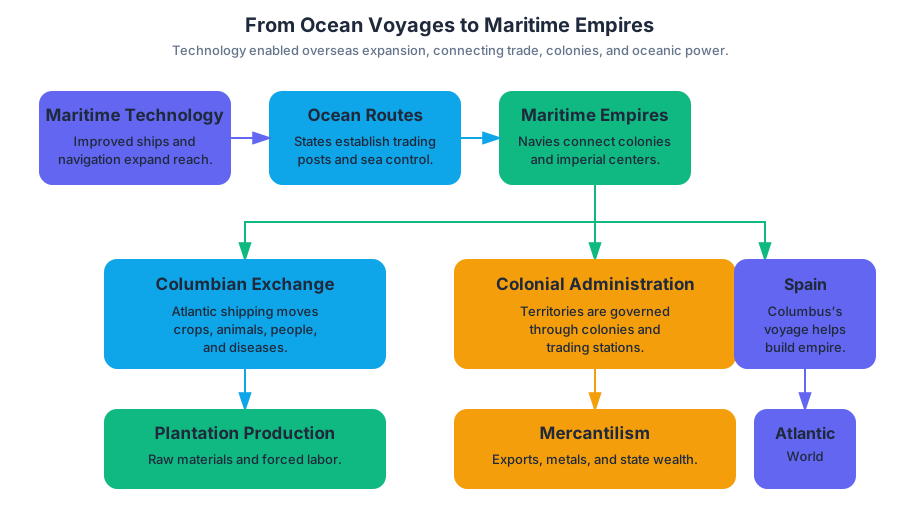
European maritime technological advancements made overseas expansion practical. Improved ships and navigation enabled European states to establish trading posts, control sea routes, and claim overseas territories. A maritime empire is an empire whose power depends heavily on naval strength, oceanic commerce, and colonies or trading stations separated from the imperial center by sea.
Spain became a major maritime empire after Columbus’s voyage. Other European states also pursued overseas trade and conquest, seeking territory, commercial goods, and access to precious metals. These empires connected Europe, Africa, and the Americas through Atlantic shipping, colonial administration, plantation production, and forced labor.
The economic system associated with many maritime empires was mercantilism—the belief that a state should increase its wealth by exporting more than it imported and by accumulating precious metals. Colonies supplied raw materials to imperial states, which used those materials in manufacturing, while colonial markets purchased European goods.
The exchange of biology—and the unequal consequences
The Columbian Exchange moved biological materials in both directions, but its effects were highly uneven.
| Direction | Major transfers | Important consequences |
|---|---|---|
| Americas to Afro-Eurasia | Maize, potatoes, and other plants | Improved diets and supported population growth in parts of Afro-Eurasia |
| Afro-Eurasia to the Americas | European diseases and pathogens | Catastrophic mortality among Indigenous peoples |
| Africa and Europe to the Americas | Enslaved Africans, crops, animals, and cultural practices | Plantation labor systems and new African cultural communities |
| Across the Atlantic world | People, commodities, technologies, and beliefs | Expansion of colonial societies and a global economy |
European pathogens—including smallpox, measles, and malaria—had especially devastating effects in the Americas. Afro-Eurasian societies had experienced repeated exposure to many diseases through long-standing interregional connections, while many Indigenous American communities had been separated from those disease environments. As a result, epidemics killed millions, weakened political structures, reduced labor forces, and made European conquest and colonization easier.
Key asymmetry: the exchange was transatlantic, but it was not equal. American populations suffered enormous demographic losses from disease, while some Afro-Eurasian populations benefited from American food crops.
American crops improved diets in Afro-Eurasia and helped some populations live longer or support more people. At the same time, European colonization brought forced labor, land seizure, Christianization, and new racial and social hierarchies to the Americas.
Plantations, slavery, and Atlantic society
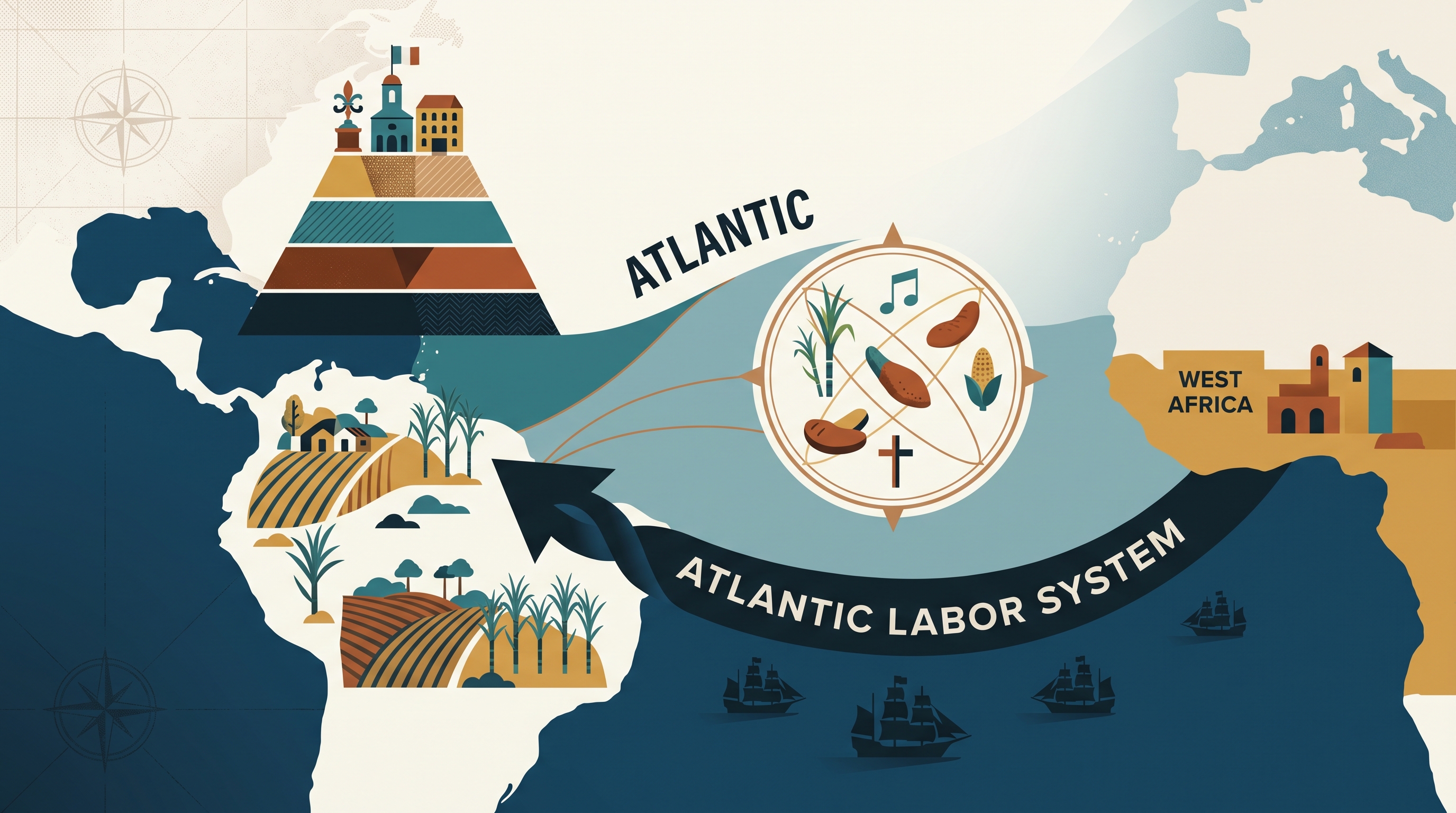
The growth of plantations intensified the Atlantic labor system. Plantations in the Americas and Africa produced valuable commodities for overseas markets, while European colonizers increasingly relied on the forced transportation of enslaved Africans to provide labor. African languages, foods, religious practices, and music diffused into American societies, even under conditions of coercion.
This process produced cultural change alongside exploitation. Colonial societies developed hierarchies shaped by European ancestry, Indigenous identity, and African descent; the exchange therefore changed not only population numbers but also social organization, labor systems, and cultural life.
Worked historical example: tracing one global chain
Consider a potato grown in the Andes:
- Indigenous American farmers cultivated and improved the crop.
- European voyagers transported it across the Atlantic.
- Farmers in Afro-Eurasia adopted it in suitable regions.
- A calorie-rich crop supported larger populations.
- Population growth increased labor availability, consumption, and state resources.
- At the same time, European colonization of the Americas intensified disease transmission, land seizure, and plantation labor.
The same exchange could therefore produce population growth in one region and demographic collapse in another. Treating the Columbian Exchange as simply “beneficial” or simply “harmful” misses its central historical feature: unequal effects across regions and social groups.
CED traceability and historical reasoning
4.3 Learning Objective: Explain the causes of the Columbian Exchange and its effects on the Americas and Europe.
4.3.A: The new global circulation of goods had a variety of effects on the world.
4.3.A.1: European colonization of the Americas led to the exchange of new plants, animals, and diseases between the Eastern and Western Hemispheres.
4.3.A.2: The exchange of plants and animals between the Americas and Europe had a significant impact on both populations.
4.4 Learning Objective: Explain the development of maritime empires from 1450 to 1750.
4.4.A: Europeans established maritime empires in the Americas.
4.4.A.1: Portuguese maritime expansion focused heavily on establishing trading-post empires.
4.4.A.2: Spanish maritime expansion involved conquest and the establishment of colonies in the Americas.
The most useful AP historical thinking skills here are Skill 1: Developments and Processes, especially 1.B Explain a historical concept, development, or process; Skill 4: Contextualization, especially 4.A Identify and explain the historical context of a source or development; Skill 5: Making Connections, especially 5.B Explain the causes and effects of a historical development and 5.C Explain patterns of continuity and change over time; and Skill 6: Argumentation, especially 6.A Develop a thesis or claim that responds to a question. These skills turn a list of exchanges into an explanation of causation, comparison, and consequence.
Misconception check
Misconception: “Columbus discovered an empty New World.”
Correction: The Americas contained numerous Indigenous societies with established populations, political systems, economies, and cultures. Columbus’s voyage initiated sustained contact and colonization by Europeans; it did not create the societies already present.
Retrieval check
Explain, in two linked sentences, why the Columbian Exchange contributed both to population growth in parts of Afro-Eurasia and to demographic catastrophe in the Americas. Then identify one way plantations connected biological exchange to the expansion of Atlantic economic systems.
Source Materials
- AP World History: Modern Course and Exam Description
- AP World History: Modern Course and Exam Description Clarifications and Corrections
- AP World History: Modern Course Overview
- AP World History: Modern Course at a Glance
- AP World History: Modern Course at a Glance Poster
- AP World History: Modern
- AP World History: Modern
- AP World History: Modern Sample Syllabus 1