From the free course AP World History: Modern on Lykke
6.5 Economic Imperialism from 1750 to 1900 · 6.6 Causes of Migration in an Interconnected World
Key concepts: Economic imperialism · Causes of migration in an interconnected world · Consequences of industrialization, c. 1750–1900 · Commodity trade and unequal economic relationships · European economic influence in China · European joint-stock companies and imperial control in Asia · State intervention in economic life · Migration of Europeans to the Americas · Government regulation of immigrants · The relationship between economic pressures and social or gender changes
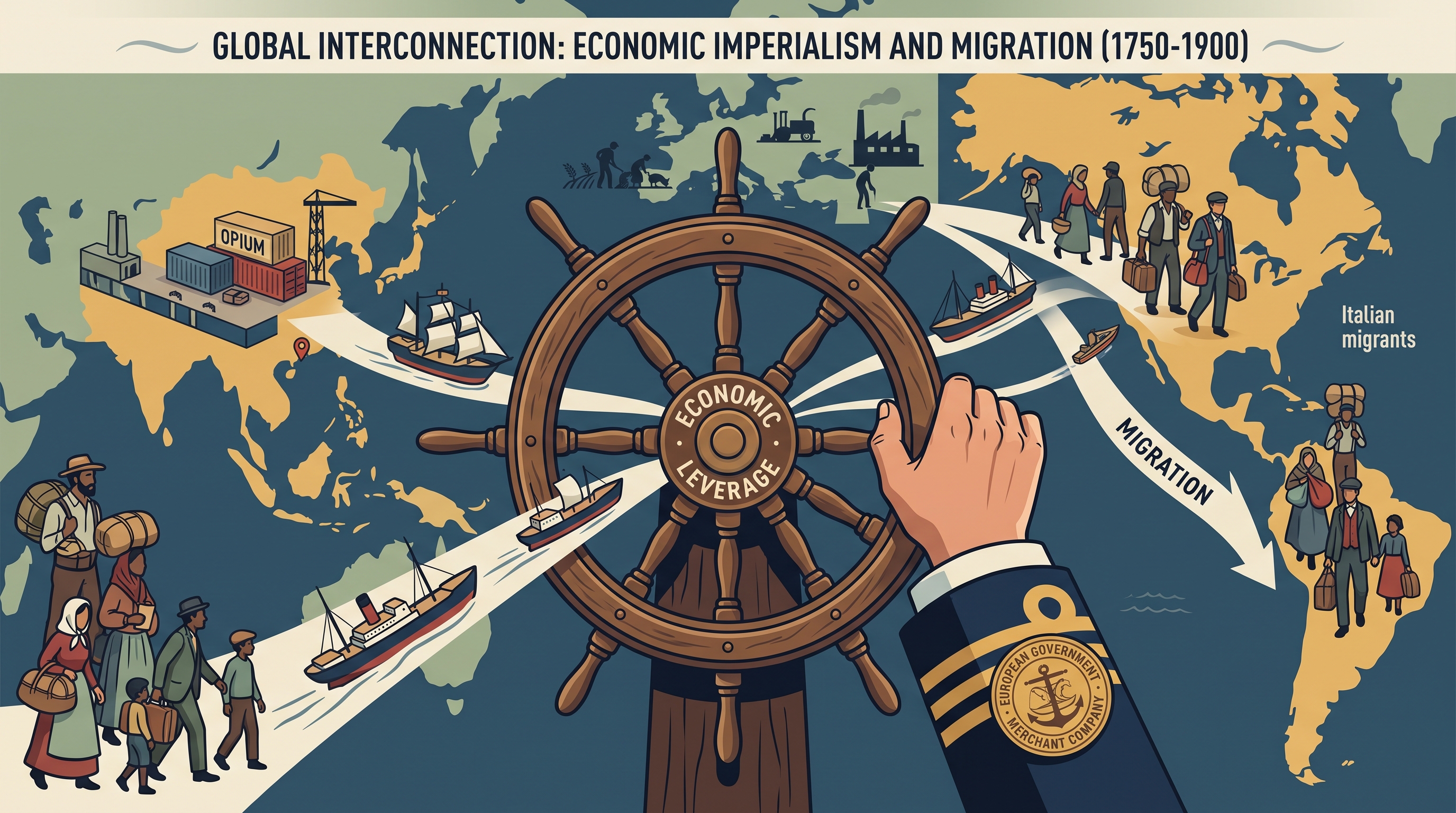
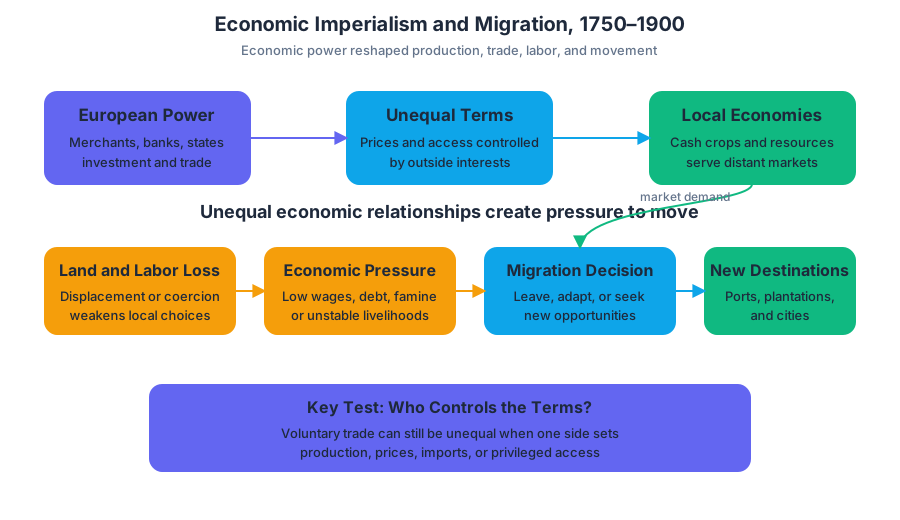
A country could dominate another economy without formally annexing its territory. Between $1750$ and $1900$, European merchants and states used economic imperialism—the extension of economic power over another society’s trade, markets, labor, or resources—to make distant regions serve European commercial interests.
6.5 Economic Imperialism from 1750 to 1900 · 6.6 Causes of Migration in an Interconnected World
A country could dominate another economy without formally annexing its territory. Between $1750$ and $1900$, European merchants and states used economic imperialism—the extension of economic power over another society’s trade, markets, labor, or resources—to make distant regions serve European commercial interests.
Economic imperialism is control or influence gained through trade, investment, finance, or commodity production rather than through direct political conquest alone.
The key distinction is who benefits and who controls the terms. A trade relationship may look voluntary while still being unequal if European merchants determine what a region produces, what it imports, how prices are set, or which companies receive privileged access.
Economic imperialism and commodity trade
Trade in some commodities was organized to give merchants and companies greater control over markets. Instead of simply exchanging whatever local producers chose to sell, European commercial networks increasingly connected particular regions to particular products and markets.
Two examples show how this worked:
| Commodity and region | Economic relationship | Larger imperial pattern |
|---|---|---|
| Diamonds from Africa | Diamonds were exchanged or used to purchase finished goods | African resources entered European-controlled commercial circuits |
| Cotton from South Asia | Cotton grown in South Asia was exported to China | Colonial production was tied to international trade and foreign demand |
In the diamond example, the valuable raw material originated in Africa, while finished goods were produced elsewhere. This arrangement could leave African producers supplying resources but depending on foreign merchants for manufactured products. In the cotton example, South Asian agriculture became connected to a wider commercial system in which European influence shaped the movement and value of the crop.
Misconception check — “Economic imperialism was only private business.” European joint-stock companies mattered, but economic imperialism involved European merchants and states. Governments protected trade routes, granted monopolies, enforced contracts, imposed regulations, and sometimes used military power when commercial interests were threatened.
China: commerce becoming political pressure
European economic influence in China illustrates the blurred boundary between trade and coercion. European immigrants increased their economic influence in China, while European merchants pursued profitable exchanges even when Chinese officials objected to the social and political consequences.
The opium trade is a useful worked example. British merchants used opium grown in India to obtain silver and Chinese goods, especially tea. When Chinese authorities attempted to suppress the trade, British military action produced the Treaty of Nanjing in $1842$, which expanded foreign commercial privileges and transferred Hong Kong to Britain.
Reasoning chain:
$ \text{European commercial demand} \rightarrow \text{opium sales in China} \rightarrow \text{Chinese resistance} \rightarrow \text{military conflict} \rightarrow \text{expanded European economic influence} $
The important point is not merely that Europeans traded in China. It is that commercial disputes could be backed by state power, allowing foreign merchants to gain advantages that Chinese authorities had not freely chosen to provide.
Joint-stock companies and direct imperial control
Earlier European expansion in Asia often relied on joint-stock companies, businesses funded by multiple investors who shared profits and risks. Companies such as the British East India Company could collect taxes, maintain armies, and govern territory. Over time, however, European states assumed more direct imperial control.
This shift did not mean European influence disappeared. It meant that the state, rather than a private company, became the main instrument of imperial rule. The British government’s takeover of India after the 1857 rebellion demonstrates this transition: company authority gave way to direct British imperial administration.
Comparison insight: Company rule and direct state rule differed in administration, but both connected Asian economies to European power.
Why people migrated in an interconnected world
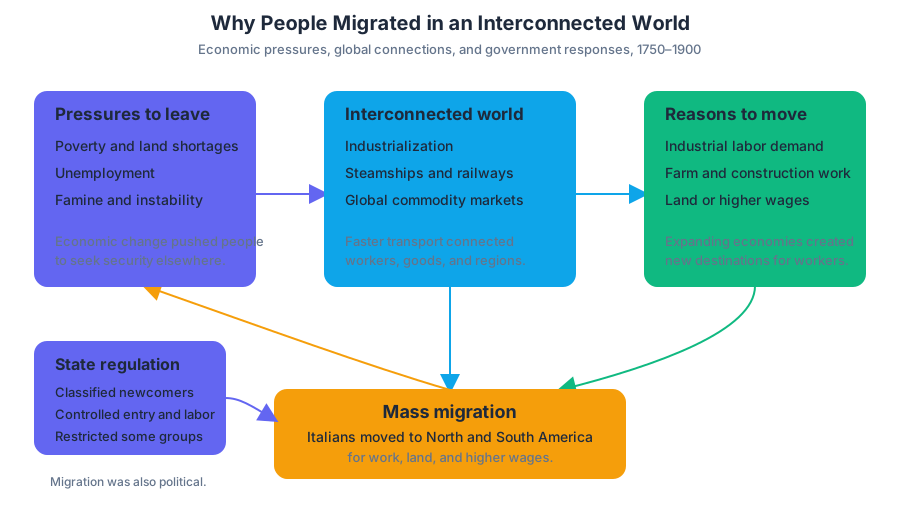
Migration—the movement of people from one place to another—expanded as industrialization, imperialism, transportation, and global commodity markets connected societies more tightly. People moved because economic opportunities and pressures changed, not simply because they wanted to travel.
Economic causes included poverty, land shortages, unemployment, famine, political instability, and the demand for labor in expanding industries and agricultural regions. Italians, for example, migrated in large numbers to both North and South America, where growing economies offered work and the possibility of land or higher wages.
Governments responded by creating regulations governing immigrants. States classified newcomers, controlled entry, monitored labor, or restricted particular groups. These policies reveal that migration was not purely a personal decision: governments viewed mobile workers as sources of labor, possible threats, or competitors for jobs.
Migration and social change
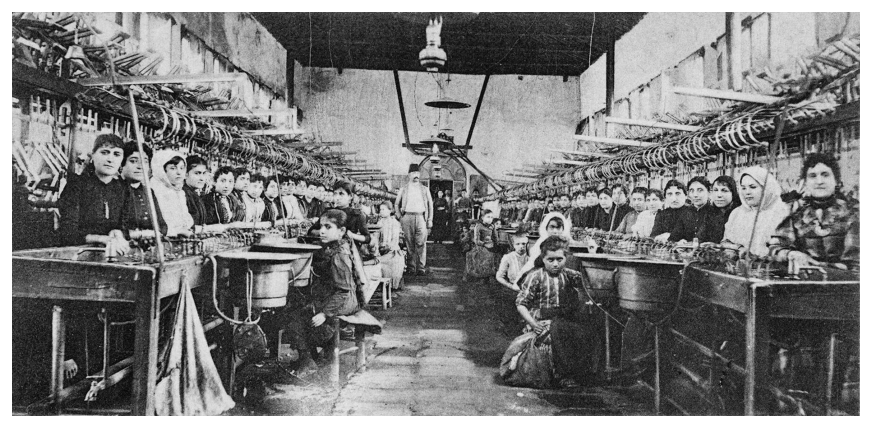
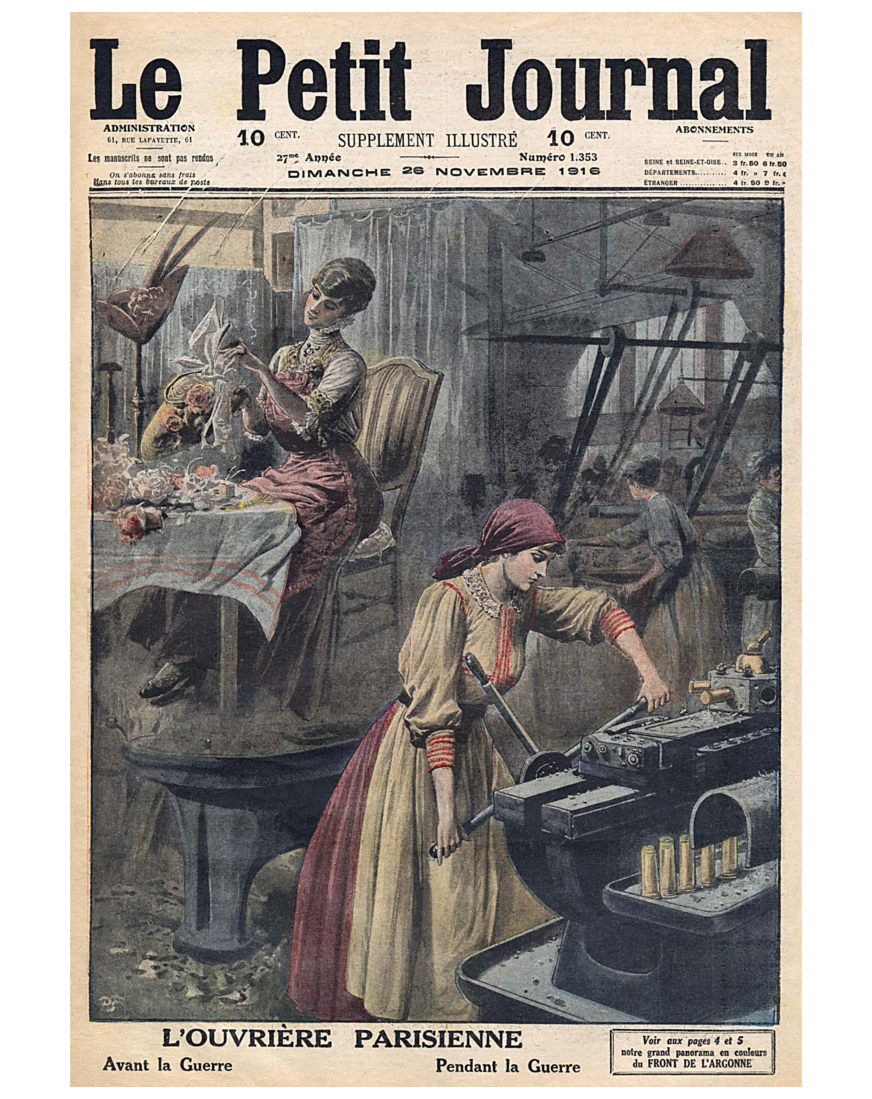
Economic pressures and migration also contributed to changes in social and gender practices. When men migrated for wage work, families could become separated across regions or oceans. Women and other relatives might assume new economic responsibilities, manage households, enter paid labor, or maintain transnational family networks.
These changes did not automatically create equality. Migration could expand choices for some people while increasing exploitation, insecurity, and discrimination for others. That tension is essential to the ECN (Economic Systems) and ENV (Humans and the Environment) themes in 6.6.
AP reasoning focus
Topic 6.5 Economic Imperialism from 1750 to 1900 is tied to ECN (Economic Systems) and Skill 4: Contextualization in the provided topic map; its comparison emphasis also requires the course’s Skill 5: Making Connections. Topic 6.6 Causes of Migration in an Interconnected World is tied to ENV (Humans and the Environment) and ECN (Economic Systems) and emphasizes Skill 5: Making Connections.
A strong comparison identifies a meaningful similarity or difference and explains why it matters. For instance, diamonds from Africa and cotton from South Asia both entered European-centered trade networks, but their specific markets and consequences differed. A strong causal explanation then connects economic restructuring to migration: industrial demand and unequal markets created pressures that encouraged Italians and others to move.
Retrieval check
- Why is economic imperialism broader than direct colonial conquest?
- How did the opium trade demonstrate the connection between private commerce and state power?
- What economic pressures encouraged Italian migration to the Americas?
- Why did European joint-stock companies lose political power in parts of Asia?
Interpretation: If a prompt describes foreign merchants controlling a commodity market while a European government protects their privileges, the best explanation is not “private trade alone.” It is economic imperialism by European merchants and states.
Source Materials
- AP World History: Modern Course and Exam Description
- AP World History: Modern Course and Exam Description Clarifications and Corrections
- AP World History: Modern Course Overview
- AP World History: Modern Course at a Glance
- AP World History: Modern Course at a Glance Poster
- AP World History: Modern
- AP World History: Modern
- AP World History: Modern Sample Syllabus 1
- Album/ Alamy Stock Photo
- Chronicle / Alamy Stock Photo
- Chronicle / Alamy Stock Photo