From the free course AP World History: Modern on Lykke
8.3 Effects of the Cold War · 8.4 Spread of Communism After 1900
Key concepts: Effects of the Cold War · Spread of communism after 1900 · The ideological struggle between the United States and the Soviet Union · The emergence of the United States and USSR as superpowers after World War II · Military alliances during the Cold War · The nuclear weapons buildup · Proxy wars in the developing world · Cold War effects in the Eastern and Western Hemispheres · Sukarno in Indonesia · Kwame Nkrumah in Ghana
The Cold War transformed an ideological disagreement between the democratic United States and the authoritarian communist Soviet Union into a worldwide struggle over political influence, military security, and the future of postcolonial states.
8.3 Effects of the Cold War · 8.4 Spread of Communism After 1900
The Cold War transformed an ideological disagreement between the democratic United States and the authoritarian communist Soviet Union into a worldwide struggle over political influence, military security, and the future of postcolonial states.
A bipolar world after World War II
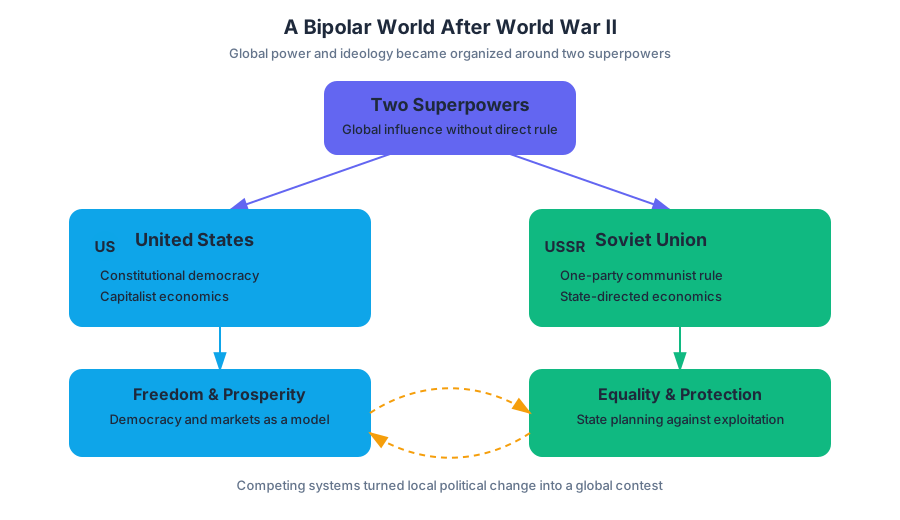
World power shifted sharply during and after World War II. European empires were weakened, while the United States and the USSR possessed the economic, military, and political capacity to shape events far beyond their own borders. A superpower is a state powerful enough to project influence globally, even when it does not directly control every country affected by its policies.
The conflict was ideological as well as geopolitical. The United States generally presented constitutional democracy and capitalist economics as the basis of freedom and prosperity; the Soviet Union promoted one-party communist rule and state-directed economics as the path toward equality and protection from capitalist exploitation. These competing systems encouraged each superpower to treat political developments elsewhere as part of a global contest.
How superpower influence operated
The Cold War’s effects appeared in both the Eastern and Western Hemispheres. The United States and USSR rarely fought one another directly because direct war risked escalation, especially after both acquired nuclear weapons. Instead, they maintained influence through alliances, military aid, economic assistance, political pressure, intelligence operations, and support for friendly governments or revolutionary movements.
| Instrument of influence | Cold War effect | Historical significance |
|---|---|---|
| NATO | United States, Canada, and Western European states formed a collective military alliance in 1949. | An attack on one member could be treated as a threat to the alliance, strengthening the Western bloc. |
| Warsaw Pact | The USSR organized a rival military alliance with Eastern European communist states in 1955. | It formalized Soviet military influence in Eastern Europe. |
| Nuclear weapons buildup | The superpowers accumulated increasingly destructive arsenals. | Nuclear deterrence discouraged direct war but created permanent danger and competition. |
| Proxy wars | Local conflicts received outside weapons, money, training, or diplomatic support. | The Cold War became violent in Latin America, Africa, and Asia even when Washington and Moscow avoided direct combat. |
Nuclear proliferation and proxy conflict
Nuclear proliferation means the spread or expansion of nuclear weapons capabilities. The arms race produced a paradox: nuclear weapons made direct superpower war extraordinarily dangerous, yet the same rivalry encouraged military planning, weapons development, and crises in which a small miscalculation could have global consequences.
The ideological struggle also contributed to proxy wars, conflicts in which outside powers support opposing sides rather than fighting each other openly. In postcolonial states, local political disputes could therefore become connected to the larger contest between communism and anticommunism. A movement seeking social or economic transformation might receive Soviet support, while its opponents received American assistance—or the pattern could be more complicated, since local actors pursued their own goals rather than acting as simple puppets.
Key distinction: A proxy war was not merely a war “caused by” the United States or USSR. Local political, economic, ethnic, and anticolonial conflicts mattered; superpower intervention intensified and internationalized them.
Communism and postcolonial political choices
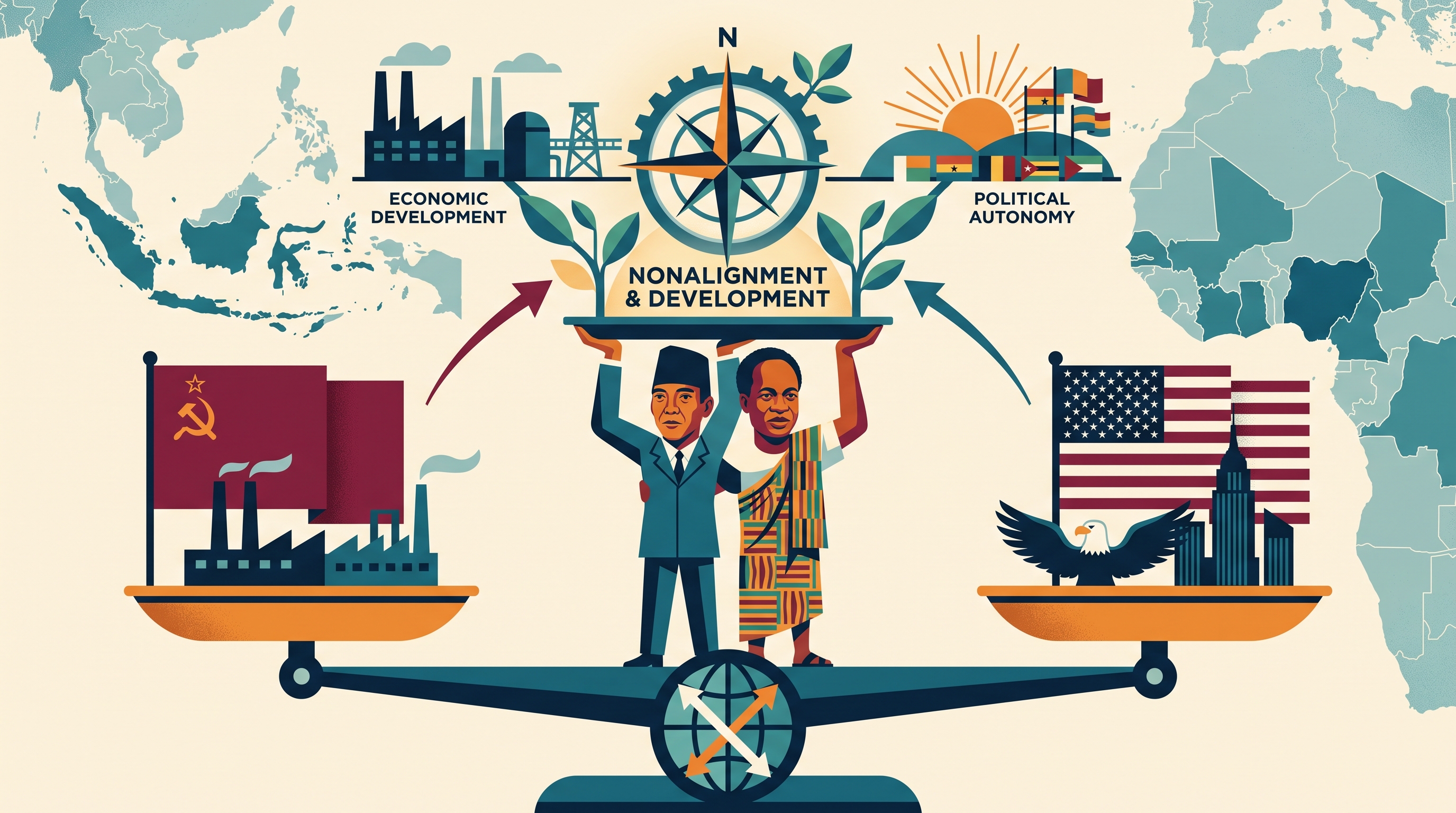
The spread of communism after 1900 was a major historical development, but postcolonial leaders did not always choose a simple American or Soviet identity. Indonesia under Sukarno and Ghana under Kwame Nkrumah illustrate how leaders in newly independent countries confronted Cold War pressure while seeking political autonomy and economic development.
A useful comparison begins with situation and point of view. Sukarno spoke from the position of an Indonesian nationalist leader attempting to protect independence after colonial rule; Nkrumah spoke as Ghana’s leader during African decolonization, seeking to prevent political independence from becoming continued economic dependence. Their perspectives help explain why leaders could criticize Western imperialism, cooperate with communist states, or pursue nonalignment without necessarily adopting Soviet-style communism.
Worked contextual example: interpreting a leader’s position
Prompt: Why might Sukarno or Nkrumah cooperate with communist governments while resisting alignment with either superpower?
Step 1 — Identify the situation. Indonesia and Ghana were postcolonial states operating in a world dominated by the United States and USSR.
Step 2 — Explain the point of view. A nationalist leader would likely view foreign alliances through the experience of colonial domination. Assistance from a superpower could be useful, but dependence on either bloc might threaten sovereignty.
Step 3 — Connect ideology to politics. Cooperation with communist states could provide trade, weapons, diplomatic support, or development aid. It did not automatically mean that the leader accepted every feature of Soviet authoritarian communism.
Step 4 — State the historical consequence. Cold War competition shaped political developments in countries such as Indonesia and Ghana, but local leaders and movements retained agency. This is why “communist versus capitalist” is sometimes too simple to explain postcolonial politics.
Misconception check
Misconception: “The Cold War was cold everywhere.” The United States and USSR avoided a direct full-scale war with one another, but the conflict produced intense military violence through proxy wars and political intervention in Latin America, Africa, and Asia. “Cold” describes the relationship between the superpowers, not the lived experience of every society caught within their rivalry.
Retrieval and interpretation check
Answer in two or three sentences: How did NATO, the Warsaw Pact, nuclear weapons, and proxy wars allow the United States and USSR to maintain influence without fighting one another directly? Then add one sentence explaining why Sukarno’s or Nkrumah’s perspective complicates a purely two-sided interpretation of the Cold War.
Skill focus: Unit 8: Learning Objective B asks students to explain the causes and effects of the ideological struggle of the Cold War, while Unit 8: Learning Objective C asks students to compare how the United States and Soviet Union maintained influence. The relevant evidence is KC-6.2.IV.C.ii and KC-6.2.IV.D. The source-analysis practice is Skill 2.B: Explain the point of view, purpose, or audience of a source, especially when interpreting Sukarno or Nkrumah.
Source Materials
- AP World History: Modern Course and Exam Description
- AP World History: Modern Course and Exam Description Clarifications and Corrections
- AP World History: Modern Course Overview
- AP World History: Modern Course at a Glance
- AP World History: Modern Course at a Glance Poster
- AP World History: Modern
- AP World History: Modern
- AP World History: Modern Sample Syllabus 1