From the free course AP World History: Modern on Lykke
7.1 Shifting Power After 1900 · 7.2 Causes of World War I
Key concepts: The rise of new global powers after 1900 · The decline of established empires, including the Ottoman Empire and Qing China · Imperialist expansion and competition for resources · Nationalism and territorial or regional conflicts · The alliance system and its role in creating global conflict · The relative significance of multiple causes of World War I
By 1900, global power was becoming more competitive: the United States, Russia, and Japan expanded their influence while older empires such as the Ottoman Empire and Qing China struggled to survive.
7.1 Shifting Power After 1900 · 7.2 Causes of World War I
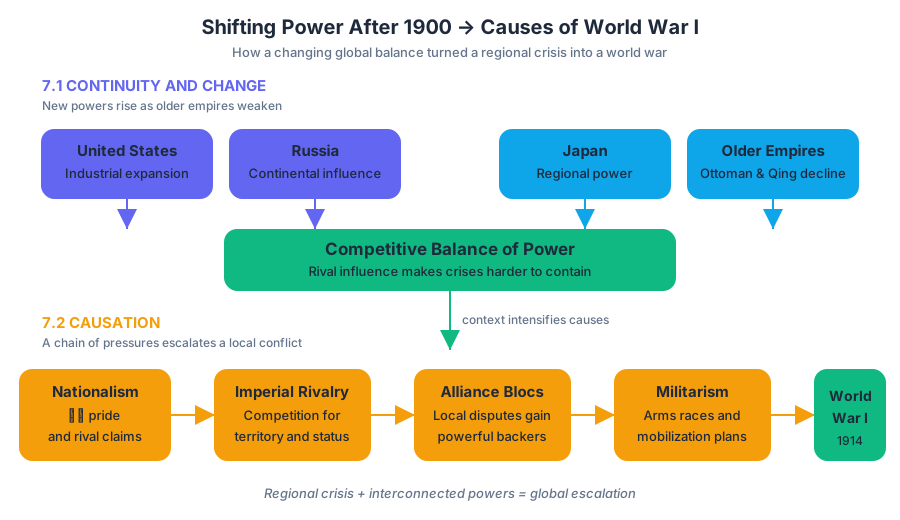
By 1900, global power was becoming more competitive: the United States, Russia, and Japan expanded their influence while older empires such as the Ottoman Empire and Qing China struggled to survive. The sharp historical question is: why did a changing balance of power turn a regional crisis into World War I?
7.1 Shifting Power After 1900 uses the reasoning process Continuity and Change and emphasizes Skill 4.B: Explain how a specific historical development or process is situated within a broader historical context. 7.2 Causes of World War I uses Causation and emphasizes Skill 1.B: Explain a historical concept, development, or process.
A changing global balance of power
The United States, Russia, and Japan emerged as increasingly powerful states after 1900, but they did so through different combinations of industrialization, military expansion, state centralization, and imperial ambition.
- The United States combined industrial production, financial strength, naval expansion, and overseas influence. Its growing power challenged the assumption that Europe alone controlled global affairs.
- Russia possessed enormous territory and population and expanded across Eurasia, but its power was weakened by uneven industrialization, political unrest, and military difficulties.
- Japan rapidly modernized after the Meiji Restoration, built a powerful army and navy, and pursued imperial expansion in East Asia. Its victories over China and Russia demonstrated that a non-European state could compete successfully with major imperial powers.
The important continuity was imperial competition: states still sought territory, resources, and strategic advantage. The important change was the identity of the competitors. Power was no longer concentrated exclusively among western European empires.
Declining empires
The Ottoman Empire faced nationalist movements, European intervention, military pressure, and internal administrative challenges. European powers competed for influence in Ottoman territories, especially in the Balkans, where competing national claims made the region politically unstable.
Qing China likewise confronted internal rebellion, foreign economic pressure, unequal treaties, territorial losses, and challenges to imperial authority. The Qing government’s decline created opportunities for Japan and European powers while encouraging Chinese reformers and revolutionaries to question the existing political order.
Misconception check — “Decline means disappearance.” The Ottoman and Qing states did not simply vanish when their power weakened. They continued governing large populations, but their ability to control territory, resist foreign pressure, and maintain legitimacy was increasingly limited.
Why imperialism increased tension
Imperialist expansion is the extension of a state’s political, military, or economic control over other territories. In the decades before World War I, European powers intensified their competition for colonies, trade routes, strategic ports, and raw materials.
Competition for resources mattered because industrial economies required dependable supplies and markets. Coal, rubber, minerals, agricultural products, and access to transportation routes could strengthen one empire while making another feel threatened. Imperialism therefore operated as both an economic project and a contest for national security.
The competition also carried symbolic meaning. Governments presented overseas expansion as evidence of national greatness, so a diplomatic compromise could be portrayed at home as humiliation. Economic rivalry thus reinforced nationalism, and nationalism made rivalry more dangerous.
From regional disputes to world war
Territorial and regional conflicts supplied the immediate pressure points. In the Balkans, the weakening Ottoman presence, the growth of competing nationalisms, and the ambitions of states such as Serbia, Austria-Hungary, and Russia produced overlapping claims to territory and political influence.
Nationalism is loyalty to, and political identification with, a nation. It could unify populations within states, but it could also encourage national groups to demand independence or persuade governments that compromise betrayed the nation. In a region containing many ethnic and linguistic communities, nationalism transformed local disputes into questions of honor and survival.
The alliance trap
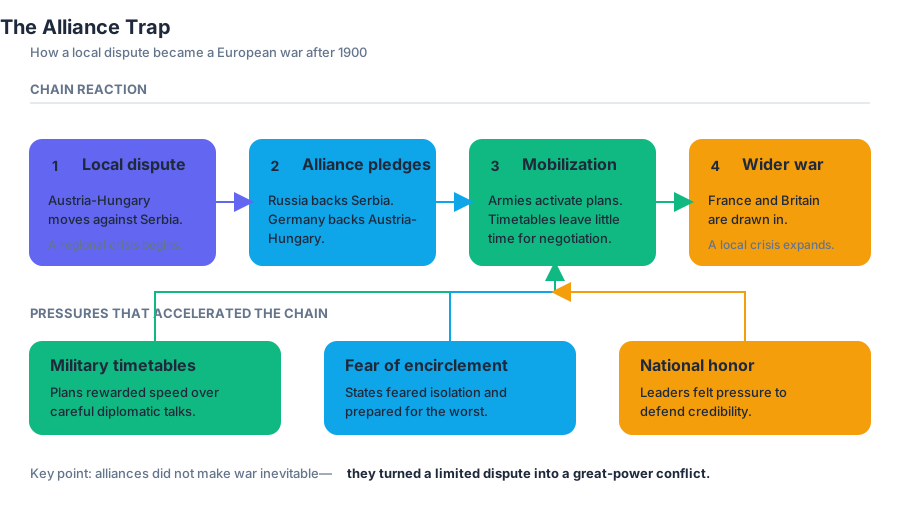
The alliance system was intended to preserve security, but it created a dangerous chain reaction. European powers made agreements promising support to one another; when conflict began between Austria-Hungary and Serbia, those commitments drew in Russia, Germany, France, and Britain.
An alliance did not make war inevitable by itself. Its significance was that it converted a limited dispute into a conflict involving several great powers. Mobilization plans, military timetables, fear of encirclement, and pressure to defend national honor reduced the time available for negotiation.
Weighing the causes
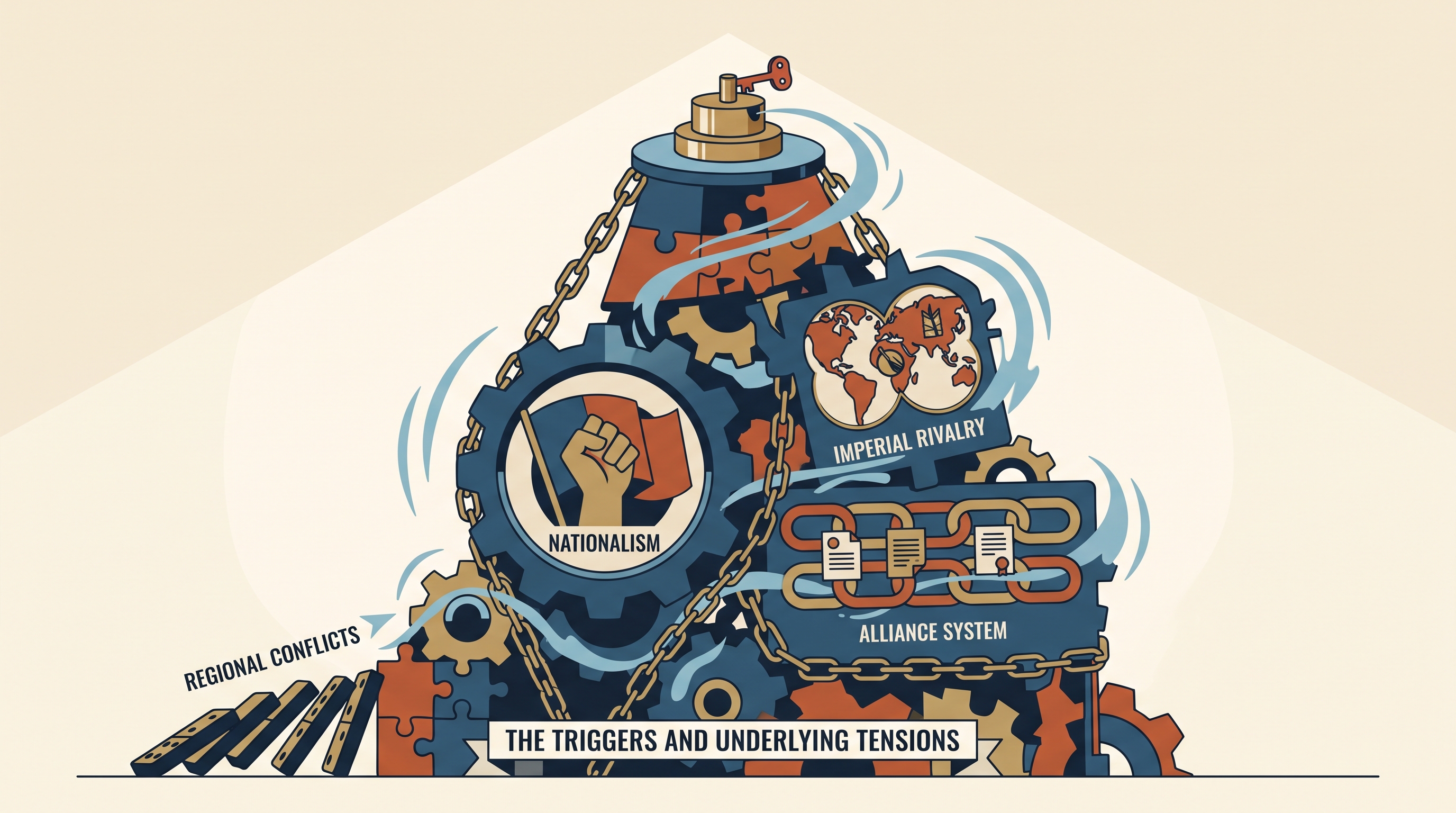
The strongest explanation treats World War I as the result of interacting causes rather than a single event. Imperialist expansion and competition for resources intensified rivalries; nationalism made compromise politically costly; territorial and regional conflicts created flashpoints; and the flawed alliance system expanded a regional war into a global conflict.
| Cause | How it increased the risk of war |
|---|---|
| Imperialist expansion | Made overseas territory and influence objects of great-power rivalry |
| Competition for resources | Encouraged states to seek economic security and strategic advantage |
| Nationalism | Turned political disputes into matters of honor and identity |
| Territorial and regional conflicts | Created immediate crises, especially in the Balkans |
| Alliance system | Spread a local conflict across Europe and beyond |
Worked interpretation: If a historian argues that the assassination of Archduke Franz Ferdinand caused World War I, the claim identifies the trigger but not the full explanation. A stronger argument distinguishes the trigger from the underlying conditions: the assassination activated tensions created by nationalism, imperial rivalry, regional conflict, and alliances.
Retrieval check: Explain one continuity and one change in global power after 1900. Then rank the alliance system, nationalism, imperialism, and regional conflict by significance, explaining why the factor you rank first could not alone explain the war.
Learning Objective — Unit 7: Learning Objective B: Explain the causes and consequences of World War I. Historical Developments — KC-6.2.IV.B.i: The causes of World War I included imperialist expansion and competition for resources. In addition, territorial and regional conflicts combined with a flawed alliance system and intense nationalism to escalate the tensions into global conflict.
Source Materials
- AP World History: Modern Course and Exam Description
- AP World History: Modern Course and Exam Description Clarifications and Corrections
- AP World History: Modern Course Overview
- AP World History: Modern Course at a Glance
- AP World History: Modern Course at a Glance Poster
- AP World History: Modern
- AP World History: Modern
- AP World History: Modern Sample Syllabus 1
- AP World History Past Exam Questions — AP Central
- Khan Academy — AP World History: Modern
- Freeman-pedia — AP World History: Modern
- YouTube — Heimler's History