From the free course AP World History: Modern on Lykke
2.3 Exchange in the Indian Ocean · 2.4 Trans-Saharan Trade Routes
Key concepts: Indian Ocean trade networks · Trans-Saharan trade · Swahili Coast · Gujarat · Sultanate of Malacca · Muslim–European rivalry in the Indian Ocean · Diasporic merchant communities · Interregional trade in luxury goods · Transportation innovations · Chinese textiles, porcelain, iron, and steel production
After $1200$, Indian Ocean and trans-Saharan commerce expanded not because entirely new routes suddenly appeared, but because older routes became more efficient, profitable, and politically important.
2.3 Exchange in the Indian Ocean · 2.4 Trans-Saharan Trade Routes
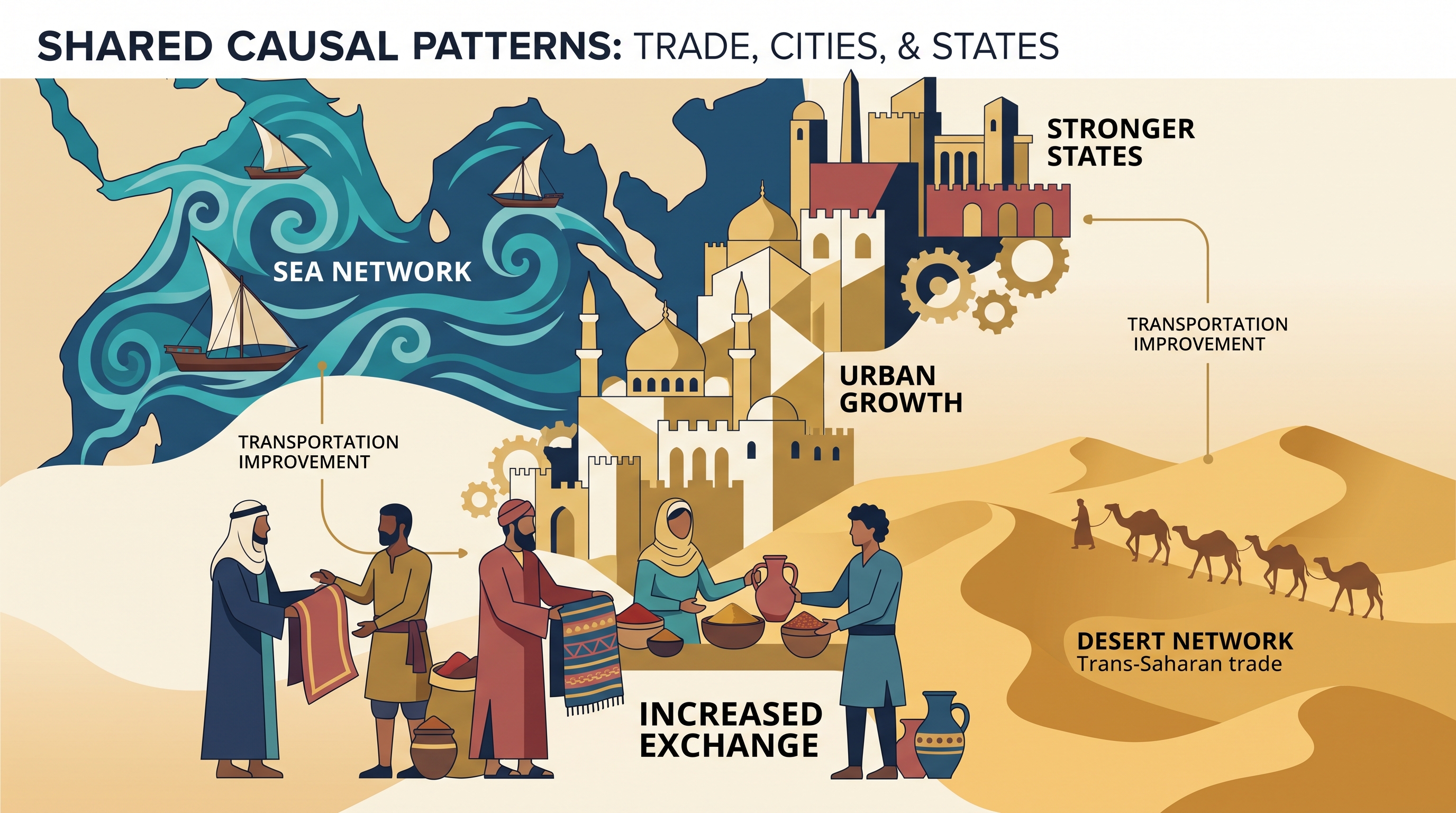
After $1200$, Indian Ocean and trans-Saharan commerce expanded not because entirely new routes suddenly appeared, but because older routes became more efficient, profitable, and politically important. The central question is causal: How did improved transportation and commercial practices transform regional exchange into networks powerful enough to build cities and strengthen states?
Unit 2: Learning Objective E: Explain the causes of the growth of networks of exchange after $1200$.
The governing thematic lens is Economic Systems (ECN): societies shape—and are shaped by—the ways they produce, exchange, and consume goods and services. The same network can therefore be read in two directions: transportation innovations increase trade, while trade enriches merchants, attracts states, and encourages further investment in production and infrastructure.
The Indian Ocean as a connected commercial system
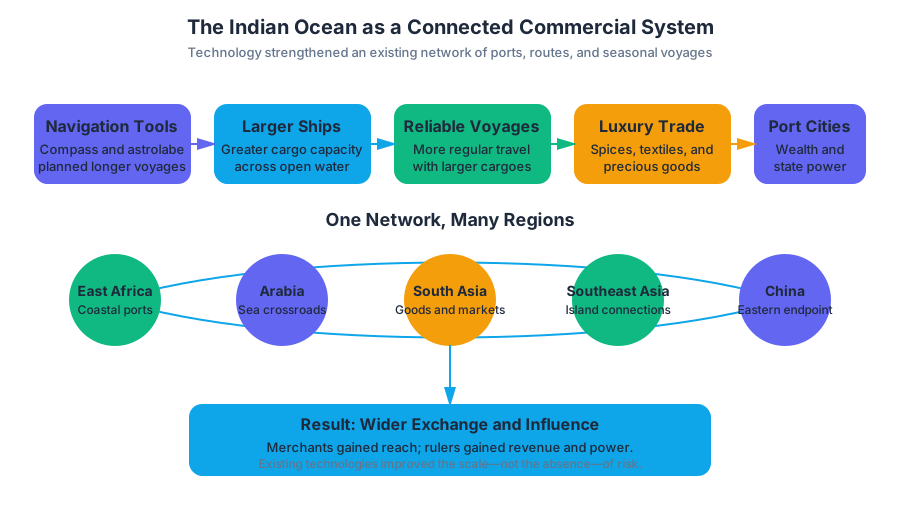
The Indian Ocean network linked the eastern coast of Africa, the Arabian Peninsula, South Asia, Southeast Asia, and China. Its growth depended on improvements to existing technologies and practices, including the compass, astrolabe, and larger ship designs. These tools did not eliminate danger or distance; they made it easier for merchants and sailors to navigate, carry larger cargoes, and plan voyages across a wider geographical range.
A useful causal chain is:
Improved navigation and ship capacity
$\rightarrow$ more reliable, higher-volume voyages
$\rightarrow$ expanded luxury-goods trade
$\rightarrow$ growth of port cities
$\rightarrow$ greater state power and merchant influence
This relationship is preserved in KC-3.1.I.A.ii, which connects improved transportation technologies and commercial practices to increased trade, expanded routes, and powerful new trading cities. KC-3.1.I.C.ii emphasizes that interregional luxury trade was encouraged by innovations in previously existing transportation and commercial technologies. KC-3.1.I.A.iii identifies the Indian Ocean trading network as a force that fostered the growth of states.
Trading cities and merchant communities
Three especially important locations were the Swahili Coast, Gujarat, and the Sultanate of Malacca. Their importance came from position as well as production: ports connected inland producers to overseas buyers and offered merchants places to store, exchange, finance, and redistribute goods.
Merchants also formed diasporic communities—communities living outside their places of origin while maintaining commercial and cultural ties to them. Gujaratis and Javanese were among the groups connected to Indian Ocean exchange. These communities helped make trade more dependable because merchants could draw on familiar languages, customs, credit relationships, and social networks in distant ports.
China illustrates how exchange affected production. Chinese merchants and producers expanded textile and porcelain manufacturing for export, while the manufacture of iron and steel also expanded. Trade was therefore not merely the movement of finished luxuries: foreign demand could reorganize production within major societies.
Worked causal example: why Malacca grew
Suppose a merchant vessel carrying valuable goods must cross the Indian Ocean and enter Southeast Asian waters. Larger ships increase cargo capacity; navigational instruments make long-distance travel more manageable; and a port located near crucial maritime routes can collect taxes, supply ships, and attract foreign merchants. The result is a reinforcing cycle: commerce increases Malacca’s wealth, wealth strengthens its political authority, and political authority makes the port more attractive to additional merchants.
Misconception check — “Technology caused trade by itself.” The compass, astrolabe, and larger ships mattered because merchants, producers, and states used them within commercial systems. Technology lowered some costs and risks, but profitable goods, established practices, strategic ports, and political protection were also necessary.
Muslim–European rivalry
The Indian Ocean was not an isolated Muslim trading lake, but Muslim merchants and states played major roles in its commerce. As European powers entered the ocean, Muslim–European rivalry became a significant development. Competition involved access to ports, routes, commercial profits, and political influence. The rivalry shows that trade networks could generate conflict as well as cooperation.
Trans-Saharan trade and growing influence
The trans-Saharan trade routes connected societies across the Sahara and increased the influence of the societies and merchants involved. Long-distance trade strengthened those able to control routes, organize caravans, protect merchants, or tax commerce. As in the Indian Ocean, exchange could convert geographic position into political and economic power.
The comparison should focus on mechanism rather than simply listing goods: both networks expanded when transportation and commercial practices made long-distance exchange more practical, and both increased the influence of merchants and states. Their environments differed—oceanic navigation versus desert crossings—so the technologies and logistical challenges were not identical.
Skills in action
Skill 5.A — Identify patterns and connections: connect the repeated pattern of transportation improvement, increased trade volume, urban growth, and stronger states across the Indian Ocean and trans-Saharan networks. A strong explanation does more than say both had trade; it identifies the shared causal structure and then notes the environmental difference between sea and desert routes.
Retrieval check: Name two technologies that encouraged Indian Ocean trade, one Indian Ocean trading center, one merchant group, and one political consequence of expanded exchange. Then explain why a port city could become powerful rather than remaining merely a stopping point.
Source Materials
- AP World History: Modern Course and Exam Description
- AP World History: Modern Course and Exam Description Clarifications and Corrections
- AP World History: Modern Course Overview
- AP World History: Modern Course at a Glance
- AP World History: Modern Course at a Glance Poster
- AP World History: Modern
- AP World History: Modern
- AP World History: Modern Sample Syllabus 1
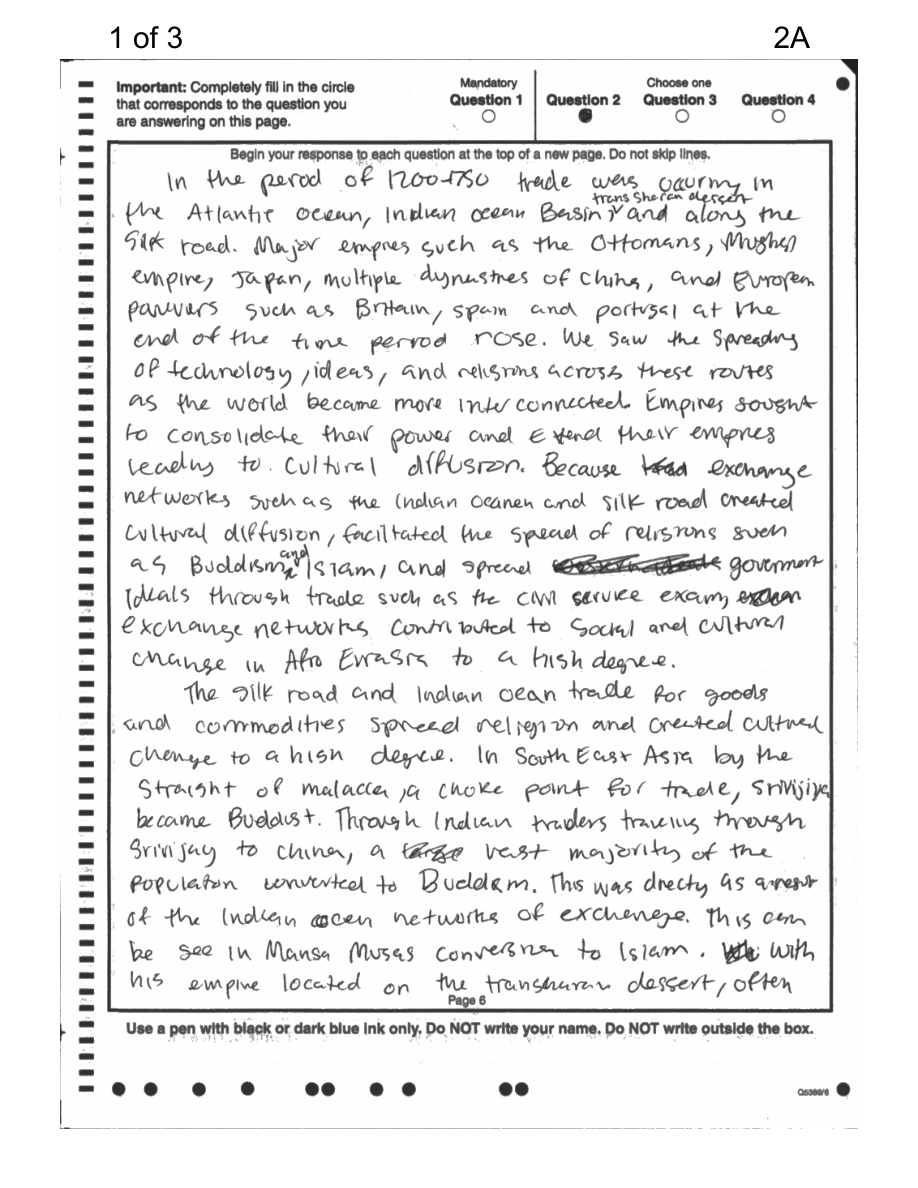
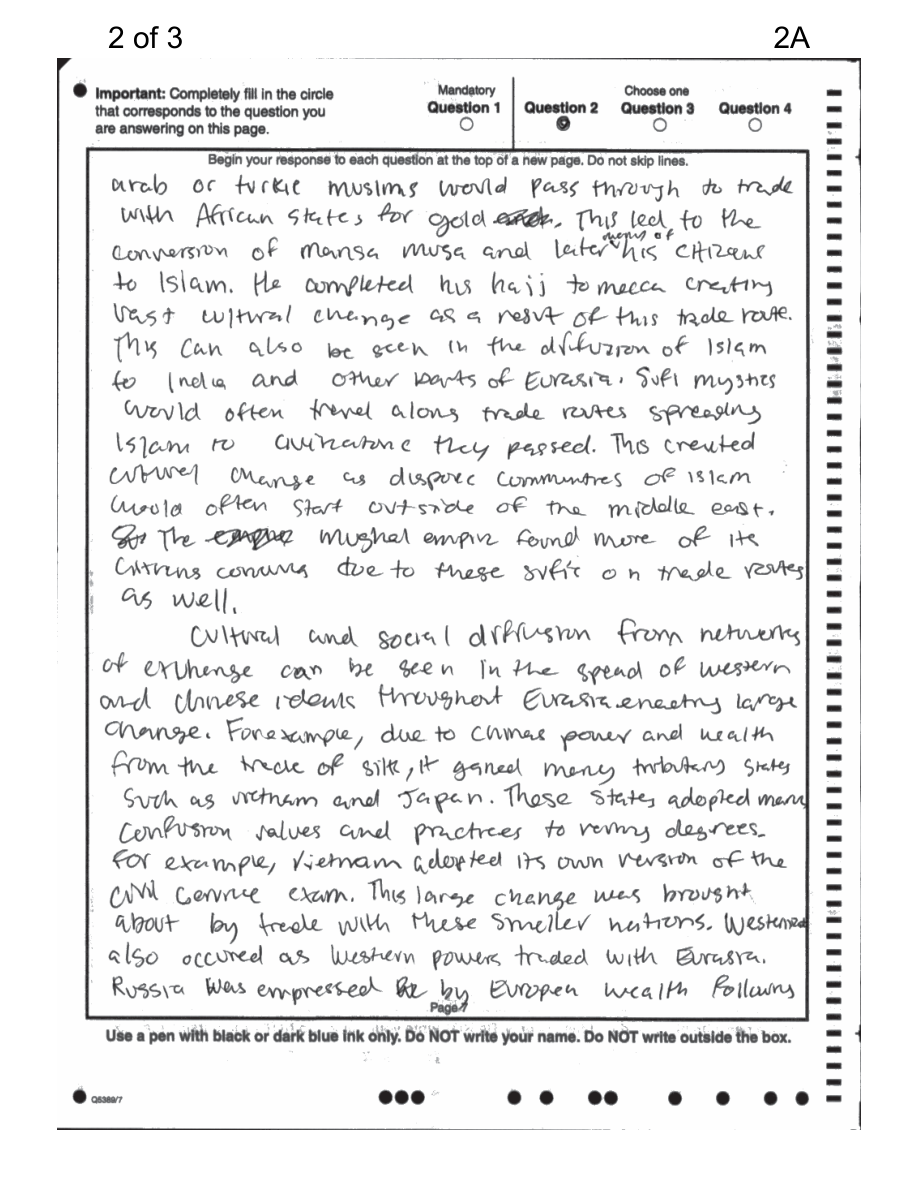
- Figure — Sample Responses - LEQ 2 - Set 1 (p. 4)
- Figure — Sample Responses - LEQ 2 - Set 1 (p. 6)
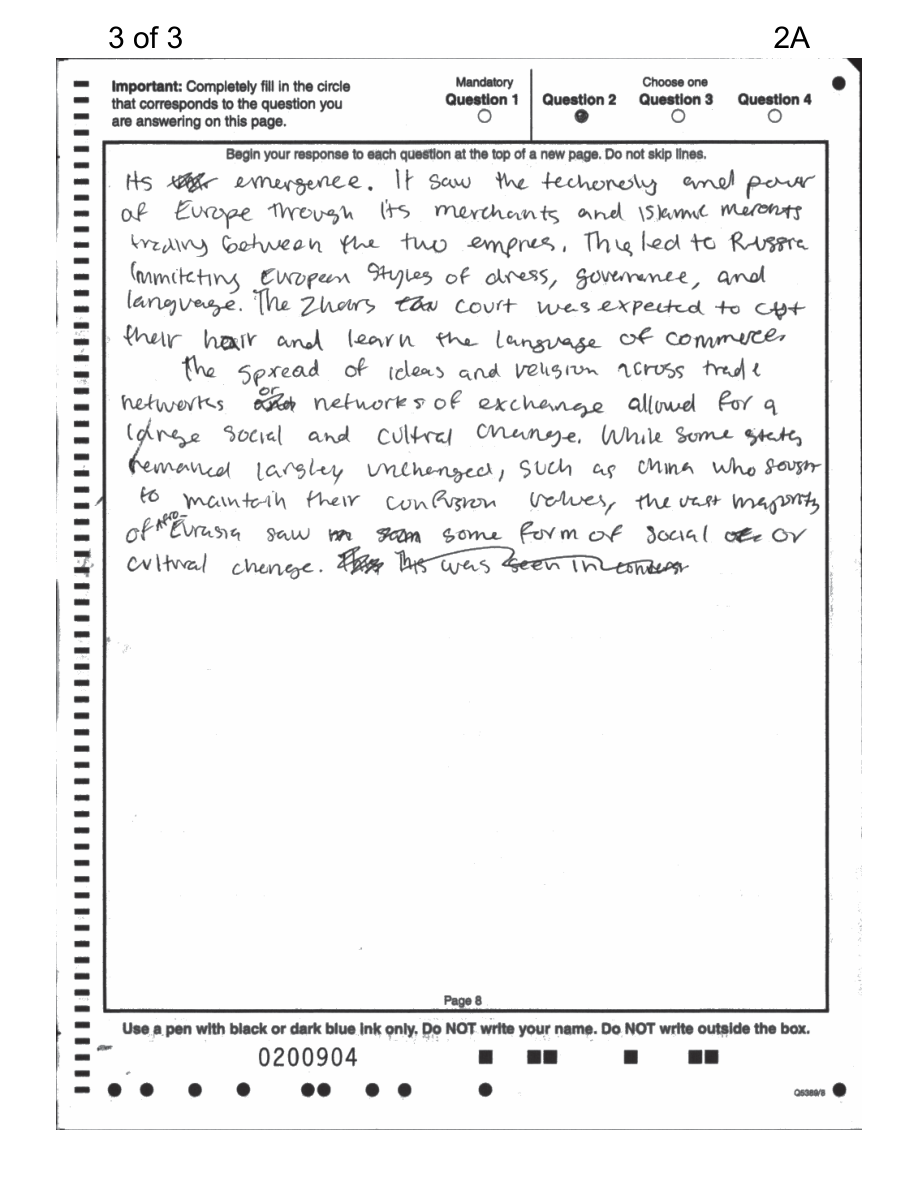
- Figure — Sample Responses - LEQ 2 - Set 1 (p. 8)
- Figure — Sample Responses - LEQ 2 - Set 1 (p. 9)