From the free course AP World History: Modern on Lykke
3.3 Empires: Belief Systems · 3.4 Comparison in Land-Based Empires
Key concepts: Land-Based Empires · Empires: Belief Systems · Comparison in Land-Based Empires · Empires: Administration · Empires Expand · Governance (GOV) · Causation · Continuity and Change · Devshirme system in the Ottoman Empire · Religious ideas, art, and monumental architecture as tools of political legitimacy
Between c. 1450 and c. 1750, rulers did not rely on force alone to govern enormous territories.
3.3 Empires: Belief Systems · 3.4 Comparison in Land-Based Empires
Between c. 1450 and c. 1750, rulers did not rely on force alone to govern enormous territories. They also built a story of rightful rule: emperors presented themselves as chosen by God, favored by sacred traditions, or connected to the cosmic order. Legitimacy means the belief that a ruler’s authority is rightful, not merely powerful.
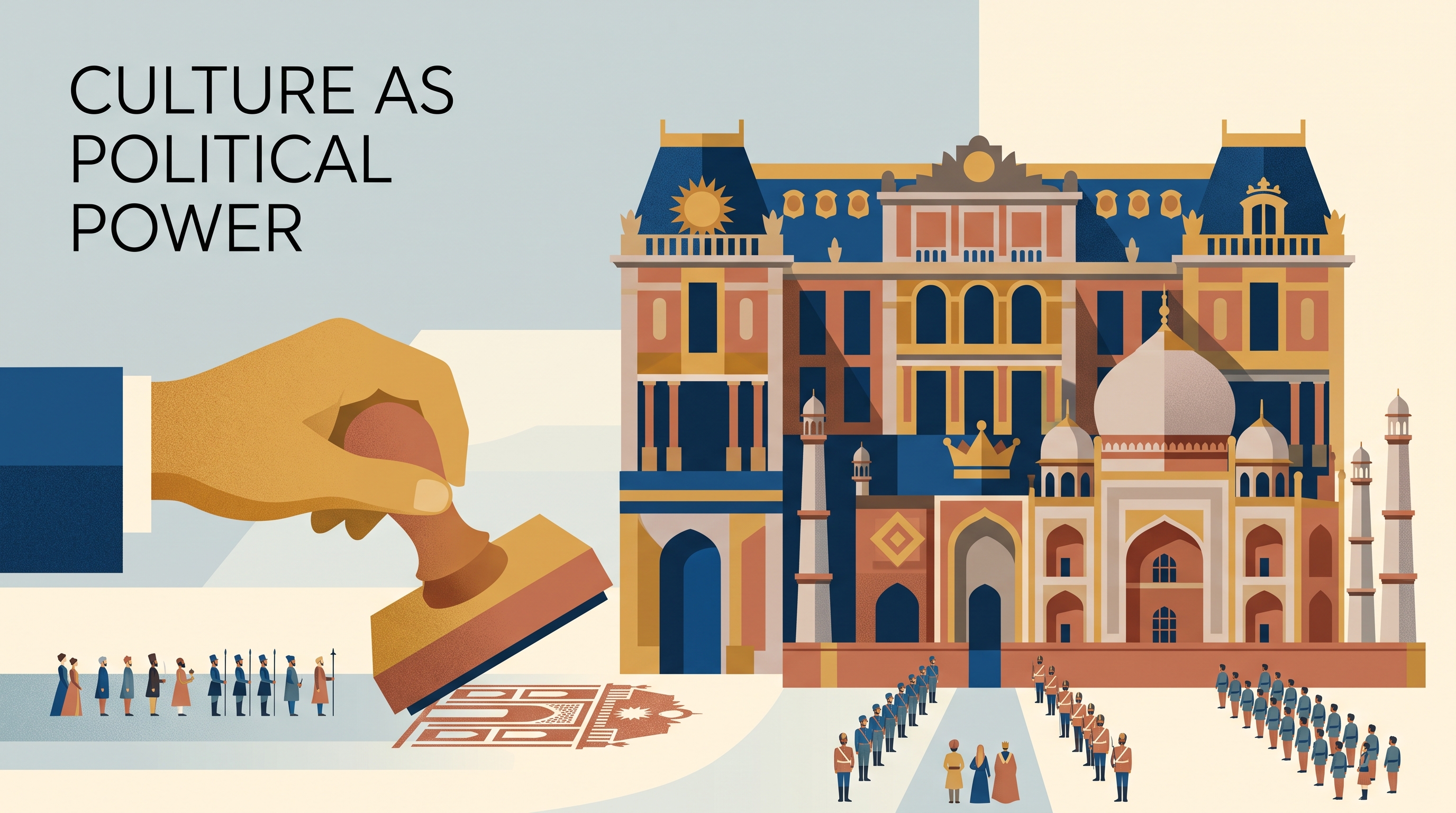
Core idea — 3.3 Empires: Belief Systems: Rulers used religious ideas, art, and monumental architecture to legitimize their rule.
Belief became visible power
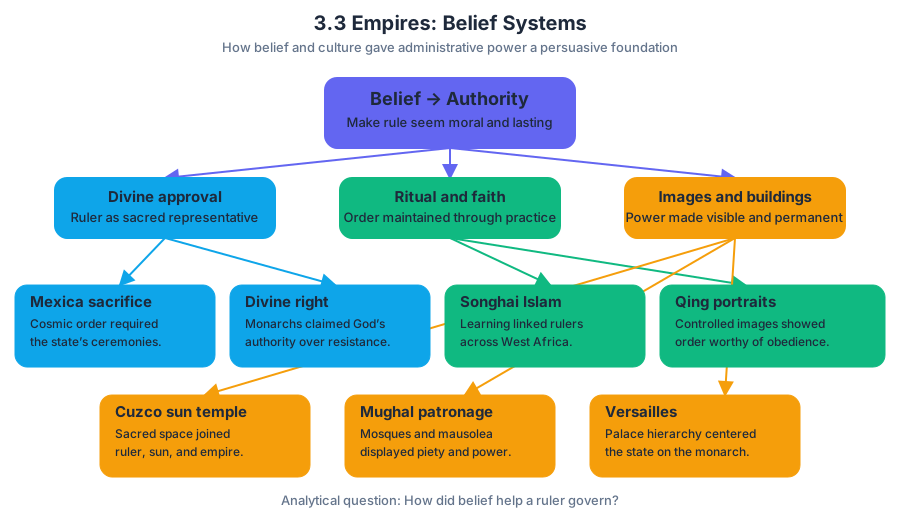
Religious legitimacy worked through several channels. A ruler could claim divine approval, sponsor a dominant faith, perform rituals, or commission buildings and images that made imperial authority seem permanent. These methods did not replace administration; they gave administrative systems a persuasive moral and cultural foundation.
| Imperial example | Belief or cultural practice | Political message |
|---|---|---|
| Mexica practice of human sacrifice | Ritual maintenance of cosmic order | The state’s ceremonies were necessary for the survival of society |
| European notions of divine right | Monarchs claimed authority from God | Resistance to the monarch could appear both political and religiously wrong |
| Songhai promotion of Islam | Rulers associated the state with Islamic learning and authority | Imperial rule gained cultural connections across West Africa |
| Qing imperial portraits | Carefully controlled images of the emperor | The ruler appeared stable, elevated, and worthy of obedience |
| Incan sun temple of Cuzco | Monumental connection between the ruler, the sun, and the empire | Political authority was embedded in sacred space |
| Mughal mausolea and mosques | Islamic architectural patronage | The dynasty displayed piety, wealth, and lasting power |
| Versailles | European palace architecture | Royal magnificence centered the state around the monarch |
The key analytical question is not simply, “Was religion important?” It is: How did a belief system help a ruler govern? For example, the Qing use of imperial portraits transformed a political leader into a carefully represented symbol of order. Versailles similarly made hierarchy physical: courtiers had to approach power through the monarch’s court, while the palace’s scale advertised the resources of the state.
Continuity and change, c. 1450–c. 1750
Continuity and Change asks what persisted and what shifted across time. A major continuity was that land-based empires continued to combine coercion with legitimacy. Mexica rulers used ritual, European monarchs invoked divine right, and Mughal rulers sponsored religious architecture; in each case, belief helped explain why subjects should accept political hierarchy.
A major change was the increasing scale and institutional sophistication of imperial representation. Earlier rulers certainly used sacred traditions, but by the seventeenth century empires increasingly coordinated portraits, court ceremonies, monumental buildings, religious patronage, and taxation into centralized displays of dynastic power. Qing portraits, Mughal mausolea, and Versailles show how imperial culture became more elaborate as states expanded their fiscal and administrative capacity.
Revenue systems also reveal both continuity and change. Rulers continued to collect tribute and taxes to finance armies, officials, and expansion. However, methods became more systematized: the Mexica maintained tribute lists, the Mughal Empire used zamindar tax collection through local revenue intermediaries, the Ottoman Empire used tax farming, and Ming officials increasingly collected taxes in hard currency. The continuity was the fiscal need; the change was the development of more regularized and monetized collection systems.
The institutional connection: devshirme
The Ottoman devshirme system illustrates how legitimacy interacted with institutions already examined under imperial administration. Christian boys from the empire’s provinces were recruited, converted to Islam, and trained for service in the Ottoman state. The system therefore connected religious identity, loyalty to the dynasty, and access to imperial service—but its significance here is not simply recruitment; it shows how an empire could use religious transformation to reinforce the authority of its ruling house.
Analytical distinction: Belief systems legitimized rule; administrative institutions made rule workable. Strong empires connected the two.
How to compare empires
A comparison must identify a shared historical category and then explain meaningful similarities or differences. A weak claim says, “The Ottomans and Mughals were both Muslim.” A stronger claim explains that both used Islamic legitimacy and monumental architecture, but they adapted those tools to different populations, political traditions, and local governing arrangements.
Skill 2.B — Explain the point of view, purpose, historical situation, and/or audience of a source. When analyzing an imperial portrait, palace, mosque, or chronicle, ask who created it, for whom, and under what political circumstances. A Qing portrait commissioned by the court was designed for an audience that needed to see the emperor as orderly and authoritative; it should therefore be read as political representation, not a neutral photograph.
Skill 6.B — Support an argument using specific and relevant evidence. This skill requires more than naming examples. To support the argument that empires used culture to legitimize power, connect the evidence to the claim: Versailles supported royal authority because its monumental scale and controlled court access concentrated status around the monarch.
Misconception check — “Religion alone held empires together.” Religion mattered, but it operated alongside armies, taxation, officials, and local intermediaries. Misconception check — “Continuity and change means listing similarities and differences.” It requires a chronological judgment: identify what persisted, identify what transformed, and explain why that pattern mattered.
Retrieval check: In two or three sentences, compare the political function of the Mughal mausolea and Versailles. Then identify one continuity and one change in imperial governance between c. 1450 and c. 1750. A complete answer should name specific evidence and explain how each example strengthened or displayed state power.
Source Materials
- AP World History: Modern Course and Exam Description
- AP World History: Modern Course and Exam Description Clarifications and Corrections
- AP World History: Modern Course Overview
- AP World History: Modern Course at a Glance
- AP World History: Modern Course at a Glance Poster
- AP World History: Modern
- AP World History: Modern
- AP World History: Modern Sample Syllabus 1