From the free course AP Psychology on Lykke
5.5 Treatment of Psychological Disorders
Key concepts: Positive psychology and mental health · Eclectic and integrated psychological perspectives · Behavioral perspective on psychological disorders · Biological, environmental, and genetic causes of disorders · Diathesis-stress model · Evidence-based interventions and treatment planning · Psychotropic medication therapy · Ethical principles in psychological treatment · Humanistic therapy · Agoraphobia-related situations and avoidance
Effective treatment begins with a question more precise than “What is wrong?”: Which explanation best fits this person’s difficulties, and which intervention has evidence for helping?
5.5 Treatment of Psychological Disorders
Effective treatment begins with a question more precise than “What is wrong?”: Which explanation best fits this person’s difficulties, and which intervention has evidence for helping? A psychologist may combine psychological therapy, medication, social support, and health-focused strategies because disorders can arise from interacting biological, genetic, physiological, behavioral, and environmental causes.
From one cause to an integrated treatment plan
Eclectic therapy draws from more than one psychological perspective. An integrated treatment plan goes further by combining those perspectives into a coordinated explanation and intervention. For example, a person experiencing panic and avoidance of public transportation might have a biological vulnerability, learned fear associations, catastrophic thoughts, and stressful living conditions. A plan could therefore combine medication, cognitive-behavioral therapy, gradual exposure, and practical support.
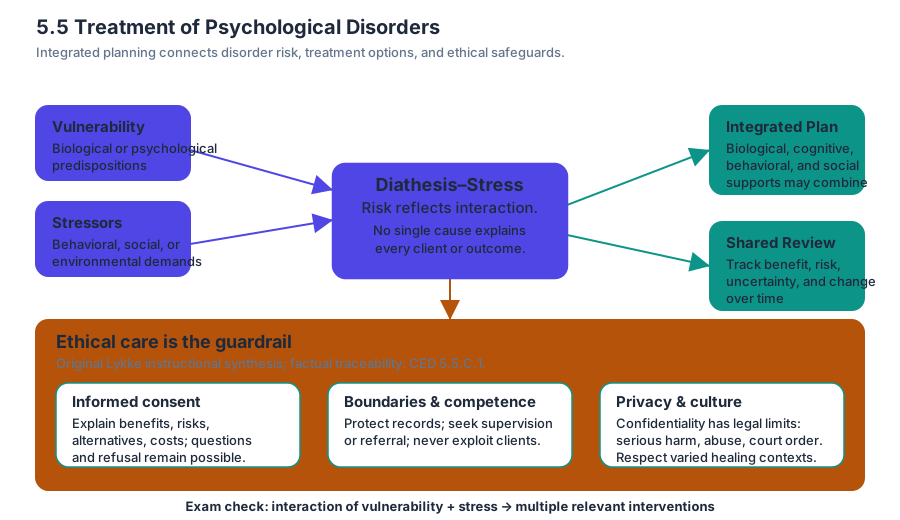
The diathesis-stress model explains this interaction: a diathesis is a predisposition or vulnerability, while stress is an activating life experience. Neither vulnerability nor stress alone guarantees a disorder. A useful causal sketch is:
$$ \text{genetic or biological vulnerability}+\text{stressful experience}\rightarrow\text{increased risk} $$
The model describes risk, not destiny. Positive psychologists add another perspective by studying mental health through positive emotions, adaptive cognitions, meaningful experiences, resilience, and happiness—not merely the absence of symptoms. (CED traceability: 5.5.A.1–5.5.A.2; 5.5.G.1–5.5.G.2.)
One case, several mechanisms
Suppose an original fictional client, Mara, avoids buses, elevators, crowded shops, and leaving home alone. This pattern may be consistent with agoraphobia, which can involve fear or avoidance of transportation, open spaces, enclosed spaces, crowds or lines, or being outside the home alone. A behavioral psychologist might ask what fear association was learned and maintained by avoidance; a cognitive therapist might examine catastrophic predictions; a biomedical clinician might consider medication; a humanistic therapist might provide a supportive relationship that encourages self-directed change.
Misconception check: “A biological explanation proves that therapy is unnecessary.” It does not. A biological vulnerability can interact with learning and environment, and effective treatment may appropriately combine psychotropic medication with psychological therapies. Increased use and effectiveness of psychotropic medication contributed to deinstitutionalization, replacing many large hospitals and asylums with more decentralized treatment. (CED traceability: 5.5.B.1.)
Matching perspective to intervention
A treatment is not judged only by whether it sounds plausible. Psychologists examine controlled research, replication, clinically meaningful improvement, risks, client preferences, and fit between the intervention and the person’s circumstances. These evidence-based interventions guide treatment planning rather than relying on tradition, intuition, or a single theory. (CED traceability: 5.5.B.1; 5.5.G.1–5.5.G.2.)
The behavioral perspective explains disorders through maladaptive learned associations and consequences. Exposure therapies, including systematic desensitization, gradually and safely confront feared stimuli while reducing avoidance; aversion therapy pairs an unwanted behavior with an unpleasant consequence; token economies reinforce desired behaviors with exchangeable tokens. Applied behavior analysis also supports interventions for mental disorders and developmental disabilities. Biofeedback uses conditioning principles to help a person regulate body systems, including sympathetic and parasympathetic activity related to anxiety or depression. (CED traceability: 5.5.D.2–5.5.D.3.)
Cognitive-behavioral therapy targets maladaptive thoughts and behaviors together. A client might test the prediction “If I enter a crowded store, I will certainly lose control,” while also practicing gradual approach behaviors. Psychodynamic therapy uses free association and dream interpretation to uncover unconscious conflicts (5.5.D.1). Humanistic, or person-centered, therapy uses active listening and unconditional positive regard to support growth and self-direction (5.5.D.5). Hypnosis may help with pain and anxiety, but research does not support using it to retrieve accurate memories or regress someone to an earlier age (5.5.F.1).
Biomedical treatment can include psychotropic medication, which changes neural or physiological processes associated with symptoms. Medication can be useful, but treatment planning must consider effectiveness, side effects, interactions, informed choice, monitoring, and whether psychological or social interventions should be added. Group approaches can provide interpersonal practice and social support when their structure fits the client’s needs. (CED traceability: 5.5.D.4; 5.5.E.1–5.5.E.2.)
Ethics are part of treatment, not an optional extra
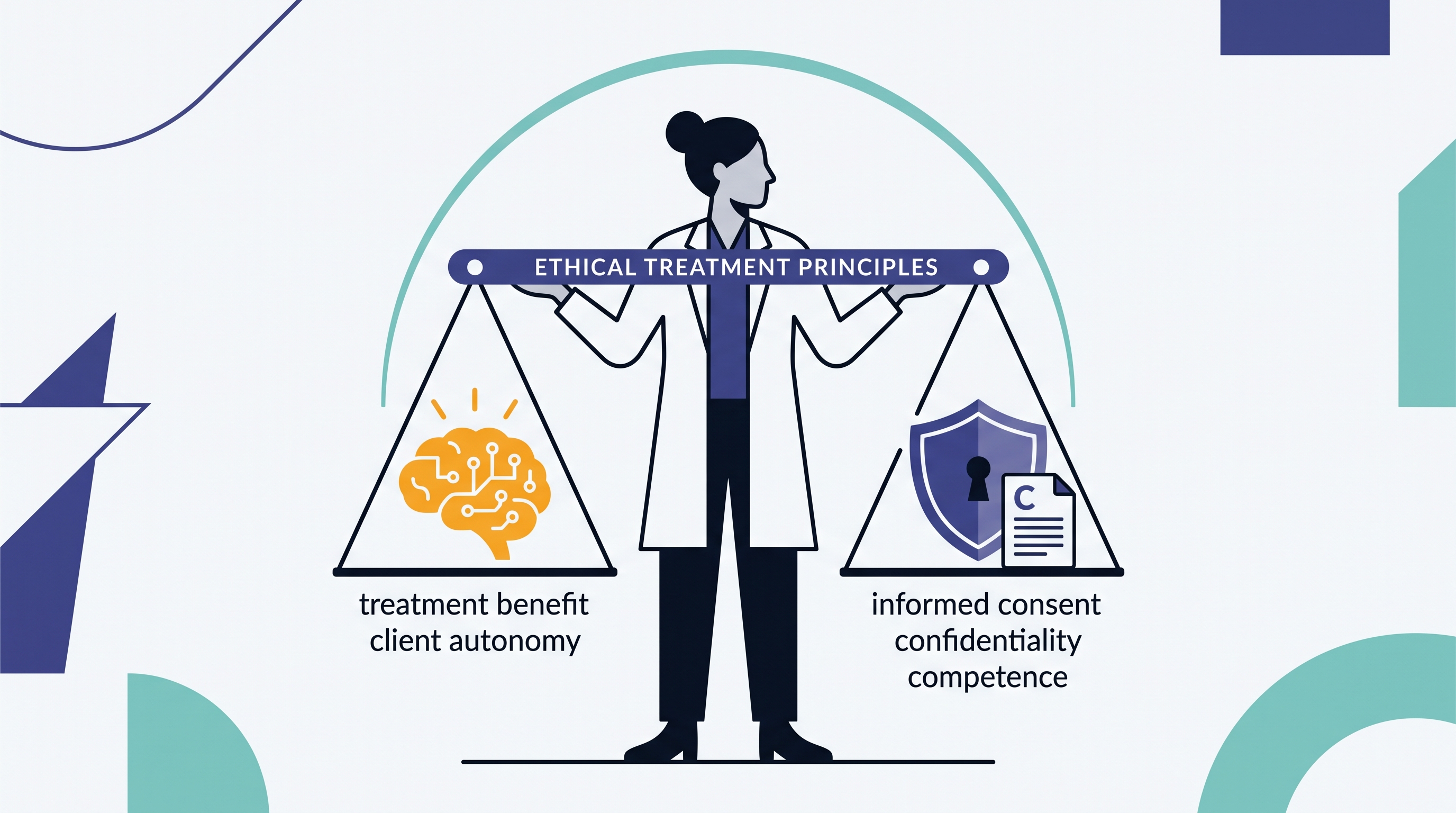
Psychologists in clinical or therapeutic settings must follow ethical principles established by the APA, including nonmaleficence, avoiding harm; beneficence, promoting well-being; fidelity, honoring professional responsibilities; integrity, acting honestly; and respect for people’s rights and dignity (5.5.C.1).
In practice, this includes informed consent: explaining the proposed treatment, likely benefits, risks, alternatives, costs, and the client’s right to ask questions or refuse. Confidentiality protects private information, but it has limits established by law and professional duty, such as serious risk of harm, abuse reporting requirements, or a valid court order. A psychologist must practice within their competence, seek supervision or referral when necessary, maintain appropriate professional boundaries, and avoid exploiting a client.
Ethical care also requires respect for autonomy—supporting the client’s informed choices rather than coercing agreement. Cultural sensitivity matters because distress, help-seeking, family roles, communication, and healing practices vary across cultural contexts. A responsible clinician avoids stereotypes, explains uncertainty, uses respectful language, protects records, and continually weighs benefit against risk. (CED traceability: 5.5.C.1.)
Retrieval check: Why does the diathesis-stress model support an integrated treatment plan rather than a single-cause explanation?
Answer: It treats disorder risk as an interaction between vulnerability and stressful experience, so biological, behavioral, cognitive, environmental, and social interventions may all be relevant.