From the free course AP Psychology on Lykke
4.4 Psychodynamic and Humanistic Theories of Personality
Key concepts: Psychodynamic theory of personality · Unconscious processes · Ego defense mechanisms · Projective personality tests · Preconscious and unconscious mind · Humanistic theory of personality · Defining personality through humanistic theory · Assessing personality through humanistic theory · Psychosexual stage theory exclusion
Two people can face the same criticism yet react in opposite ways because personality is not only what you consciously choose to show; it may also reflect hidden conflicts, protective mental strategies, and a drive toward growth.
4.4 Psychodynamic and Humanistic Theories of Personality
Two people can face the same criticism yet react in opposite ways because personality is not only what you consciously choose to show; it may also reflect hidden conflicts, protective mental strategies, and a drive toward growth.
Psychodynamic theory: personality beneath awareness
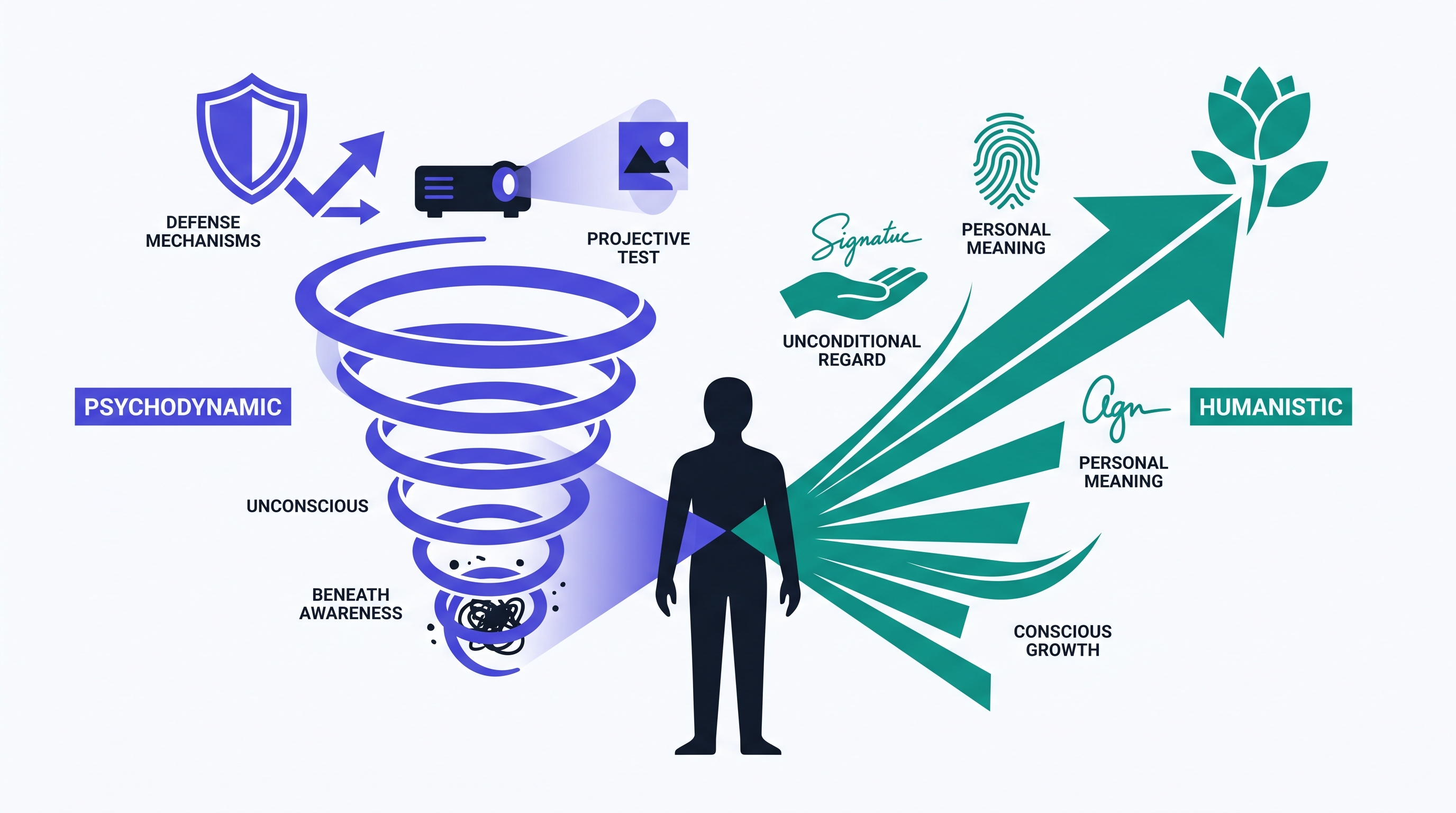
Psychodynamic theory explains personality through unconscious processes—mental activities outside immediate awareness that influence thoughts, feelings, and behavior. Under Essential Knowledge 4.4.A.1, these processes drive personality: a person may sincerely report one reason for an action while a less visible motive also shapes it.
Key distinction: Unconscious does not mean imaginary. It means that the person is not currently aware of the process influencing the behavior.
Psychodynamic theory also proposes that the ego—the part of personality that manages demands from the self and the surrounding world—can experience threats such as anxiety, shame, or conflict. Ego defense mechanisms operate unconsciously to protect the ego from those threats, as required by Essential Knowledge 4.4.A.2.
The eight required defense mechanisms
| Defense mechanism | What happens | Original example |
|---|---|---|
| Denial | Refusing to accept a threatening reality | A driver dismisses clear evidence that alcohol is impairing their judgment. |
| Displacement | Directing emotion toward a safer target | After being criticized by a supervisor, a person snaps at a roommate. |
| Projection | Attributing one’s own unacceptable thoughts or feelings to someone else | A jealous person insists that their partner must be unfaithful. |
| Rationalization | Creating a plausible but inaccurate explanation | Someone rejected from a team claims they never wanted to join. |
| Reaction formation | Expressing the opposite of an unacceptable impulse | A person who feels strong resentment acts unusually affectionate. |
| Regression | Returning to an earlier pattern of behavior under stress | An overwhelmed adult becomes unusually dependent and demands others solve simple problems. |
| Repression | Keeping threatening material outside conscious awareness | A person cannot recall an emotionally distressing event, though the event may still affect reactions. |
| Sublimation | Redirecting an unacceptable impulse into a socially acceptable activity | Someone channels intense aggression into disciplined athletic training. |
Worked application: Suppose Mira receives a poor evaluation and immediately says, “The evaluator is incompetent,” despite privately worrying that she performed badly. If Mira is shifting her own uncomfortable feeling of inadequacy onto the evaluator, the best answer is projection. If she invents a convenient explanation such as “I was only marked down because the office dislikes me,” the pattern is rationalization. The key is to identify the psychological function of the response, not merely its emotional tone.
Misconception check: A defense mechanism is not simply a lie or a deliberate excuse. The defining feature is that it protects the ego unconsciously. Also, do not label every confident explanation as rationalization; the scenario must show an inaccurate explanation that reduces threat or discomfort.
Assessing personality with projective tests
Psychodynamic personality psychologists use projective tests, which present ambiguous stimuli—such as an unclear image or incomplete prompt—and ask a person to interpret or complete them. The design is intended to probe the preconscious and unconscious mind, as stated in Essential Knowledge 4.4.A.3: the person’s response may reveal themes, conflicts, or motives that are not directly reported.
A projective response is therefore not a transparent window into the mind. It requires interpretation, and interpretation raises questions about reliability and validity. For Science Practice 2.C, evaluate whether the non-experimental assessment method is appropriate for the claim: an interpretive pattern may suggest a hypothesis, but it does not automatically establish a hidden motive as fact.
Humanistic theory: personality as growth
Humanistic theory approaches personality by emphasizing the person’s capacity for choice, meaning, and development. Essential Knowledge 4.4.B.1 identifies two central ideas: unconditional regard, accepting a person’s worth without making acceptance depend on perfect performance, and the self-actualizing tendency, the motivation to develop one’s abilities and become the fullest version of oneself.
For example, a mentor who communicates, “Your worth is not conditional on this test score, and I will help you grow,” reflects unconditional regard. The learner’s effort to pursue meaningful goals and develop capabilities illustrates the self-actualizing tendency. Humanistic assessment consequently focuses on how people understand themselves, their goals, their growth, and the conditions that support or block that growth.
Comparing the perspectives
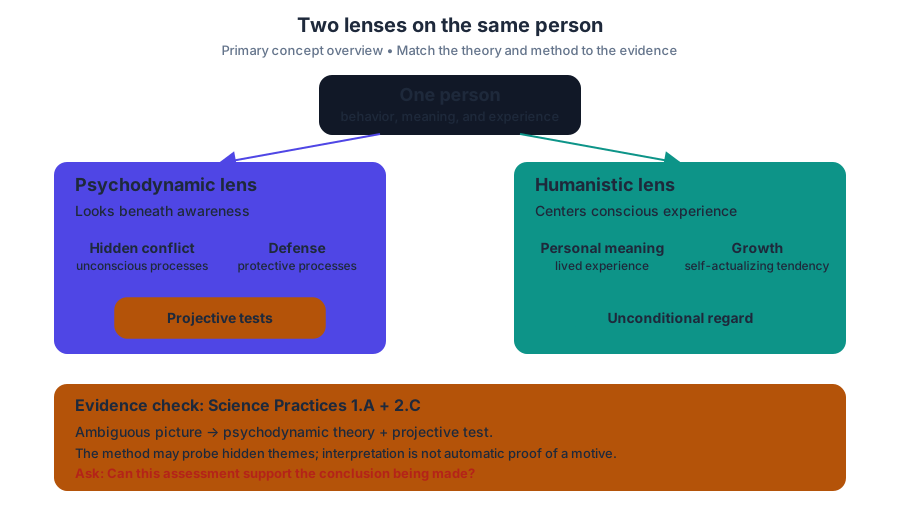
Psychodynamic and humanistic theories ask different questions about the same person. Psychodynamic analysis looks beneath awareness for conflict and protective processes; humanistic analysis emphasizes conscious experience, personal meaning, acceptance, and growth. Apply Science Practice 1.A by matching the theory to the evidence in the scenario, and apply 2.C by asking whether the assessment method can support the conclusion being made.
Scope boundary: The stage theory of psychosexual development is out of scope for the AP Psychology Exam. Maslow’s hierarchy of needs is also outside the scope of this topic. Keep the required focus on unconscious processes, defense mechanisms, projective tests, unconditional regard, and self-actualizing tendencies.
Retrieval check: A researcher asks a participant to interpret an ambiguous picture to explore hidden personality themes. Which theory and assessment method are being used?
Answer: The psychodynamic theory is being applied through a projective test. The test is designed to probe preconscious and unconscious processes, but its interpretation should not be treated as automatic proof of a hidden motive without adequate evidence.