From the free course AP Psychology on Lykke
3.2 Physical Development Across the Lifespan
Key concepts: Physical development across the lifespan · Prenatal physical development · Teratogens, maternal illness, and genetic factors · Physical development in infancy and childhood · Motor development · Critical and sensitive periods · Adolescent physical development and puberty · Physical development in adulthood and aging
Physical development changes the body’s capacity to act, sense, reproduce, and adapt—from prenatal growth to the gradual sensory and motor changes of adulthood. The key question is not simply what changes when, but how those physical changes influence behavior and mental processes.
3.2 Physical Development Across the Lifespan
Physical development changes the body’s capacity to act, sense, reproduce, and adapt—from prenatal growth to the gradual sensory and motor changes of adulthood. The key question is not simply what changes when, but how those physical changes influence behavior and mental processes.
Prenatal Physical Development: Many Influences, Not One Cause
Teratogens are environmental influences that can disrupt prenatal development. Examples include certain drugs, toxic substances, infections, and severe nutritional deficiencies. Their effects depend on factors such as timing, dose, duration, and the developing system affected.
3.2.A.1: Teratogens, maternal illness, genetic mutations, hormonal factors, and environmental factors can influence major physical and psychological milestones during prenatal development.
Keep the categories distinct. A teratogen is an environmental influence; a genetic mutation is a change in genetic material. Maternal illness can affect development through fever, inflammation, altered nutrition, or other biological pathways. Inherited genetic variation comes from a biological parent, whereas a de novo variation arises during development rather than being inherited. These influences can also interact: a genetic difference might increase or decrease sensitivity to an environmental exposure.
The names of the prenatal stages are outside the required exam scope. What matters is reasoning from a prenatal influence to a possible developmental outcome without claiming that one factor determines a person’s entire future.
Worked example — original instructional scenario: A pregnant person contracts an illness and experiences prolonged fever during a period when the developing nervous system is especially vulnerable. A defensible explanation is that maternal illness may influence prenatal physical and psychological milestones. It would not be defensible to conclude that the illness guarantees a particular later behavior, because development reflects multiple biological and environmental influences.
Infancy and Childhood: Motor Development and Perception
Motor development is the progression of physical abilities involving movement and coordination. Early development generally proceeds from broad control toward increasingly precise control: infants gain control over large body movements before refined skills such as grasping small objects or manipulating tools.
Use a chart or figure as evidence rather than treating a milestone as a rigid deadline. A curve showing increasing balance, reaching accuracy, or walking frequency supports a claim about a general developmental pattern; it does not prove that every child follows the same timetable.
Visual cliff research uses a transparent surface arranged to look like a drop-off. An infant placed on the apparent “deep” side may avoid crossing even though the surface is physically safe. This finding demonstrates aspects of perceptual and physical development, especially the ability to detect depth and coordinate movement with perceived danger. It does not prove that infants possess an adult-like understanding of cliffs or that fear alone explains every response.
Critical and Sensitive Periods
A critical period is a limited time when a particular experience is especially necessary for typical development. A sensitive period is a time when an experience has an unusually powerful effect, although later development may remain possible.
3.2.B.4: Critical or sensitive periods in infancy and childhood can have strong developmental effects, especially for skills such as language. Some non-human animals imprint on the first object they encounter as a means of survival.
Imprinting is a rapid form of early learning in which some non-human animals attach to the first moving object they encounter. In an animal’s natural environment, following that object can promote survival. Human language development is not identical to animal imprinting, but both examples show why timing can matter.
Misconception check: “A sensitive period means learning is impossible afterward.” Not necessarily. The precise claim is that learning is easier or development is more strongly shaped during that period. A later opportunity may still produce learning, though the outcome may differ.
Adolescence: Puberty and Reproductive Development
3.2.C.1: Adolescence includes the adolescent growth spurt and puberty, the period during which reproductive ability develops.
Puberty produces primary sex characteristics, which involve the reproductive organs and reproductive capacity, and secondary sex characteristics, which are physical changes associated with sexual maturation but not directly required for reproduction. Menarche is the first menstrual period. Spermarche is the first ejaculation containing viable sperm.
These milestones are related to physical development, not automatic evidence of emotional maturity, personality, or identical behavior across all adolescents.
Adulthood: Leveling Off and Variable Decline
3.2.D.1: Adulthood spans most of the lifespan and is characterized by a general leveling off followed by varying declines in reproductive ability, mobility, flexibility, reaction time, and visual and auditory sensory acuity.
Adulthood is therefore not one uniform stage. Many physical capacities level off for a period, then decline at different rates across individuals and systems. Menopause illustrates declining reproductive ability in adulthood. Changes in reaction time, flexibility, mobility, and sensory acuity may also occur, but their timing and severity vary.
Claim-Evidence Reasoning
For a defensible claim, connect the finding to exactly what it supports.
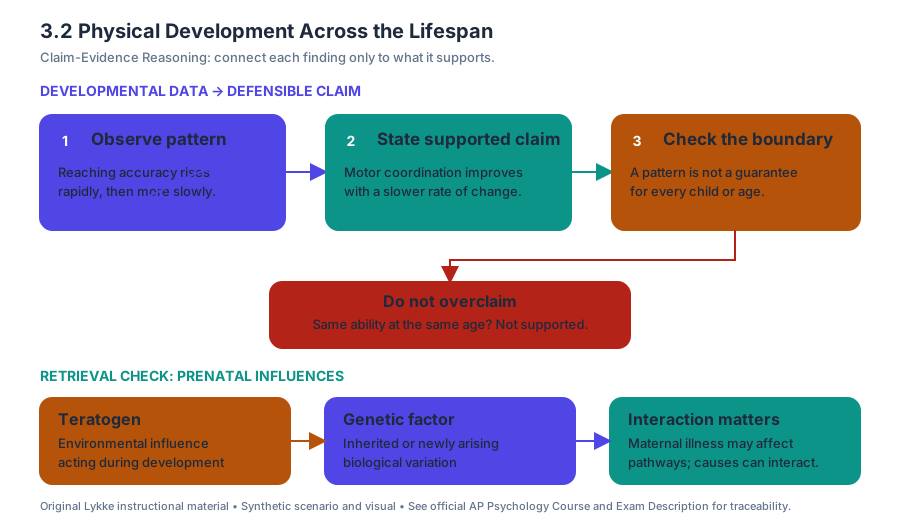
Original instructional scenario: A developmental chart shows that reaching accuracy rises rapidly during early childhood and then increases more slowly. A defensible claim is: The data support a general pattern of improving motor coordination followed by a slower rate of change. The data do not justify claiming that every child reaches the same ability at the same age.
Retrieval check: Why should you distinguish a teratogen from a genetic factor when explaining prenatal development?
Answer: A teratogen is an environmental influence, whereas a genetic factor involves inherited or newly arising biological variation. Maternal illness is another influence that may affect development through biological pathways, and these factors can interact rather than operate as single guaranteed causes.