From the free course AP Psychology on Lykke
4.6 Motivation
Key concepts: Motivation · Drive-reduction theory · Yerkes-Dodson law · Optimal level of arousal · Conflict theory of motivation · Approach-approach conflict · Approach-avoidance conflict · Avoidance-avoidance conflict · Sensation-seeking theory · Types of sensation seeking
Motivation is the process that energizes, directs, and sustains behavior. You drink water because a physical need pushes your body toward balance, practice a difficult skill because an internal goal matters to you, or choose a thrilling roller coaster because ordinary stimulation feels insufficient.
4.6 Motivation
Motivation is the process that energizes, directs, and sustains behavior. You drink water because a physical need pushes your body toward balance, practice a difficult skill because an internal goal matters to you, or choose a thrilling roller coaster because ordinary stimulation feels insufficient. Different theories explain these choices by focusing on needs, arousal, rewards, conflicts, or novelty.
Learning Objective 4.6.A: Explain how theories about motivation apply to behavior and mental processes.
Physical needs: drive reduction and homeostasis
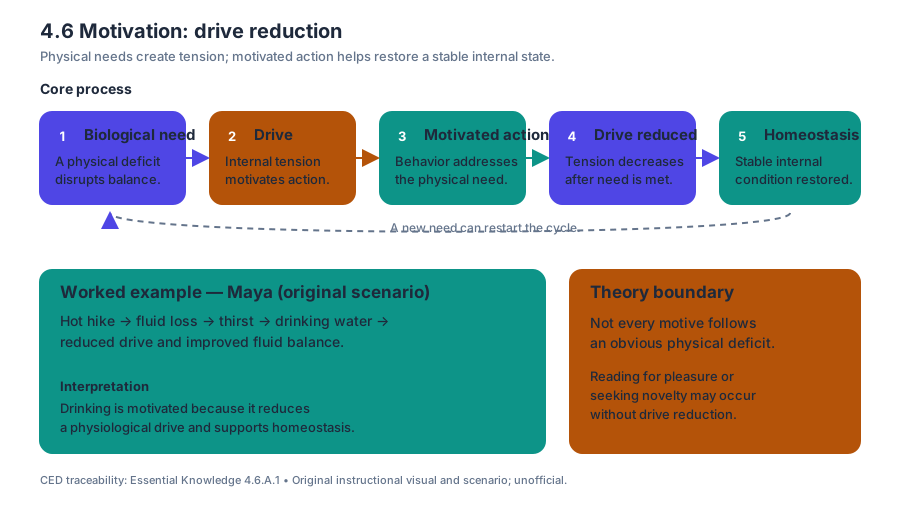
Drive-reduction theory explains motivation as behavior aimed at addressing physical needs and desires. A drive is an internal state of tension produced by a biological need; homeostasis is the body’s tendency to maintain a stable internal condition. Hunger, thirst, and the discomfort of being too cold can create drives that motivate actions designed to restore balance.
A simple sequence is:
Worked example — original instructional scenario: After hiking in hot weather, Maya becomes thirsty. Fluid loss creates a physiological imbalance, thirst acts as a drive, and drinking water reduces the drive by helping restore homeostasis. The theory explains why drinking is motivated, but it does not explain every motivated behavior: reading for pleasure or seeking a novel experience may occur without an obvious physical deficit.
Essential Knowledge 4.6.A.1 includes drive-reduction theory and its relationship to physical needs and homeostasis.
Arousal and the optimal level
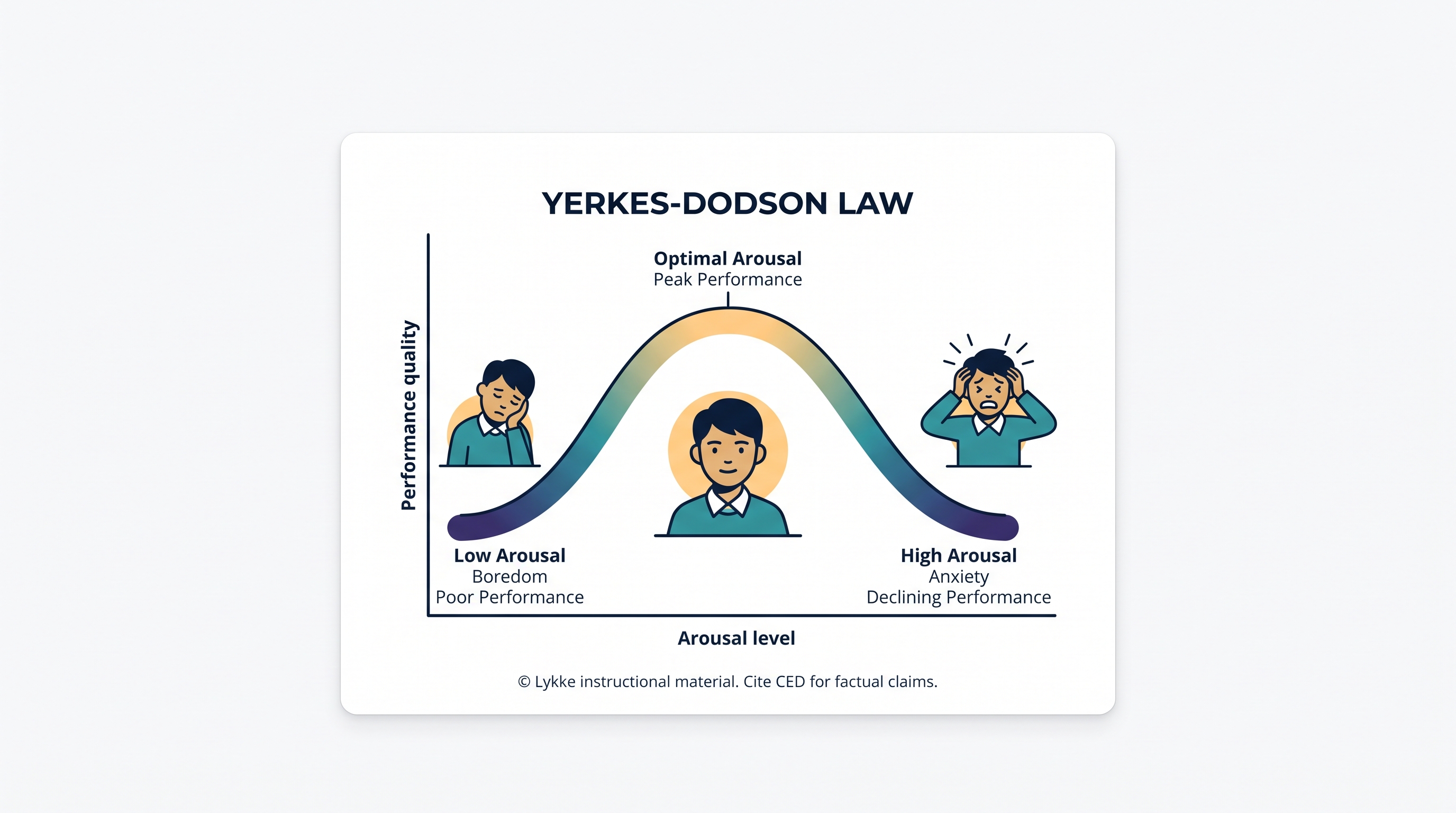
Arousal theory proposes that people seek an optimal level of arousal—a preferred level of alertness, stimulation, or activation. The Yerkes-Dodson law describes an inverted-U relationship between arousal and performance: performance often improves as arousal rises from very low levels, reaches a best point, and then declines when arousal becomes too high.
| Arousal level | Likely experience | Performance pattern |
|---|---|---|
| Low | Boredom, drowsiness | Attention and effort may be weak |
| Moderate or optimal | Alertness and engagement | Performance is often strongest |
| High | Anxiety, overload, panic | Performance may deteriorate |
Worked example — original instructional scenario: A student who is mildly energized before a presentation may speak clearly and attend closely to the audience. If the student’s arousal becomes extreme, worry may consume working attention and cause forgotten lines. The goal is not “maximum arousal”; it is an arousal level appropriate to the task.
A common misconception is that the Yerkes-Dodson law says everyone performs best at exactly the same arousal level. In fact, the optimal point can vary with the person and the task. A simple, familiar task may tolerate higher arousal than a complex task requiring careful reasoning.
Internal and external sources of motivation
Self-determination theory proposes that behavior can be motivated by intrinsic motivation, which comes from interest or satisfaction within the activity, or extrinsic motivation, which comes from an external reward or consequence. Incentive theory emphasizes the role of rewards—an important form of extrinsic motivation—in directing behavior.
Essential Knowledge 4.6.A.2 also distinguishes these motivational sources. A person may study because learning feels satisfying, because a high grade is desired, or because both motives operate together.
Essential Knowledge 4.6.A.3: Many non-human animals show instincts, innate and typically fixed patterns of behavior triggered by particular stimuli. Humans do not appear to demonstrate instinctual behavior or mental processes in the same fixed way. Do not label every strong human tendency an “instinct” on an exam.
Motivation as conflict
Lewin’s motivational conflicts theory proposes that choices create conflicts that must be resolved. The type of conflict depends on whether the options contain desirable or undesirable features.
| Conflict | Structure | Original example |
|---|---|---|
| Approach-approach | Two desirable options | Choosing between a concert and a weekend trip |
| Approach-avoidance | One choice has both desirable and undesirable features | Wanting a promotion but disliking the extra workload |
| Avoidance-avoidance | Two undesirable options | Choosing between paying a late fee or losing access to an account |
The key distinction is one option versus two. Approach-avoidance involves ambivalence about a single choice; approach-approach involves selecting between two attractive choices.
Sensation seeking
Sensation-seeking theory proposes that the need for varied or novel experiences can motivate behavior. Experience seeking involves pursuing new ideas, places, activities, or perspectives. Thrill or adventure seeking involves choosing physically exciting or risky experiences. The broader set of sensation-seeking types also includes disinhibition and boredom susceptibility.
Misconception check: Sensation seeking is not identical to “being careless.” A person may deliberately seek novelty because ordinary stimulation feels insufficient, while still evaluating risks and setting limits.
Retrieval check
A student feels mildly alert before a test and performs well, but becomes so anxious that performance drops. Which concept best explains the pattern?
Answer: The Yerkes-Dodson law: performance is often strongest at an optimal level of arousal and declines when arousal becomes too low or too high. In an AP-style explanation, identify the arousal-performance relationship rather than simply calling the student “motivated.”
AP science-practice connection: Use 1.A, Identify and explain psychological concepts, theories, and perspectives, when matching a scenario to a motivation theory. Use 3.C, Draw conclusions from data, when interpreting a graph showing the inverted-U relationship.