From the free course AP Psychology on Lykke
5.2 Positive Psychology
Key concepts: Positive psychology · Well-being · Resilience · Positive processes · Signature strengths · Virtues · Gratitude · Positive psychology research and data collection
A person can feel healthy, capable, and connected even when life is not perfectly easy. Positive psychology studies the factors that support well-being, resilience, positive emotions, and psychological health—not by ignoring problems, but by asking a complementary question: What helps people function and flourish?
5.2 Positive Psychology
A person can feel healthy, capable, and connected even when life is not perfectly easy. Positive psychology studies the factors that support well-being, resilience, positive emotions, and psychological health—not by ignoring problems, but by asking a complementary question: What helps people function and flourish? Essential Knowledge 5.2.A.1
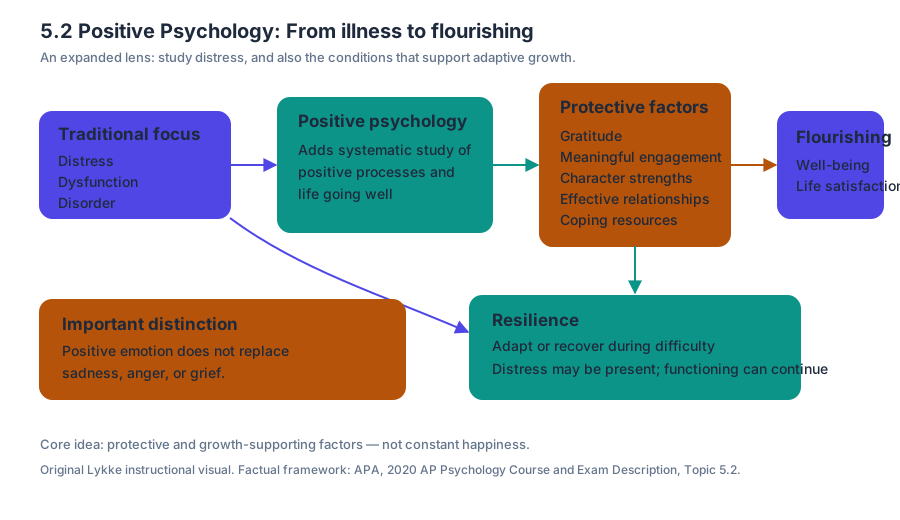
From illness to flourishing
Traditional psychological research often examines distress, dysfunction, and disorder. Positive psychology adds the systematic study of positive processes: gratitude, meaningful engagement, character strengths, resilience, and the conditions associated with feeling that life is going well. Well-being refers broadly to positive psychological functioning and life satisfaction; resilience is the capacity to adapt or recover when facing difficulty.
A crucial distinction is that positive psychology does not claim that positive emotion should replace sadness, anger, or grief. A resilient person may experience distress and still use effective relationships, values, skills, and coping resources to continue functioning. The approach studies protective and growth-supporting factors, not constant happiness.
Positive subjective experiences and character strengths
Subjective well-being means a person’s reported evaluation of their own life, including positive feelings and satisfaction. According to 5.2.B.1, expressing gratitude—a positive subjective experience—is associated with greater subjective well-being. A practical gratitude activity is to write down at least three things you are grateful for each day, such as a supportive conversation, a safe place to rest, or progress toward a goal.
Signature strengths are a person’s especially characteristic positive qualities. When people exercise their signature strengths or virtues, they report higher levels of positive outcomes such as happiness and subjective well-being (5.2.B.2). Because this wording concerns reported outcomes, treat it as an association unless a study uses a strong experimental design that supports a causal conclusion.
A classification of character strengths organizes them around six virtue categories: wisdom, courage, humanity, justice, temperance, and transcendence. For example, using courage to initiate a difficult but meaningful conversation may feel different from using humanity to support a friend, yet both can reflect strengths linked to positive functioning.
| Virtue category | Plain-language focus | Original example |
|---|---|---|
| Wisdom | Understanding and using knowledge well | Comparing evidence before making a decision |
| Courage | Acting despite fear or difficulty | Speaking up about an unfair policy |
| Humanity | Caring for and supporting others | Listening attentively to a stressed friend |
| Justice | Promoting fairness and cooperation | Sharing group work equitably |
| Temperance | Regulating impulses and excess | Pausing before responding angrily |
| Transcendence | Connecting with meaning or something larger than oneself | Finding purpose in service or creative work |
Worked example: collect, calculate, interpret
Original Lykke instructional material: A small group records a self-rated well-being score from $0$ to $10$ before and after one week of writing three gratitude entries each evening.
| Participant | Before | After |
|---|---|---|
| A | 5 | 6 |
| B | 6 | 7 |
| C | 4 | 6 |
| D | 7 | 8 |
| E | 5 | 6 |
| F | 6 | 7 |
| G | 4 | 5 |
The before scores total $37$, so the mean is $\frac{37}{7}\approx5.29$. The after scores total $45$, so the mean is $\frac{45}{7}\approx6.43$. The average difference is approximately $1.14$ points; the median also shifts from $5$ to $6$. A bar graph of the two means would communicate the pattern quickly.
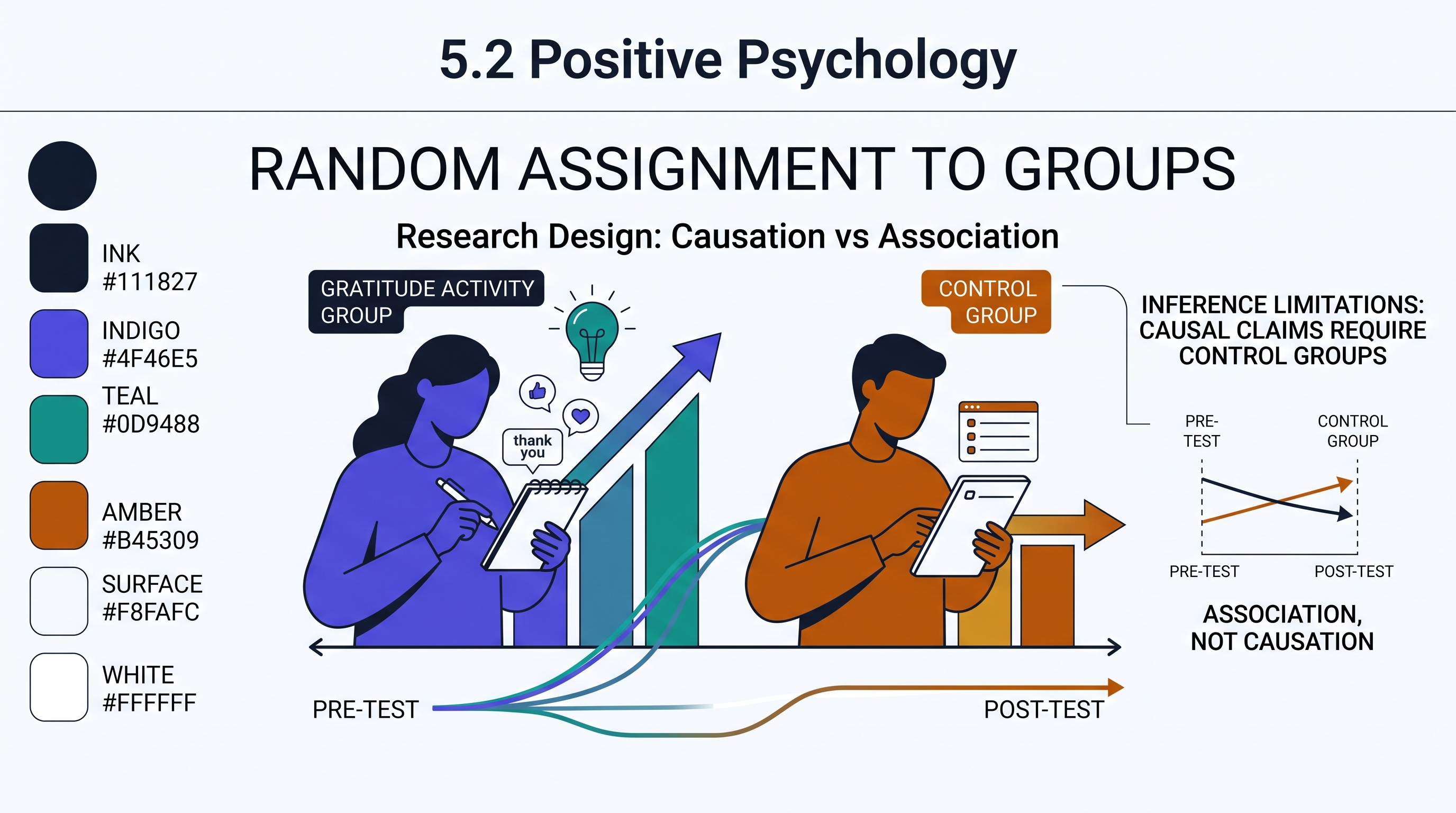
The defensible conclusion is: In this small group, completing the gratitude activity was associated with higher reported well-being scores after one week. You cannot conclude that gratitude caused the increase because this simple demonstration has no comparison group, random assignment, or control over other explanations such as time, expectation, or an unrelated positive event.
Science-practice connection
Science Practice 1: Concept Application — Skill 1.A requires you to define and apply a psychological concept accurately. In the example, identify gratitude as a positive subjective experience and well-being as the reported outcome; do not merely label the activity “positive psychology.”
Science Practice 2: Research Methods and Design — Skill 2.C matters when you evaluate what the evidence can support. Ask whether the design includes comparison, control, and an appropriate way to rule out alternative explanations. A higher post-activity mean is descriptive evidence, not automatically causal evidence.
Misconception check
Common misconception: “Positive psychology means thinking positively solves every problem.” Correction: Positive psychology investigates factors associated with well-being, resilience, positive emotions, and psychological health. It does not deny suffering, guarantee happiness, or replace treatment when serious difficulties require professional care.
Retrieval check
Question: A class completes a gratitude activity and reports higher average well-being afterward, but there is no control group. What conclusion is justified?
Answer: The activity is associated with higher reported well-being in that class. You should not claim that it caused the increase because the design does not eliminate alternative explanations. That is the central data-interpretation habit: describe the observed pattern accurately while avoiding an overclaim about causation.