From the free course AP Psychology on Lykke
1.1 Interaction of Heredity and Environment
Explain how heredity and environment interact to shape behavior and mental processes, and read twin, family and adoption designs for what they can and cannot show.
1.1 Interaction of Heredity and Environment
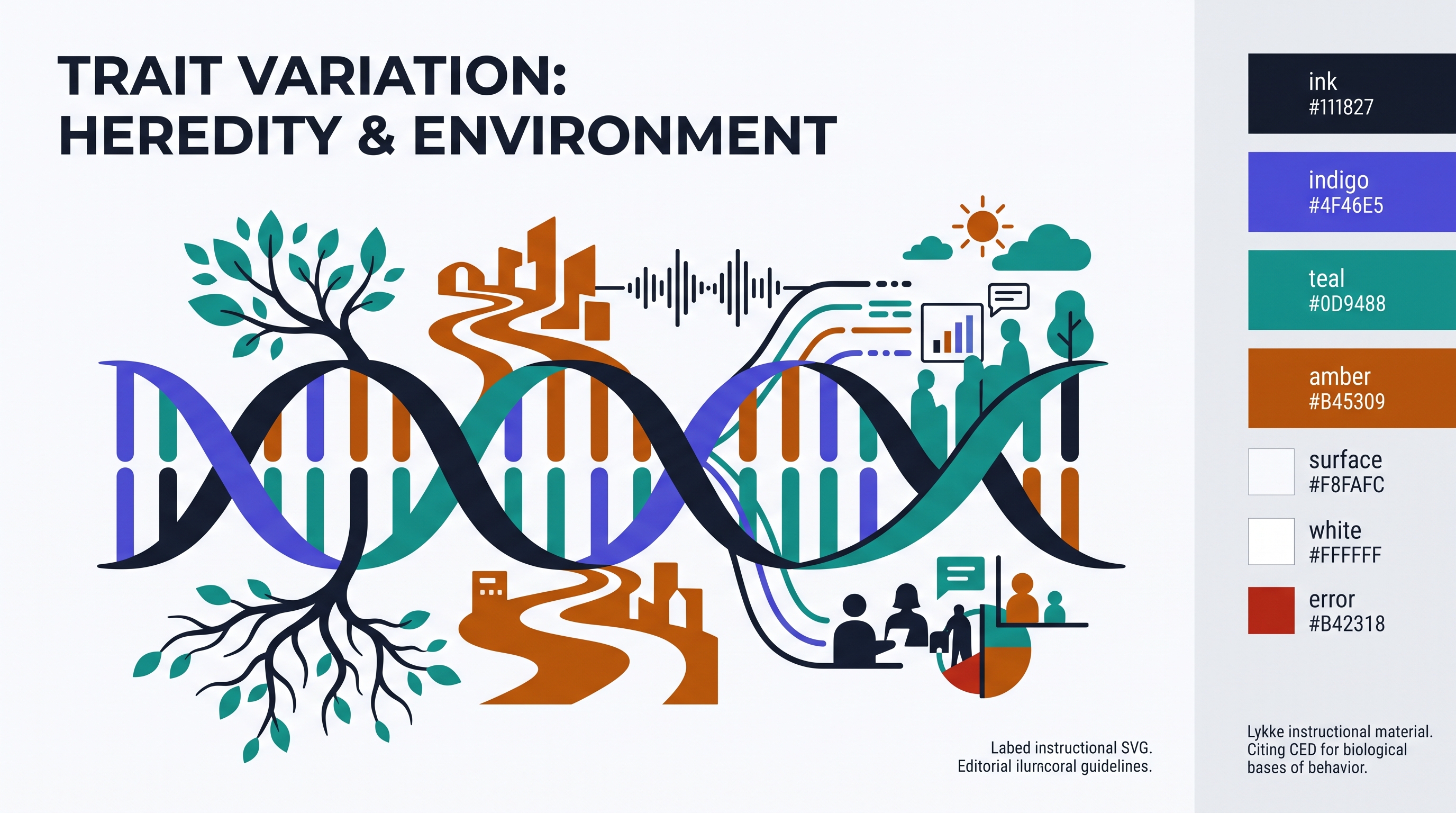
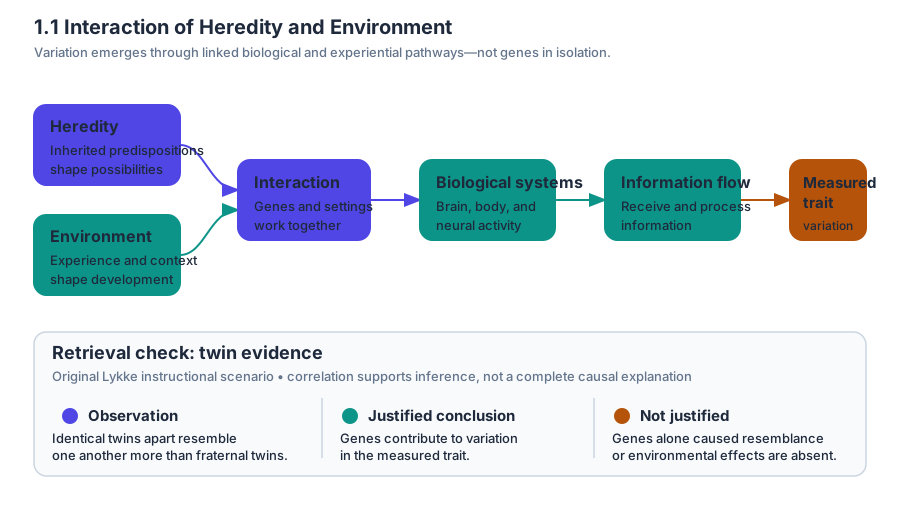
Why do two siblings raised in the same home sometimes differ sharply in personality, achievement, or stress response? Heredity and environment interact: inherited predispositions influence what is possible or likely, while environmental experiences shape how those predispositions are expressed.
Nature and nurture are partners, not rivals
Heredity, or “nature,” refers to genetic or predisposed characteristics that influence physical, behavioral, and mental traits and processes (1.1.A.1.i). Environment, or “nurture,” refers to external factors that you experience, such as family interactions or education (1.1.A.1.ii). The central claim of 1.1.A.1 is not that one side “wins”; both influence behavior and mental processes together.
Imagine two young people with a predisposition toward strong musical ability. One receives instruments, lessons, encouragement, and time to practice. The other has no access to instruction and is discouraged from making noise. The inherited potential may be similar, but the observable skill can develop differently because the environments differ. Conversely, an enriched environment cannot guarantee an identical outcome when people begin with different predispositions.
Key insight: A genetic influence is a tendency, not a destiny.
The interaction can also run in the opposite direction: inherited characteristics may influence which environments people seek or how others respond to them. A naturally outgoing child may invite more social interaction, receive more conversational practice, and become even more socially confident. This does not mean the child “caused” the trait alone; it means heredity and experience can reinforce one another over time.
How psychologists study the interaction
Psychologists cannot ethically assign genes or childhood homes at random, so they use family, twin, and adoption designs. These are generally correlational approaches: they can reveal patterns of resemblance, but they do not automatically establish that a particular gene caused a particular behavior.
Synthetic comparison example — original instructional material: Suppose a study finds that identical twins raised apart show more resemblance in a measured reasoning score than fraternal twins raised apart. The result supports a genetic contribution to variation in that score because identical twins share more genetic material. It does not prove that genes alone caused the resemblance, establish a single “reasoning gene,” or eliminate prenatal experiences and later environmental similarities.
A useful rule is to ask what the design holds relatively constant and what it compares:
| Design | Main comparison | What the pattern can suggest | Inference it does not license |
|---|---|---|---|
| Twin study | Identical twins compared with fraternal twins | Greater similarity among identical twins may indicate genetic influence | Genes alone determine the trait |
| Family study | Biological relatives compared with one another | Resemblance may reflect shared genes, shared environment, or both | Shared genes are the only explanation |
| Adoption study | Adopted people compared with biological and adoptive relatives | Similarity to biological relatives may suggest heredity; similarity to adoptive relatives may suggest environmental influence | Adoption removes every prenatal or postnatal environmental influence |
For example, if identical twins raised apart correlate at $r = 0.70$ on a trait while fraternal twins raised apart correlate at $r = 0.40$, the higher identical-twin similarity is evidence consistent with genetic influence. However, the correlation is not a percentage of the trait caused by genes in one person. It also does not prove that the environments were completely different or that the remaining difference was purely environmental.
Exam reasoning: apply, then limit the claim
Science Practice 1, Skill 1.A — “Apply psychological perspectives, theories, concepts, and research findings to a scenario.” In a question about twins, identify the pattern first, connect it to heredity or environment, and then state the limitation. A strong answer says: “The greater resemblance among genetically closer relatives is consistent with genetic influence, but the correlational design cannot establish genes as the sole cause.”
Science Practice 2, Skill 2.A — “Determine the type of research design(s) used in a given study.” A twin, family, or adoption comparison is not automatically an experiment because researchers do not manipulate genetic relatedness or randomly assign participants to families. Classify it as a non-experimental, correlational design unless the scenario includes an actual manipulated independent variable.
Misconception check
Common error: “If identical twins differ, heredity has no role,” or “If identical twins are alike, genes determine everything.” Both statements confuse influence with inevitability. Heredity can contribute to variation while environmental conditions, prenatal factors, measurement limits, and individual experiences also matter.
Retrieval check
Question: Identical twins raised apart resemble one another more than fraternal twins raised apart on a measured trait. What conclusion is justified, and what conclusion is not?
Answer: The finding supports a genetic contribution to variation in the measured trait, but it does not prove that genes alone caused the resemblance or rule out prenatal and other environmental influences.
The causal chain continues from inherited predispositions and environmental experience to biological systems, which influence how information is received and processed.
Source Materials
- Ap Psychology Course And Exam Description
- Ap Psychology Course At A Glance
- AP Psychology CED: Student Responses and Scoring Commentary
- AP Psychology Exam Questions
- Free-Response Questions
- Free-Response Questions - Set 1
- Free-Response Questions - Set 2
- AP Psychology Course — AP Central
- AP Psychology — AP Students
- Khan Academy — AP Psychology
- AP Psychology Units — Save My Exams
- AP Psychology Study Guides — Fiveable