From the free course AP Psychology on Lykke
2.1 Perception
Key concepts: Bottom-up and top-down processing · Schemas and perceptual sets · Gestalt principles of perception · Selective attention and the cocktail party effect · Inattentional blindness · Binocular depth cues · Monocular depth cues · Visual perceptual constancies · Apparent movement · Perception and cognition distortions caused by substances such as marijuana
Distinguish bottom-up from top-down processing and use depth cues, perceptual constancies and attention effects to explain what a perceiver reports.
2.1 Perception
Perception is the brain’s interpretation of sensory information, not a perfect recording of the world. The same visual scene can produce different experiences because perception combines incoming signals with expectations, attention, context, and learned patterns.
Learning Objective 2.1.A: Explain how internal and external factors influence perception.
Learning Objective 2.1.B: Explain how visual perceptual processes produce correct or incorrect interpretations of stimuli.
Two directions of processing
Bottom-up processing begins with external sensory information. Your eyes register lines, colors, brightness, and movement; your brain then builds those pieces into a meaningful object. Top-down processing begins with internal prior expectations, knowledge, schemas, and context, which guide how you interpret incomplete or ambiguous sensory input. These processes usually work together rather than competing separately.
Imagine reading a smudged sign. The uneven marks are bottom-up information. If the sign appears outside a bakery, your expectation makes you more likely to interpret the marks as “bread” rather than as an unrelated word. The expectation is top-down processing.
Schemas are mental frameworks that organize knowledge. A schema for “classroom” may lead you to expect desks, a board, and an instructor. A perceptual set is a readiness to perceive something in a particular way because of expectations, motives, experiences, or context. Cultural experience can also influence which interpretations seem most natural. These internal and external filters are specified in 2.1.A.1, 2.1.A.2, and 2.1.A.3.
Organizing the visual world
The Gestalt psychologists emphasized that you perceive organized wholes, not merely disconnected sensations. Four required principles are:
| Principle | What your perceptual system does | Original example |
|---|---|---|
| Closure | Fills in missing parts of an incomplete figure | You perceive a broken circle as a circle |
| Figure and ground | Separates a central object from its background | You see black letters as the figure on a white page |
| Proximity | Groups nearby elements together | Closely spaced dots look like a cluster |
| Similarity | Groups elements that look alike | Matching icons appear to belong to one category |
These principles help perception become efficient, but they can also produce incorrect interpretations when the available information is ambiguous. This organization process is part of 2.1.A.4.
Attention: selecting some information and missing other information
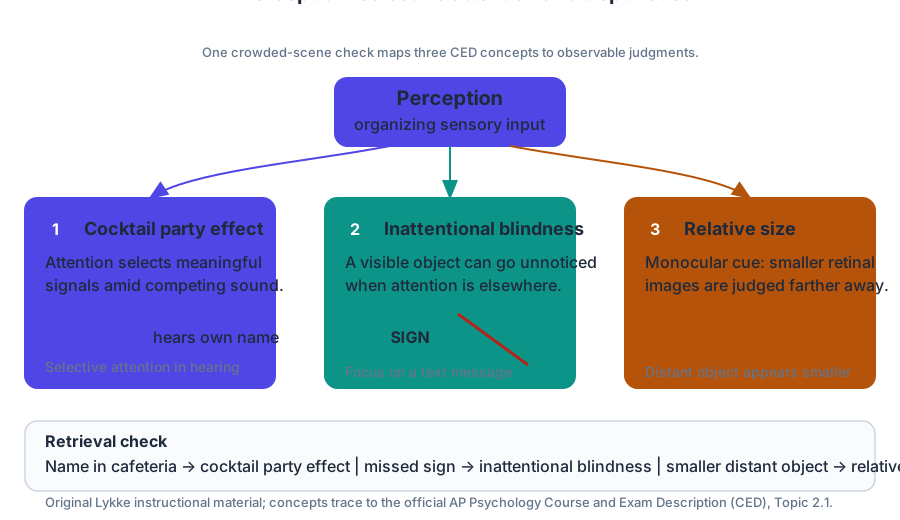
Selective attention allows you to focus on particular stimuli while filtering competing input. The cocktail party effect is the tendency to notice personally relevant information—such as hearing your own name across a noisy room—even while attending to another conversation. Attention reflects an interaction between internal goals and external stimulus features, as described in 2.1.A.5 and 2.1.A.5.i.
Inattentional blindness occurs when you fail to notice a visible aspect of the environment because your attention is directed elsewhere. The object may be plainly present, but perception does not reliably reach conscious awareness. This is not the same as literal blindness; it is an attentional limitation covered in 2.1.A.5.ii.
Misconception check: “If my eyes are pointed at something, I must have consciously perceived it.”
Correction: Eye position supplies sensory information, but selective attention determines which information receives deeper processing. A person concentrating on counting passes may miss an unexpected event in the scene.
Depth: using two eyes or one
Binocular depth cues require information from both eyes. Retinal disparity is the difference between the images projected onto the two retinas. Because each eye views the world from a slightly different position, a larger difference generally signals a nearer object. Convergence is the inward turning of both eyes toward a nearby object. The brain combines convergence information with retinal disparity to estimate depth; convergence is therefore not the merging of retinal images itself.
Monocular depth cues can be interpreted with one eye and create depth on a flat surface. For AP Psychology, the required cues are limited to these five:
- Relative clarity: Sharper objects appear nearer than hazier objects.
- Relative size: When two objects are assumed to be similar in actual size, the smaller retinal image appears farther away.
- Texture gradient: Texture appears finer and more densely packed at greater distances.
- Linear perspective: Parallel lines appear to converge as they extend into the distance.
- Interposition: If one object blocks part of another, the blocking object is perceived as nearer.
Constancy and apparent movement
Visual perceptual constancies allow you to perceive an object as stable even when its retinal image changes. Size constancy helps you perceive a person as the same size when the person walks farther away; shape constancy helps you recognize a door as rectangular while it swings open and projects a different retinal shape. These are examples of 2.1.B.3.
Apparent movement occurs when you perceive motion even though objects are not physically moving. Rapidly presented still images, such as frames in a film or animation, can produce a continuous movement experience. This demonstrates that perception is an active interpretation of changing visual input, not a simple measurement of physical motion, as specified in 2.1.B.4.
Worked AP-style application
A student sees two identical symbols on a poster. One is sharp and large; the other is blurry and small. The student also groups several nearby symbols together and interprets an incomplete outline as a familiar logo.
Reasoning: The blurry symbol appears farther away through relative clarity; the smaller symbol appears farther away through relative size; nearby symbols demonstrate proximity; and the completed logo demonstrates closure. The answer should identify the specific cue or Gestalt principle shown, not merely say “depth perception” or “pattern recognition.”
A substance such as marijuana can distort perception and/or cognition. In an unfamiliar scenario, connect the described perceptual distortion to altered interpretation rather than assuming that every unusual report reflects an actual change in the external environment.
Retrieval check
A person hears their name in a crowded cafeteria, misses a large sign while concentrating on a text message, and judges a distant object as smaller because its retinal image is smaller. Which concepts apply?
Answer: Hearing the name illustrates the cocktail party effect; missing the sign illustrates inattentional blindness; judging the distant object as smaller illustrates the monocular cue of relative size.

Source Materials
- Ap Psychology Course And Exam Description
- Ap Psychology Course At A Glance
- AP Psychology CED: Student Responses and Scoring Commentary
- AP Psychology Exam Questions
- Free-Response Questions
- Free-Response Questions - Set 1
- Free-Response Questions - Set 2
- AP Psychology Course — AP Central
- AP Psychology — AP Students
- Khan Academy — AP Psychology
- AP Psychology Units — Save My Exams
- AP Psychology Study Guides — Fiveable