From the free course AP Psychology on Lykke
2.6 Retrieving Memories
Key concepts: Recall · Recognition · Retrieval cues · Encoding specificity principle · Context-dependent memory · State-dependent memory · Mood-congruent memory · Matching encoding and retrieval conditions · Internal and external context · Applications of context-dependent memory
A memory can be stored successfully yet remain difficult to access. Retrieval is the process of bringing stored information into conscious awareness, and the conditions surrounding retrieval can determine whether the information feels available or “missing.”
2.6 Retrieving Memories
A memory can be stored successfully yet remain difficult to access. Retrieval is the process of bringing stored information into conscious awareness, and the conditions surrounding retrieval can determine whether the information feels available or “missing.”
Recall and recognition: two routes to the same memory
Recall means retrieving information without external cues. If you answer, “What was the name of the researcher?” with no list or hint, you are using recall.
Recognition means identifying previously learned information with the help of retrieval cues—signals that help activate a stored memory. Choosing the researcher’s name from four options is recognition. Recognition is often easier because the alternatives provide access points that recall does not.
| Retrieval mode | What you must do | Original example |
|---|---|---|
| Recall | Produce information without supplied choices or hints | Write the definition of context-dependent memory |
| Recognition | Identify information when a cue or option is present | Select the correct definition from four choices |
A multiple-choice item can therefore test recognition even when it feels difficult: the answer choices are retrieval cues. A free-response prompt usually demands more recall because you must generate the concept and apply it to the scenario yourself.
The encoding specificity principle
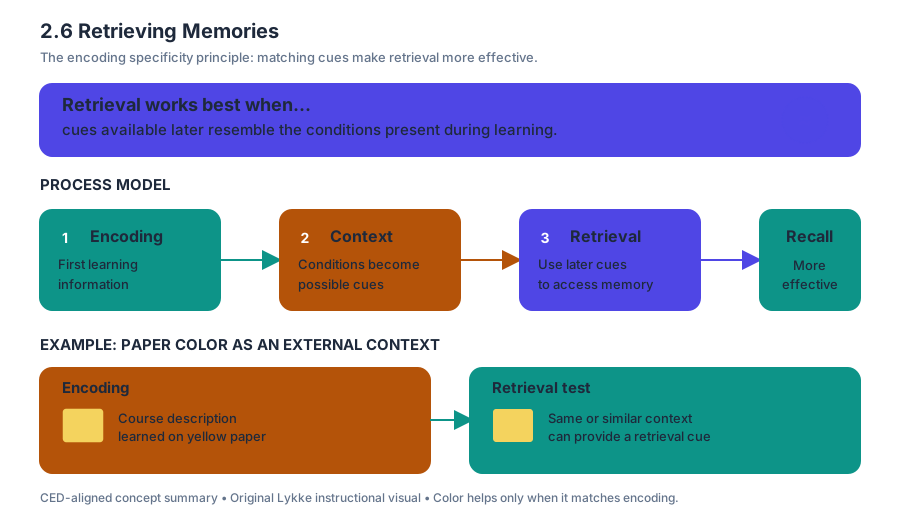
The encoding specificity principle states that retrieval is most effective when the conditions at retrieval match the conditions present during encoding. Encoding is the process of first learning information; retrieval works best when the cues available later resemble the cues present during that original learning.
Imagine learning a course description printed on yellow paper. If the color becomes part of the learning context, seeing the same or a similar context later may provide a retrieval cue. In Professor Gonzalez’s study, the color of the paper represents an external context that could affect later memory performance. The color does not magically improve memory; its usefulness depends on whether it was present during encoding and is also present during retrieval.
Context, state, and mood
Three applications of encoding specificity are easy to confuse:
| Type of memory effect | Matching condition | Concrete application |
|---|---|---|
| Context-dependent memory | External environment or location | Material learned in one classroom is retrieved more easily in that same classroom |
| State-dependent memory | Internal physical or psychological state | Material learned while physically tired may be retrieved more easily in a similar physical state |
| Mood-congruent memory | Current emotional mood | Feeling sad can make other memories formed during sadness easier to retrieve |
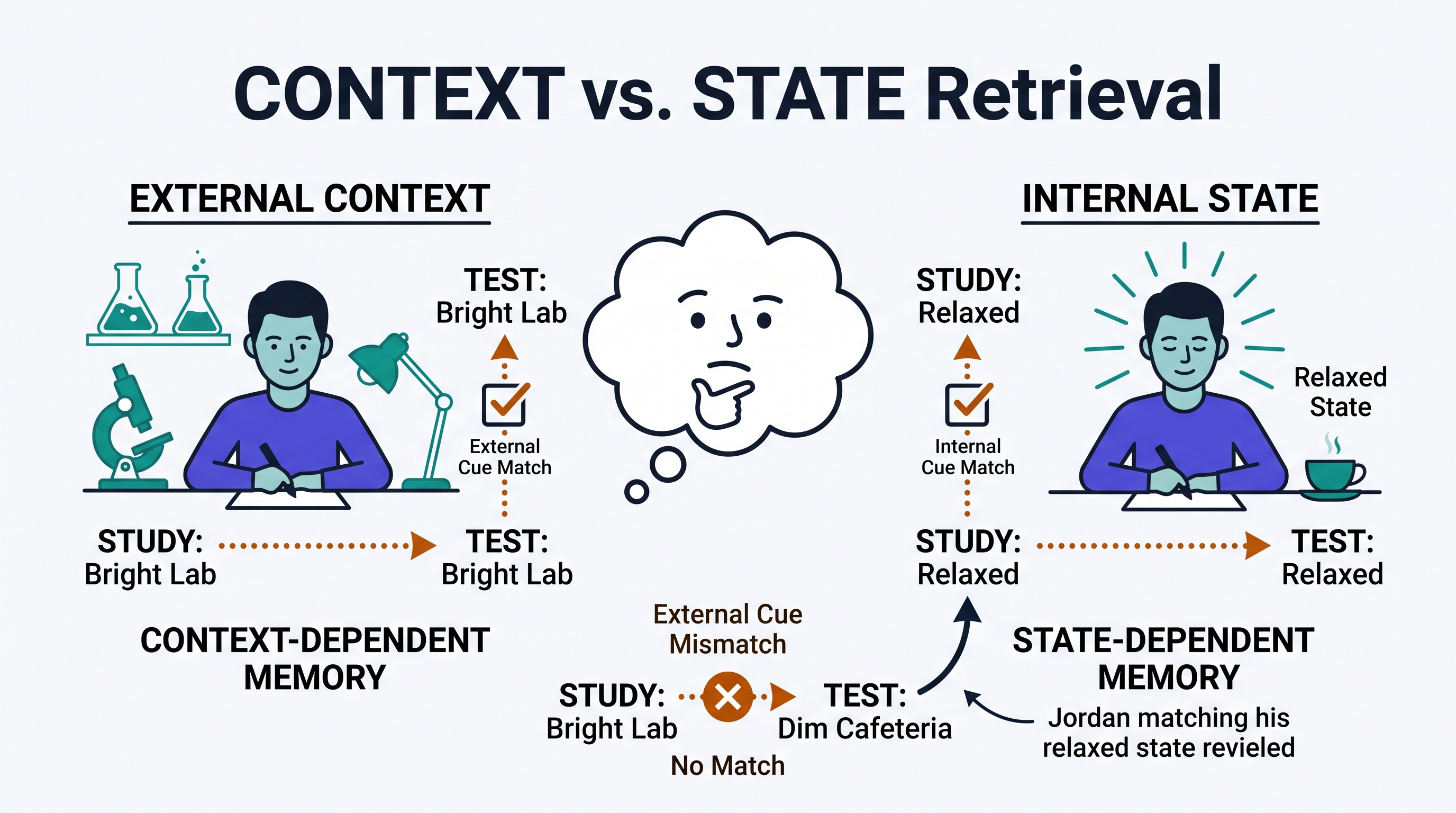
The word context means something external, such as a room, seat, smell, lighting condition, or paper color. A state is internal, such as alertness, fatigue, or another physical or psychological condition. Mood-congruent memory is an application of encoding specificity in which your present mood facilitates retrieval of memories formed in a similar mood.
Worked example — isolating context-dependent memory: Maya studies vocabulary in a quiet library while calm. On quiz day, she remains equally calm but takes the quiz in a noisy gym. She remembers fewer definitions than expected.
The best explanation is context-dependent memory: the external location and surrounding cues at retrieval differ from those present during encoding. Because Maya’s calm internal state stayed constant, state-dependent memory is not the distinguishing explanation.
For an AP-style application, do not merely write, “The context affected her memory.” Connect the concept to the matching or mismatching external cue: “Maya studied in the library but retrieved the information in the gym, so the physical context did not match.”
Improving successful retrieval
The testing effect is the improvement in later memory produced by actively retrieving information, rather than only rereading it. Closing your notes and generating the definition of recognition creates a stronger retrieval opportunity than repeatedly looking at the definition.
Metacognition means monitoring and evaluating your own thinking. You use metacognition when you predict which concepts you know, test that prediction, and change your study plan based on the result. A confident feeling while rereading is not proof that you can retrieve the idea independently.
Science-practice connection: Topic 2.6 develops 1.A, Concept Application, by requiring you to define or describe retrieval concepts and apply them to an unfamiliar situation. It also develops 2.B, Research Methods and Design, when you explain how a study could test whether matching contexts, moods, or physical states improve retrieval.
Exam rule: Name the retrieval concept, identify the matching or mismatching condition, and connect that condition to the person’s performance.
Misconception check
Misconception: “Context-dependent memory means any context, including mood or bodily state.”
Correction: context-dependent memory specifically requires an external environmental cue. If the matching feature is sadness, alertness, fatigue, or another internal condition, the better label is mood-congruent or state-dependent memory.
Retrieval check: Jordan studies a list of terms in a bright laboratory. He is relaxed while studying and remains relaxed during the test, but the test occurs in a dim cafeteria. Which concept best explains why matching his relaxed state does not guarantee improved retrieval?
Answer: Context-dependent memory. Jordan’s internal state matches, but the external context does not: the bright laboratory has changed to a dim cafeteria. The scenario isolates environmental context, so it does not demonstrate state-dependent memory.
Source Materials
- Ap Psychology Course And Exam Description
- Ap Psychology Course At A Glance
- AP Psychology CED: Student Responses and Scoring Commentary
- AP Psychology Exam Questions
- Free-Response Questions
- Free-Response Questions - Set 1
- Free-Response Questions - Set 2
- • State a valid operational definition of the dependent variable in this study. • Identify the control group in this study. • Explain why the study would be considered an experiment. • Explain how the