From the free course AP Psychology on Lykke
1.3 The Neuron and Neural Firing
Key concepts: Neural transmission · Neural firing · Neurotransmitters · Neurotransmitter-specific functions · Neurotransmitter location and effects on behavior and mental processes · Spinal cord reflex arc · Agonists · Antagonists · Reuptake inhibitors · Psychoactive drugs
A neuron communicates by receiving information, firing an electrical signal, and releasing chemical messengers that can alter behavior and mental processes. The process is orderly rather than random: a signal travels through a neuron, crosses a synapse, and influences the next cell.
1.3 The Neuron and Neural Firing
A neuron communicates by receiving information, firing an electrical signal, and releasing chemical messengers that can alter behavior and mental processes. The process is orderly rather than random: a signal travels through a neuron, crosses a synapse, and influences the next cell.
From stimulus to synapse
A neural transmission is the movement of information through the nervous system. When a neuron receives enough stimulation to reach its threshold, it produces an action potential, a brief electrical impulse that travels down the axon. The sequence is often represented as:
$$ \text{resting potential} \rightarrow \text{threshold} \rightarrow \text{depolarization} \rightarrow \text{repolarization} \rightarrow \text{refractory period} $$
During the resting potential, the neuron is ready but not firing. If incoming signals push it to threshold, depolarization rapidly changes the electrical charge across the membrane. Repolarization restores the membrane toward its resting state, and the refractory period briefly limits another action potential. This all-or-none firing means that a neuron either fires fully or does not fire; stronger stimulation generally increases firing rate, not the size of each action potential.
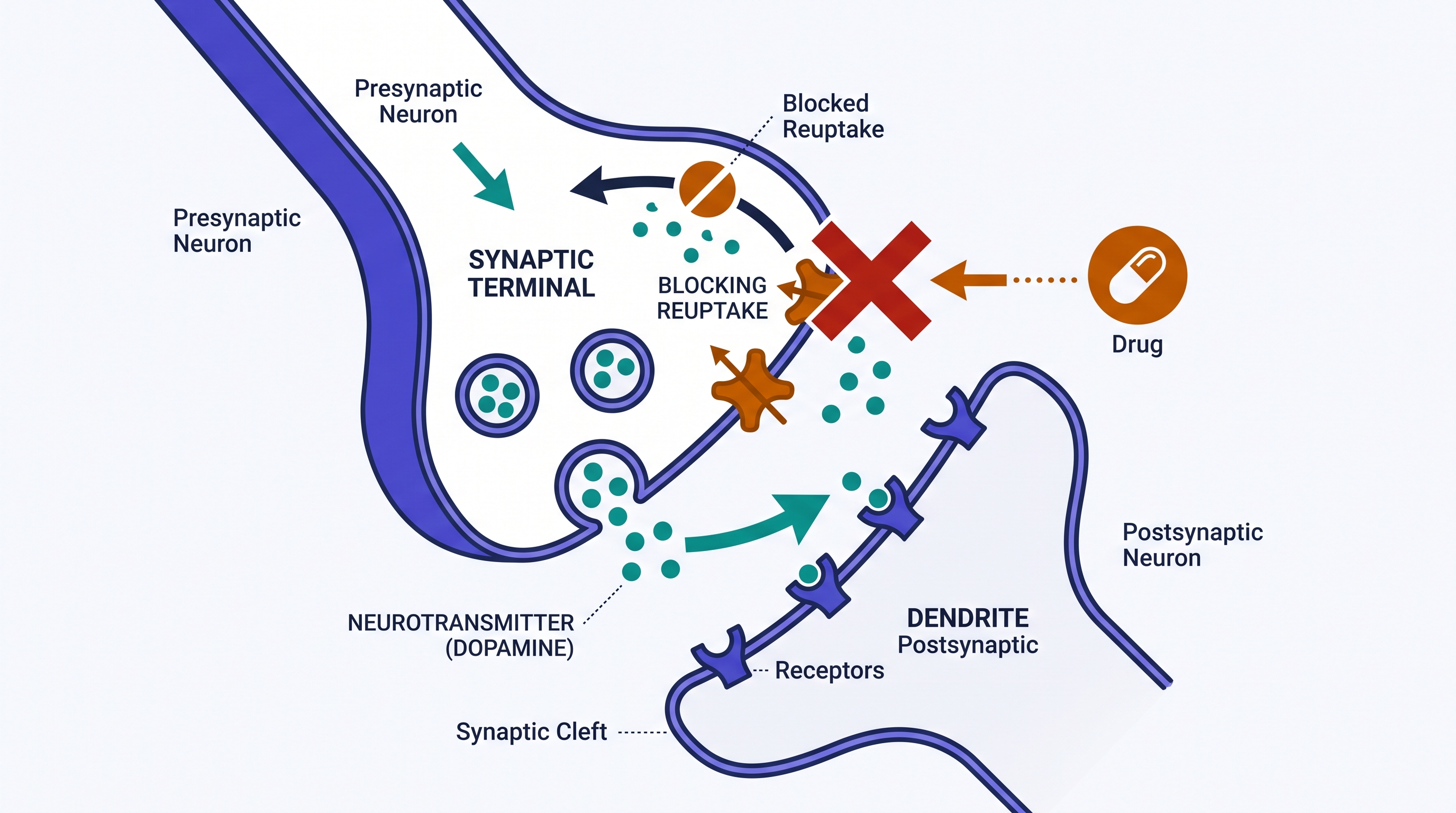
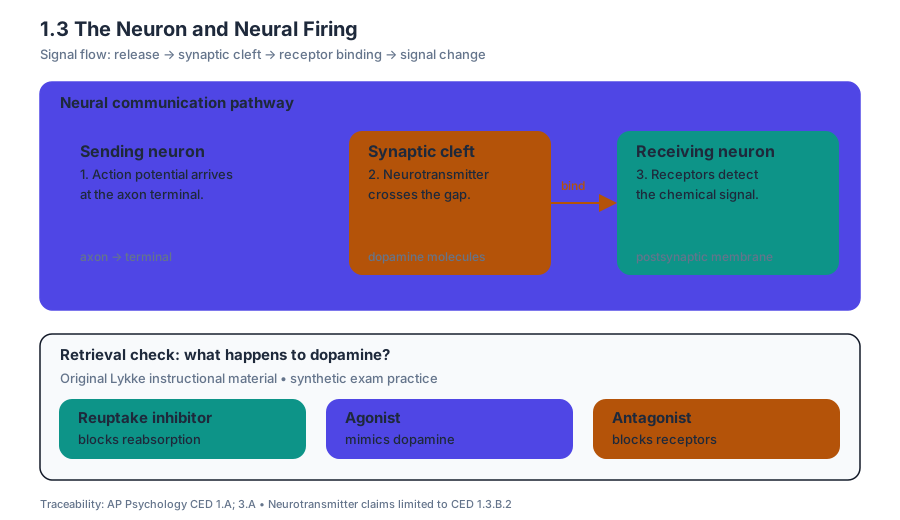
At the axon terminal, the electrical signal triggers the release of neurotransmitters into the synaptic gap. These chemicals bind to receptors on a receiving neuron, muscle, or gland. Their effects depend on the neurotransmitter, receptor, and location, so the same chemical cannot be assigned one universal psychological effect. Neural transmission therefore connects cellular events to mental processes such as attention, mood, movement, pain, and motivation (1.3.A.1; 1.3.B.1).
The spinal cord reflex arc
A spinal cord reflex arc shows neural firing in action without requiring the brain to make the first response. Touching a hot surface activates sensory receptors; a sensory neuron carries the signal into the spinal cord; an interneuron relays it; and a motor neuron activates muscles that withdraw the hand. The peripheral sensory and motor pathways connect with central processing in the spinal cord, producing a rapid protective response. The brain receives information as well, allowing you to experience the pain and learn from the event (1.3.A.2).
Worked example: You step on a sharp object. The sensory signal enters the spinal cord, an interneuron helps organize the response, and motor neurons contract the leg muscles. The speed of withdrawal is the behavioral consequence of the reflex arc; the later conscious experience of pain involves additional neural processing.
Neurotransmitters: function depends on location
The AP Psychology neurotransmitters named in Essential Knowledge 1.3.B.2 are dopamine, serotonin, norepinephrine, glutamate, GABA, endorphins, substance P, and acetylcholine. Their functions are associated with behavior and mental processes, but location matters.
| Neurotransmitter | Concrete location or pathway | Associated effect |
|---|---|---|
| Acetylcholine | Neuromuscular junctions; brain attention circuits | Muscle contraction; attention and memory processes |
| Substance P | Pain pathways in the spinal cord and brain | Carries pain-related signals and can increase pain experience |
| Endorphins | Brain and spinal pain-modulation pathways | Reduces pain perception |
| Dopamine | Movement and reward-related circuits | Influences movement, motivation, and reinforcement |
| Serotonin | Brain circuits involved in mood and regulation | Influences mood and other mental processes |
| Norepinephrine | Arousal and attention systems | Supports alertness and attention |
| Glutamate | Widespread excitatory brain signaling | Promotes neural communication and learning-related activity |
| GABA | Widespread inhibitory brain signaling | Reduces neural activity |
The location qualification is essential. Acetylcholine released at a neuromuscular junction helps produce skeletal-muscle contraction, while acetylcholine in brain circuits contributes to attention and memory. Substance P in pain pathways can increase pain signaling, whereas endorphins can reduce the experience of pain. A neurotransmitter’s effect is therefore not a simple label such as “good,” “bad,” “exciting,” or “calming.”
Psychoactive drugs
Psychoactive drugs influence behavior and mental processes by changing neurotransmitter function somewhere in neural communication. An agonist mimics or enhances a neurotransmitter’s action. An antagonist blocks or reduces that action. A reuptake inhibitor blocks the sending neuron from reabsorbing released neurotransmitters, leaving more of them in the synaptic gap for a longer time (1.3.C.1).
Do not assume that an agonist always increases firing or that an antagonist always decreases it. If a neurotransmitter normally inhibits a receiving neuron, an agonist may strengthen inhibition and reduce firing; an antagonist may remove that inhibition and increase firing. The receptor and neurotransmitter determine the result.
Misconception check: “An antagonist is a stimulant because it opposes inhibition.” Not necessarily. An antagonist opposes a neurotransmitter’s action; the resulting behavior depends on whether that neurotransmitter normally excites or inhibits the target cell.
Retrieval check
A fictional drug prevents dopamine molecules from being taken back into the sending neuron after release. Is it an agonist, antagonist, or reuptake inhibitor? Answer: It is a reuptake inhibitor because it blocks reabsorption. If a drug instead mimicked dopamine, it would be an agonist; if it blocked dopamine receptors, it would be an antagonist. For AP exam purposes, limit neurotransmitter claims to the eight chemicals listed in 1.3.B.2 (1.A; 3.A).