From the free course AP Psychology on Lykke
4.1 Attribution Theory and Person Perception
Key concepts: Attribution theory · Dispositional attribution · Situational attribution · Explanatory style · Fundamental attribution error · Actor-observer bias · In-group bias · Person perception
When a classmate arrives late, you may think, “They are careless,” while the classmate thinks, “The bus broke down.” Attribution theory examines these explanations: how people make sense of their own and others’ behavior and mental processes.
4.1 Attribution Theory and Person Perception
When a classmate arrives late, you may think, “They are careless,” while the classmate thinks, “The bus broke down.” Attribution theory examines these explanations: how people make sense of their own and others’ behavior and mental processes.
Internal and external explanations
A dispositional attribution explains behavior through an internal quality, such as intelligence, personality, effort, or kindness. A situational attribution explains behavior through external circumstances or conditions the person experienced.
| Attribution | Main question | Example |
|---|---|---|
| Dispositional | “What is this person like?” | “Maya won because she is highly intelligent.” |
| Situational | “What happened around this person?” | “Maya won because she had extra time to prepare.” |
This distinction matters because the explanation you choose changes how you respond. If you interpret a missed deadline as laziness, you may punish or avoid the person. If you interpret it as the result of illness or an unclear instruction, you may offer support instead.
A related idea is locus of control, the degree to which you believe outcomes are controlled by your own actions. With an internal locus of control, you might say, “My practice improved my score.” With an external locus of control, you might say, “The test was easy for everyone, so my score had little to do with me.” Locus of control describes a person’s general belief about control; an attribution explains a particular event.
Explanatory style
Explanatory style is a predictable pattern in how someone explains good and bad events in their own life and in the lives of others (4.1.A.2). An optimistic style tends to explain setbacks as temporary or specific and successes as connected to lasting personal qualities. A pessimistic style tends to explain setbacks as lasting, widespread, and personally rooted.
Imagine that Jordan performs poorly on one debate. An optimistic explanation might be, “I was exhausted today, but I can improve with practice.” A pessimistic explanation might be, “I am bad at debating, and I always fail.” These explanations are not simply descriptions; they can influence persistence, emotion, and future behavior.
Attribution biases
People do not always explain behavior evenly. Actor-observer bias occurs when you explain your own behavior mainly through the situation but explain another person’s similar behavior through that person’s disposition. The fundamental attribution error is the tendency to overemphasize dispositional causes when explaining another person’s behavior while underestimating situational causes. Self-serving bias is the tendency to credit personal qualities for success but blame circumstances for failure.
Worked example: Jordan wins a debate after receiving several days to prepare. Jordan says, “I won because I had time to prepare,” making a situational attribution. Her teammates say, “She won because she is intelligent,” making a dispositional attribution. The actor-versus-observer difference illustrates actor-observer bias; the teammates’ emphasis on Jordan’s ability, without considering preparation time, illustrates the fundamental attribution error. If Jordan later says, “I passed because I am talented, but I failed the next quiz because the questions were unfair,” the success-versus-failure pattern illustrates self-serving bias.
Misconception check: Actor-observer bias and the fundamental attribution error are not identical. Actor-observer bias requires a comparison between the actor’s explanation and observers’ explanations of the same behavior. The fundamental attribution error refers specifically to an observer’s tendency to overattribute another person’s behavior to personality or ability.
Person perception and group membership
Person perception is the process of forming impressions and judgments about other people. Those judgments can affect helping behavior. In-group bias occurs when people favor or respond more positively to members of their own social group.
Suppose two people witness someone drop a backpack. If one onlooker is identified as a member of your school, team, language community, or other in-group, you may be more likely to approach that onlooker or coordinate help with them. The mechanism is not that group membership proves the person is more trustworthy; rather, perceived shared identity can shape attention, interpretation, and willingness to help.
How to write a strong application
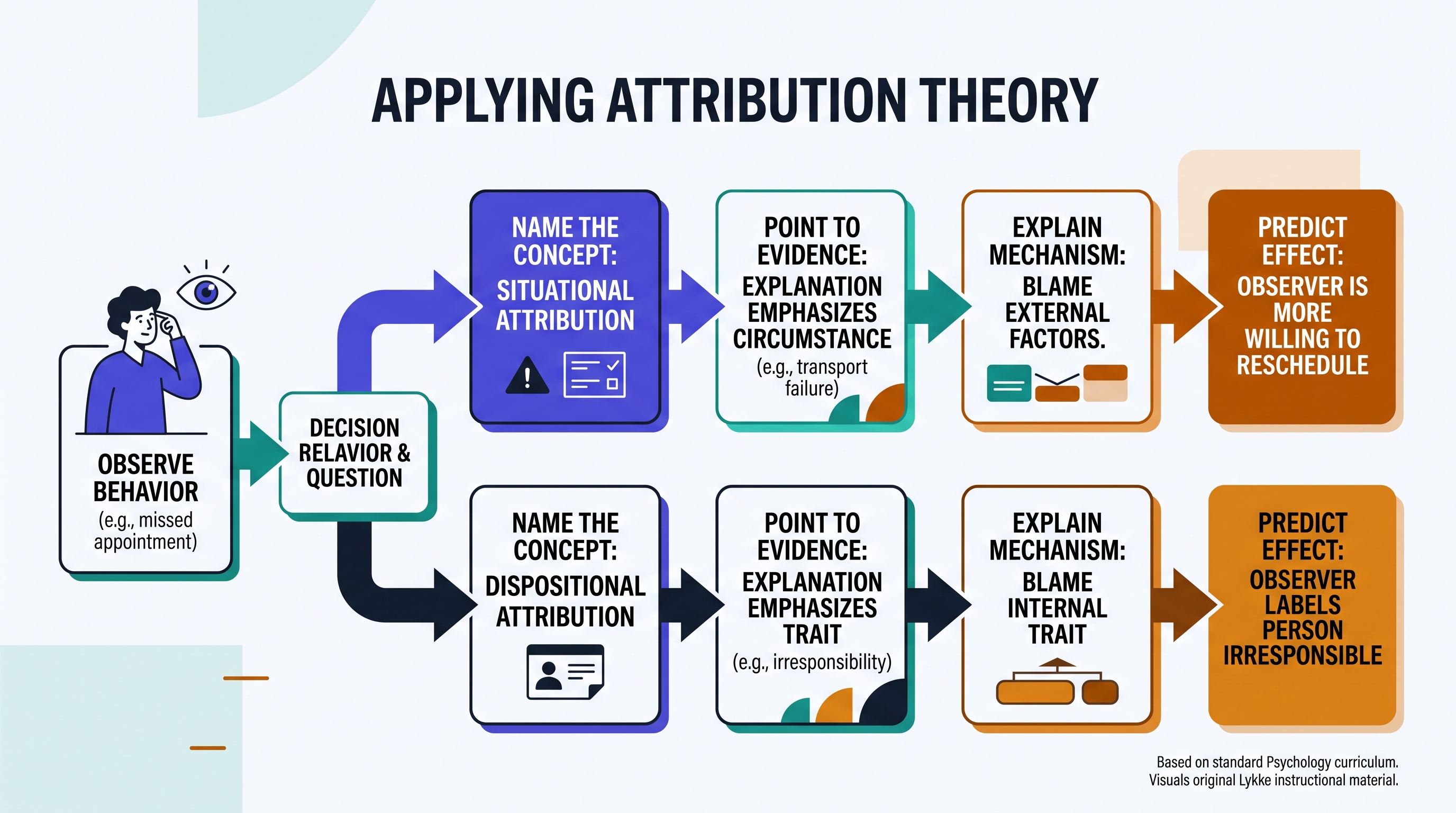
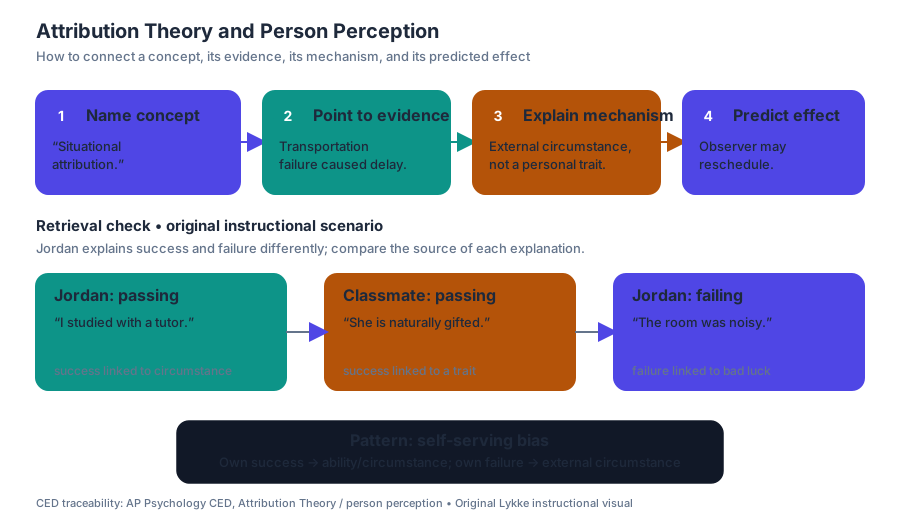
A strong application does more than name a term. It connects the term, its mechanism, and the exact behavior in the scenario:
- Name the concept: “This is a situational attribution.”
- Point to the evidence: “The person explains the missed appointment by describing a transportation failure.”
- Explain the mechanism: “The explanation emphasizes an external circumstance rather than a personal trait.”
- Predict the effect: “The observer may be more willing to reschedule than to label the person irresponsible.”
Retrieval check: Jordan says she passed because she studied with a tutor, while a classmate says she passed because she is naturally gifted. Jordan later says she failed because the room was noisy. What pattern appears?
Answer: Jordan makes a situational attribution for passing, while the classmate makes a dispositional attribution. Jordan’s pattern of explaining success through personal ability but failure through bad luck illustrates self-serving bias.
Source Materials
- Ap Psychology Course And Exam Description
- Ap Psychology Course At A Glance
- AP Psychology CED: Student Responses and Scoring Commentary
- AP Psychology Exam Questions
- Free-Response Questions
- Free-Response Questions - Set 1
- Free-Response Questions - Set 2
- AP Psychology Course — AP Central
- AP Psychology — AP Students
- Khan Academy — AP Psychology
- AP Psychology Units — Save My Exams
- AP Psychology Study Guides — Fiveable