From the free course AP Psychology on Lykke
4.5 Social-Cognitive and Trait Theories of Personality
Key concepts: Social-cognitive theories of personality · Trait theories of personality · Self-concept · Self-efficacy · Self-esteem · The Big Five theory of personality · Agreeableness · Personality inventories · Factor analysis · Determinism
Your personality is not only a private collection of qualities; it also reflects how you interpret yourself, how capable you believe you are, and how you respond repeatedly to situations.
4.5 Social-Cognitive and Trait Theories of Personality
Your personality is not only a private collection of qualities; it also reflects how you interpret yourself, how capable you believe you are, and how you respond repeatedly to situations. Two major approaches capture this idea differently: social-cognitive theories emphasize interaction among the person, behavior, and environment, while trait theories emphasize relatively enduring characteristics that produce typical responses to stimuli.
Social-cognitive theories: personality in motion
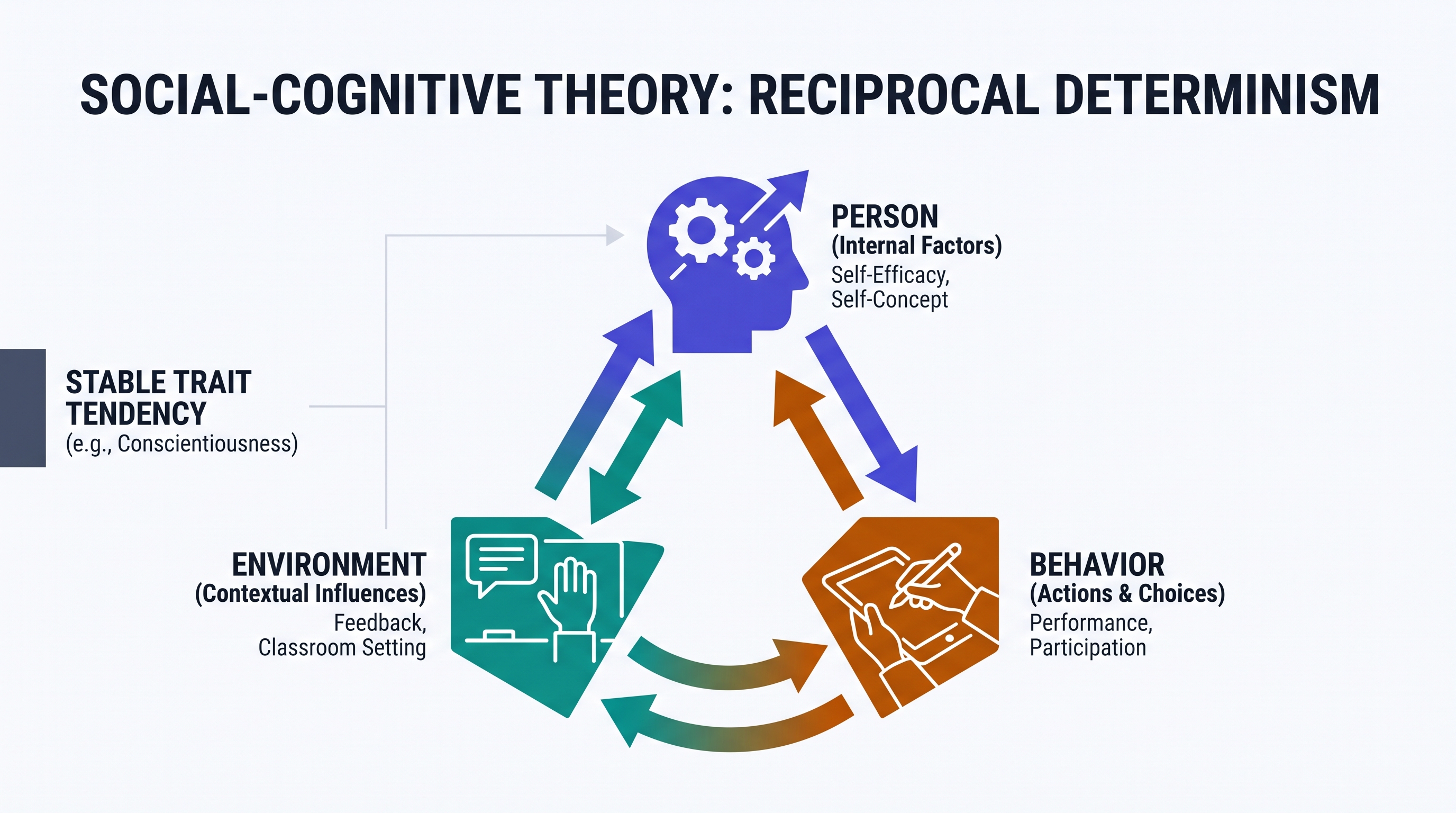
According to social-cognitive theory, personality develops through reciprocal determinism: your personal characteristics, your behavior, and your environment continually influence one another. You do not simply receive the effects of your surroundings, and your traits do not operate independently of situations. Your actions can change your environment, while that changed environment can influence what you do next. This is the central idea in 4.5.A.1.
Self-concept means how you view yourself and how you understand yourself in relation to other people. It may include descriptions such as “I am a careful planner,” “I am a supportive friend,” or “I find unfamiliar groups difficult.” Two important parts of self-concept are self-efficacy and self-esteem, but they are not interchangeable.
| Concept | Core question | Example |
|---|---|---|
| Self-efficacy | “Can I perform this particular task?” | “I can explain this data graph if I work through it carefully.” |
| Self-esteem | “How do I evaluate my own worth or value?” | “I feel that I am a worthwhile person, even when I make mistakes.” |
| Self-concept | “How do I understand myself overall and in relation to others?” | “I see myself as a persistent learner and a dependable teammate.” |
Self-efficacy is therefore task-specific confidence in your ability to succeed, whereas self-esteem is a broader evaluation of your worth. A person may have high self-esteem but low self-efficacy for public speaking, or strong self-efficacy in mathematics but low self-esteem after repeated criticism. Both beliefs contribute to self-concept, as required by 4.5.A.1.
Worked application: reciprocal determinism
Mina believes she can contribute useful ideas during science meetings, so she volunteers to present (self-efficacy). Her classmates respond positively, and the teacher gives her more opportunities to lead. Those experiences strengthen her view of herself as a capable collaborator (self-concept), which makes her more likely to volunteer again. Her behavior changed the environment, and the environment then reinforced her personal beliefs and future behavior. This is reciprocal determinism—not a one-way effect of personality on action.
A common misconception is: “Self-efficacy and self-esteem both mean confidence.” The correction is precise: self-efficacy concerns confidence in performing a particular behavior; self-esteem concerns general self-evaluation. Another error is assuming that social-cognitive theory treats behavior as fixed. Instead, behavior can vary because the person and situation continually affect each other.
Trait theories: personality as enduring patterns
Trait theories of personality conclude that personality involves a set of enduring characteristics that lead to typical responses to stimuli (4.5.B.1). A trait does not guarantee a behavior every time. Instead, it describes a tendency: a highly conscientious person is more likely to organize materials and meet deadlines, although that person may still occasionally forget an assignment.
The Big Five theory of personality describes five broad trait dimensions (4.5.B.2):
- Agreeableness: tendency toward cooperation, trust, and concern for others.
- Openness to experience: tendency toward curiosity, imagination, and receptiveness to new ideas.
- Extraversion: tendency toward sociability, activity, and positive engagement with others.
- Conscientiousness: tendency toward organization, responsibility, and persistence.
- Emotional stability: tendency to remain relatively calm and resilient rather than experiencing frequent emotional instability.
Personality inventories assess traits by asking people to respond to many items, such as statements about preferences, habits, or typical reactions. Factor analysis is a statistical method used to organize patterns in those item responses. If people who endorse one group of items tend to respond similarly across many participants, the items may be grouped as measuring a common underlying factor, such as agreeableness or conscientiousness. The inventory does not read a person’s mind; it estimates trait patterns from responses.
Applying both perspectives
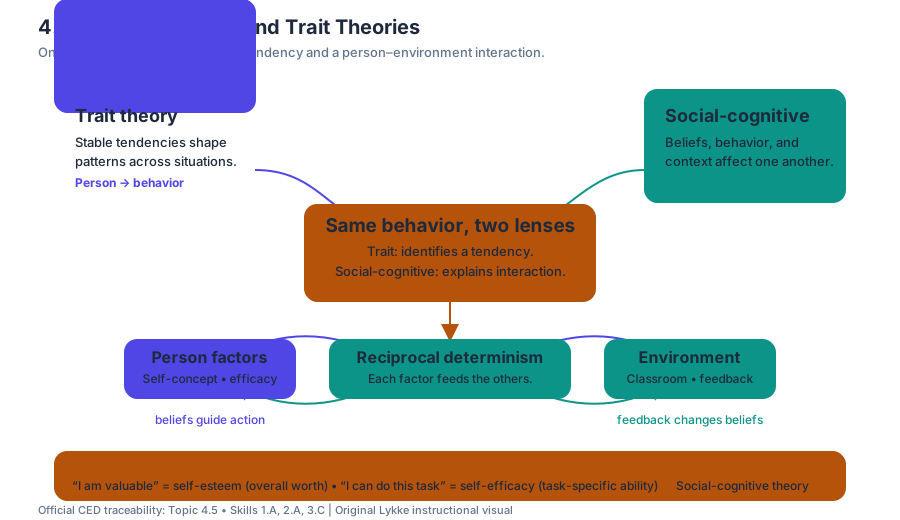
Suppose Jordan regularly arrives early, keeps detailed project notes, and checks work before submitting it. A trait theorist might describe Jordan as high in conscientiousness, an enduring characteristic associated with typical organized responses. A social-cognitive theorist might ask how Jordan’s self-concept, self-efficacy, past feedback, and classroom environment shaped those behaviors. The two explanations can coexist: one identifies a stable tendency, while the other explains how behavior and context interact.
For Science Practice 1, Skill 1.A, apply the theory named in the scenario rather than merely labeling the behavior. For Skill 2.A, if a study gives one group a personality inventory and another group a different inventory without randomly assigning participants, identify the design from the procedures—not from the topic. For Skill 3.C, interpret a profile or graph by describing the pattern of scores and avoiding unsupported claims that one high score determines the whole personality.
Retrieval check: A student says, “I am valuable, so I will definitely succeed at every task.” Which distinction is missing, and which theory could explain how classroom feedback changes the student’s future behavior?
Answer: The statement confuses self-esteem with self-efficacy. Self-esteem concerns overall self-worth, whereas self-efficacy concerns ability in a particular task. Social-cognitive theory explains how feedback from the environment can interact with the student’s beliefs and behavior through reciprocal determinism.