From the free course AP Psychology on Lykke
4.2 Attitude Formation and Attitude Change
Key concepts: Stereotypes and implicit attitudes · Prejudice and discrimination · Belief perseverance · Confirmation bias · Cognitive dissonance · Attitude formation and attitude change · Persuasion · Peripheral route to persuasion · False consensus effect · Just-world phenomenon, out-group homogeneity bias, in-group bias, and ethnocentrism
An attitude is a learned evaluation—a relatively positive or negative way of thinking and feeling about a person, group, object, idea, or action. You can develop an attitude through direct experience, observation and social influence, repeated messages, and emotional associations.
4.2 Attitude Formation and Attitude Change
An attitude is a learned evaluation—a relatively positive or negative way of thinking and feeling about a person, group, object, idea, or action. You can develop an attitude through direct experience, observation and social influence, repeated messages, and emotional associations. For example, a student who receives encouragement while playing music may form a positive attitude toward practice; friends who ridicule the activity may weaken it; a joyful song associated with a brand may create a favorable reaction to that brand.
How attitudes form: learning, experience, and association
Attitudes do not appear from one source alone. Direct experience gives you personally relevant evidence, while parents, peers, media, cultural norms, and institutions provide social information. Classical conditioning can attach an emotion to an object or group—for example, a product repeatedly paired with upbeat music may acquire a positive association. Observational learning can also shape attitudes when you notice which opinions respected people express or reward.
Essential Knowledge 4.2.A.1 defines a stereotype as a generalized concept about a group. A stereotype can reduce cognitive load, meaning it offers a quick mental shortcut when you make a judgment. The shortcut may be efficient, but it can also be inaccurate and become the cause or result of biased perceptions and experiences.
A stereotype is a belief or generalization; prejudice is a prejudiced attitude or negative evaluation; discrimination is behavior that treats people differently because of group membership. They can influence one another, but they are not identical. A person may know a stereotype without endorsing it, hold a prejudiced attitude without acting on it, or discriminate through a policy even when the decision-maker does not report personal hostility.
Essential Knowledge 4.2.A.2 describes implicit attitudes as attitudes you hold without being aware of them or without acknowledging them. They may influence attention, interpretation, or quick judgments even when your explicit beliefs—the attitudes you consciously report—are egalitarian. An implicit attitude is not proof that a person consciously endorses prejudice, and one reaction or test result cannot establish a complete account of someone’s behavior.
Several social-cognitive patterns can support biased attitudes and discriminatory behavior:
| Pattern | What it means | How it can affect attitudes |
|---|---|---|
| Just-world phenomenon | Believing that people generally get what they deserve | You may blame someone for misfortune rather than examine situational causes |
| Out-group homogeneity bias | Seeing members of another group as more alike than they really are | “They are all the same” makes individual differences harder to notice |
| In-group bias | Favoring members of your own group | You may evaluate comparable behavior more positively within your group |
| Ethnocentrism | Evaluating other cultures by the standards of your own culture | You may treat unfamiliar practices as inferior rather than culturally different |
Original instructional scenario: A hiring committee remembers one applicant from a familiar community as “well rounded” but describes applicants from an unfamiliar community using one shared label. The second judgment illustrates out-group homogeneity bias. If the committee then rejects comparable applicants because of that generalized evaluation, the attitude has contributed to discriminatory behavior.
Why beliefs resist change
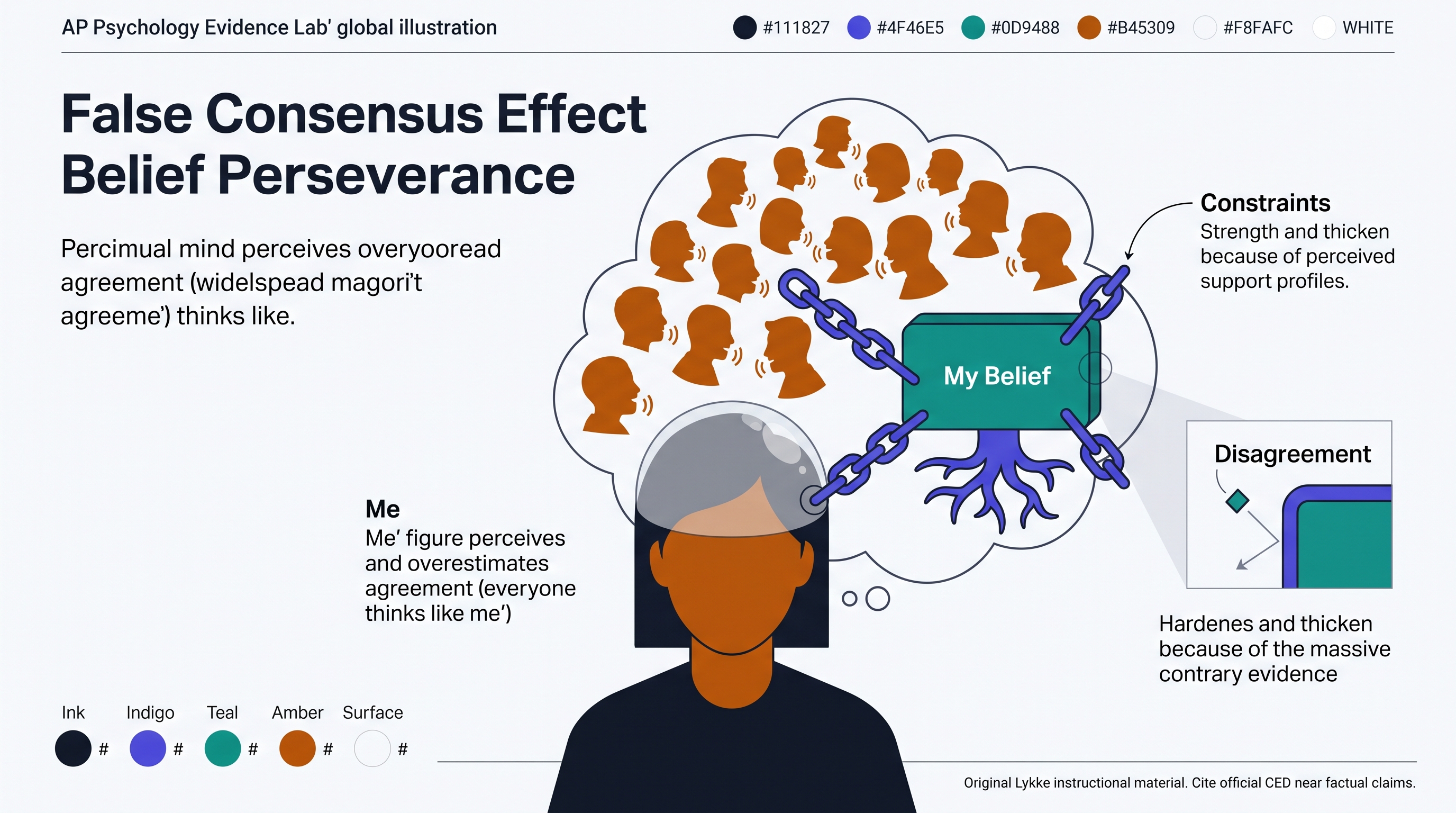
Essential Knowledge 4.2.B.1 defines belief perseverance as the persistence of a belief even when evidence suggests that the belief is inaccurate. Once a belief is established, confirmation bias can protect it: you focus on information that supports the belief, interpret ambiguous evidence in its favor, and discount opposing evidence.
Suppose Maya believes that a particular study method always improves performance. She remembers the exam after which her score rose, but ignores two exams after which it did not. Her belief perseveres because confirmation bias selectively keeps supportive evidence visible. The error is not simply “having a stereotype” or “being confident”; it is maintaining a belief despite relevant contradictory evidence.
Misconception check: Confirmation bias does not mean that people never encounter opposing evidence. It means that their attention, interpretation, or memory can favor evidence consistent with an existing belief.
Cognitive dissonance and attitude change
Essential Knowledge 4.2.B.2 defines cognitive dissonance as mental discomfort produced when actions and attitudes conflict. Because inconsistency feels uncomfortable, you may reduce dissonance by changing your behavior, changing your attitude, or adding an explanation that makes the conflict seem smaller.
For example, Jordan publicly supports environmental conservation but repeatedly buys a heavily wasteful product. Jordan might reduce dissonance by switching products, revising the attitude (“individual choices do not matter much”), or rationalizing the behavior (“the packaging is necessary”). Dissonance can therefore change an attitude, but it does not guarantee that the new attitude is more accurate.
Persuasion: changing attitudes through different routes
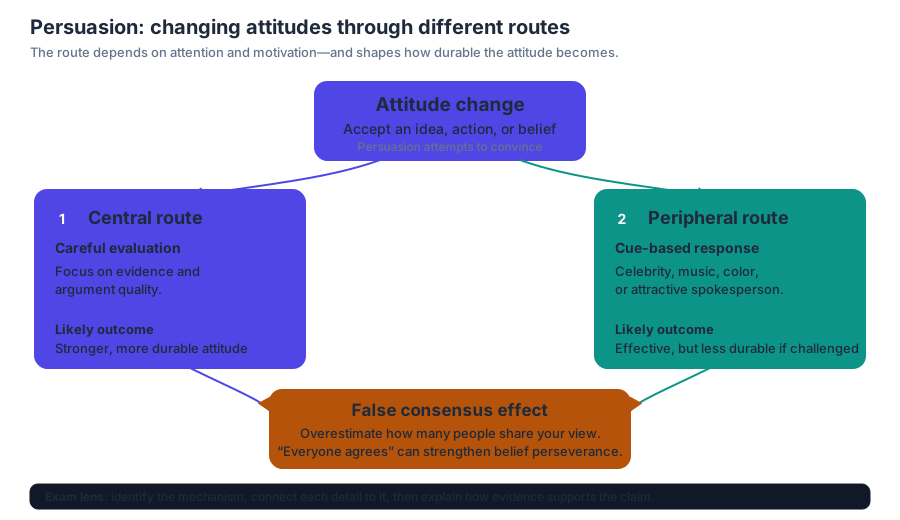
Persuasion is an attempt to convince yourself or another person to accept a particular idea, action, or belief. The central route relies on careful attention to the quality and strength of the argument. The peripheral route relies on cues such as attractive spokespeople, celebrities, bright colors, or music to create positive associations rather than on the argument’s evidence.
A detailed comparison of two advertisements makes the distinction visible: one changes an attitude because its evidence is strong and relevant; the other creates a favorable feeling through a celebrity and upbeat music. Peripheral persuasion may be effective when attention or motivation is low, but attitudes formed primarily through peripheral cues may be less durable when challenged.
The false consensus effect is the tendency to overestimate how many other people share your opinions or preferences. It can strengthen belief perseverance: if you assume “everyone agrees,” disagreement may seem unusual or uninformed, making you less willing to examine contrary evidence.
Science Practice 1, Skill 1.A—Apply psychological concepts to a scenario: identify the mechanism that best explains the attitude or behavior, then connect each detail of the scenario to that mechanism. Science Practice 2, Skill 2.B—Explain how evidence supports a psychological claim: distinguish a claim about attitude change from evidence merely showing that two attitudes are associated.
Retrieval check: A person continues believing a rumor after reliable corrections, reads only posts that support it, and assumes most people agree. Name the primary process and the reinforcing bias. Answer: The primary process is belief perseverance; selective attention to supportive posts is confirmation bias, and the assumption that most people agree reflects the false consensus effect.