From the free course AP Psychology on Lykke
1.5 Sleep
Key concepts: Consciousness · Sleep and wakefulness · Circadian rhythm and sleep/wake cycle · NREM sleep stages · REM sleep · REM rebound · Dream theories · Memory consolidation · Sleep disorders · Effects of sleep disruption on waking behavior and health
Sleep is not the opposite of consciousness; it is one form of consciousness, alongside wakefulness. Your brain remains active during sleep, but its patterns of activity, responsiveness, and control of the body change across the night.
1.5 Sleep
Sleep is not the opposite of consciousness; it is one form of consciousness, alongside wakefulness. Your brain remains active during sleep, but its patterns of activity, responsiveness, and control of the body change across the night.
The circadian sleep/wake cycle
A circadian rhythm is a roughly $24$-hour biological cycle that coordinates changes in alertness, body functions, and sleepiness. The sleep/wake cycle is therefore not simply a decision to “turn off” at bedtime: it is a repeating biological pattern that affects attention, mood, memory, reaction time, and physical performance throughout the day and night.
Light exposure, daily routines, and social schedules help synchronize this rhythm with the outside world. When your internal timing and the local schedule disagree, jet lag can occur: after rapid travel across time zones, you may feel sleepy during the day or alert at night because your circadian rhythm has not yet adjusted. Shift work can create a similar mismatch when work requires wakefulness at night and sleep during daylight.
Misconception check — “Being tired means the body simply needs more willpower.” Fatigue can reflect a circadian signal that promotes sleep at a biologically inappropriate time. Effort may temporarily maintain performance, but it does not instantly reset the underlying rhythm.
How sleep stages are identified
Researchers identify sleep stages primarily through patterns recorded by an electroencephalogram, or EEG, which measures electrical activity in the brain. A night is not one uniform state. You cycle through non-rapid-eye-movement sleep, called NREM sleep, and rapid-eye-movement sleep, called REM sleep, several times.
NREM sleep: Stages 1 through 3
NREM sleep includes Stages 1, 2, and 3, moving generally from lighter to deeper sleep. Stage 1 is the transition from wakefulness into sleep. You may experience hypnagogic sensations, such as feeling that you are falling or hearing a brief imagined sound, as waking awareness loosens its grip.
Stage 2 is more stable sleep. Stage 3 is the deepest NREM stage and is especially difficult to interrupt. Across the night, the amount of time spent in NREM sleep typically decreases, so early cycles contain more deep NREM sleep than later cycles.
REM sleep: an active brain and a relaxed body
During REM sleep, EEG activity becomes relatively active, while most of the body’s large skeletal muscles remain relaxed. This combination makes REM sleep “paradoxical”: the brain appears active, but the body is largely prevented from carrying out the movements represented in dreams. Dreaming is especially associated with REM sleep, although dreamlike experiences can occur at other times as well.
REM periods typically become longer and occur more frequently as the night progresses. If REM sleep is repeatedly interrupted, the body may later spend extra time in REM sleep, a pattern called REM rebound. For example, after substantial REM deprivation, a person may enter REM sleep sooner or experience longer REM periods during recovery.
Why do we dream, and why do we sleep?
The activation-synthesis theory proposes that dreams emerge when the brain attempts to organize and interpret internally generated neural activity during sleep. In this view, the brain supplies a narrative structure to activation that may not have begun as a deliberate story.
The consolidation theory of dreaming emphasizes the relationship between dreaming and memory. Sleep may help organize and strengthen information encountered during the day, making some experiences more stable and easier to retrieve later. These theories address the structure and function of dreams; they do not require dreams to be hidden symbolic messages.
Two broader theories of sleep emphasize memory consolidation and restoration. Consolidation treats sleep as a period in which memories are organized and strengthened. Restoration treats sleep as a time for replenishing physical and mental resources depleted during waking activity. These explanations can work together: sleep may support both learning and recovery.
When sleep is disrupted
Sleep disruption can impair waking attention, learning, emotional regulation, physical performance, and overall health. For instance, repeated interruptions in breathing during sleep can fragment the sleep cycle and leave a person impaired during the day, even if the person does not remember waking. Persistent difficulty sleeping, sudden sleep episodes, sleepwalking, or acting out dream movements are other examples of patterns that can disturb healthy sleep and waking behavior.
A useful causal chain is:
circadian timing or sleep disruption $\rightarrow$ altered sleep stages or reduced sleep quality $\rightarrow$ poorer restoration and memory organization $\rightarrow$ changes in daytime behavior and mental processes
Retrieval check
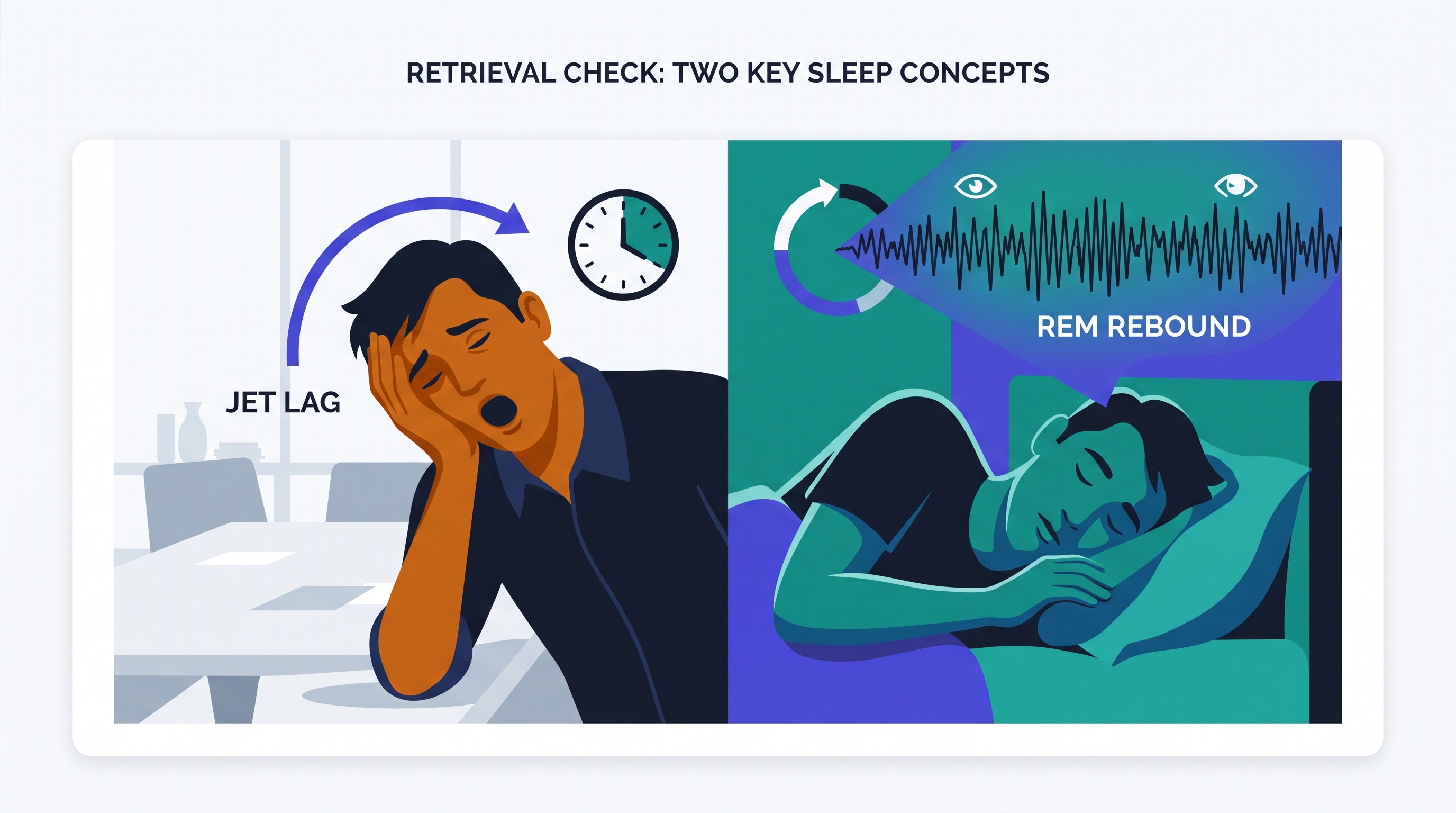
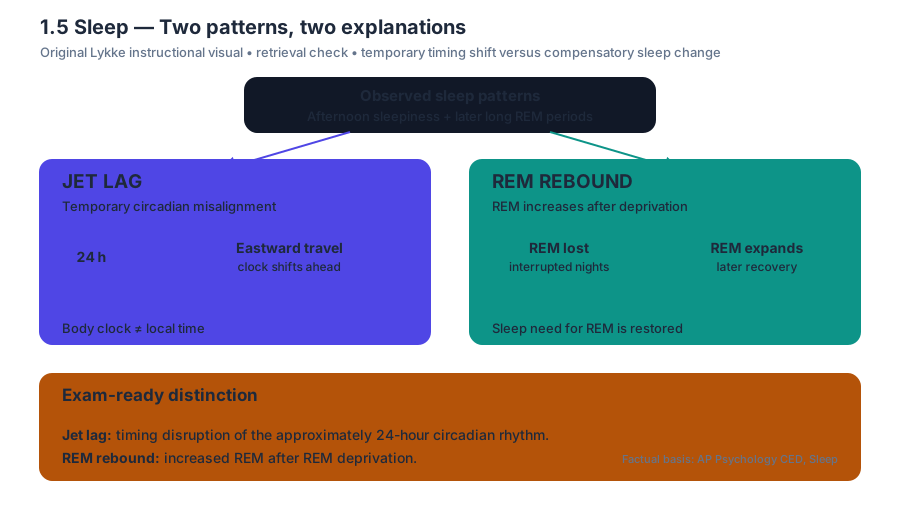
A person flies east across several time zones and feels sleepy during afternoon meetings. After several nights of interrupted REM sleep, the person later shows unusually long REM periods. What two concepts explain these observations?
Answer: The daytime sleepiness reflects jet lag, a temporary disruption of the approximately $24$-hour circadian sleep/wake rhythm. The unusually long later REM periods illustrate REM rebound, in which REM sleep increases after REM deprivation.