From the free course AP Psychology on Lykke
P.2 Multiple-Choice Method: Scenario, Concept, Elimination, Verification
Key concepts: Scenario-based multiple-choice reasoning · Concept identification and application · Answer-choice elimination · Verification of selected answers · Research ethics and protection from harm · Confidentiality and anonymity · Deception and research confederates · Debriefing participants · Statistical significance · Evaluative social presence and vigilance
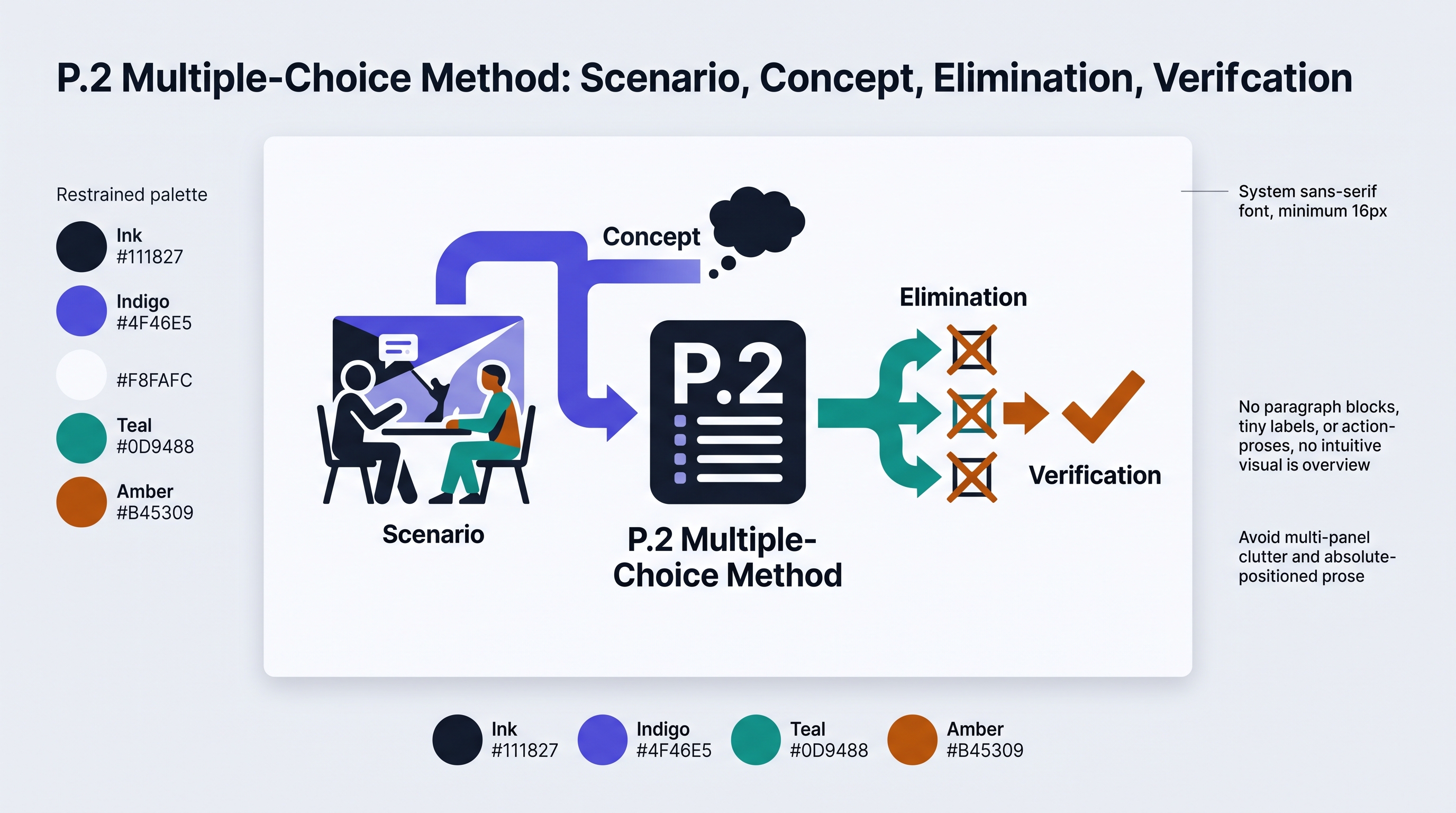
A strong multiple-choice answer is not a lucky guess; it is a four-step evidence chain: Scenario → Concept → Elimination → Verification. You first identify what the vignette actually says, then name the psychological idea being tested, remove choices that contradict the evidence, and finally verify that the…
P.2 Multiple-Choice Method: Scenario, Concept, Elimination, Verification
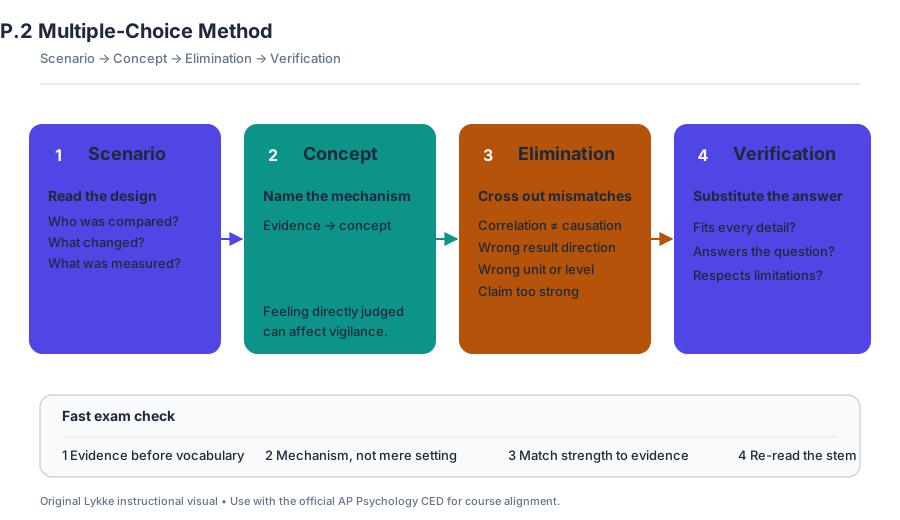
A strong multiple-choice answer is not a lucky guess; it is a four-step evidence chain: Scenario → Concept → Elimination → Verification. You first identify what the vignette actually says, then name the psychological idea being tested, remove choices that contradict the evidence, and finally verify that the remaining choice answers the precise question asked.
The four-step method
1. Scenario: Read for the research design, participants, procedure, measured outcome, and result. Do not begin by hunting for a familiar vocabulary word. Ask: What changed? What was observed? Who was compared? What did the researchers conclude?
2. Concept: Translate the evidence into a psychological concept. For example, if people perform better when an observer evaluates them, the relevant concept is not simply “having other people nearby.” It is evaluative social presence—the effect of feeling directly judged by an in-person or electronic observer on vigilance performance.
3. Elimination: Cross out answers that confuse correlation with causation, change the direction of a result, use a concept from the wrong unit, or make a claim stronger than the evidence permits. A choice can sound psychologically reasonable and still be wrong because it does not match the scenario.
4. Verification: Re-read the stem and substitute your selected answer into it. Check three things: Does it fit every detail? Does it answer the question asked? Does it respect the study’s evidence and limitations?
Worked reasoning from research results
Suppose a study compares three conditions: no observer, a merely present observer, and an evaluative observer. Participants complete a vigilance task requiring sustained attention. The reported result is that people who feel directly evaluated by an in-person or electronic observer perform better.
Apply the sequence:
| Step | Reasoning |
|---|---|
| Scenario | The key distinction is evaluation, not merely physical presence. |
| Concept | Evaluative social presence improves performance on vigilance tasks. |
| Elimination | Reject “any audience always improves performance”; the merely present observer did not produce the same comparison. Reject “evaluation causes anxiety and poorer performance”; that reverses the reported result. |
| Verification | The selected answer must mention direct evaluation and vigilance, not just social facilitation in general. |
A second example tests statistical interpretation. In a school-start-time study, the likelihood of students obtaining the recommended hours of sleep did not change at statistically significant levels in early-start districts. The safest answer is therefore that the study did not provide sufficient evidence of a statistically reliable change in that outcome. Do not convert “not statistically significant” into “there was definitely no effect.” That is an overclaim.
Ethics as an elimination checklist: Skill 2.D
When a question asks whether a study followed ethical procedures, evaluate each issue separately. Skill 2.D requires you to evaluate whether a psychological research scenario followed appropriate ethical procedures, including institutional review, informed consent or assent, protection from harm, confidentiality or anonymity, deception, research confederates, and debriefing.
| Ethical issue | What it means | Scenario clue |
|---|---|---|
| Institutional review | An appropriate review body evaluates risks, consent, privacy, and safeguards before research begins. | The study was reviewed by an institutional review board, or by the appropriate oversight process for animal research. |
| Informed consent | Participants receive enough information about procedures, risks, and rights to choose voluntarily. Assent is an age-appropriate agreement from a minor, usually alongside permission from a guardian. | Participants or guardians agree after receiving relevant information. |
| Protection from harm | Researchers reduce unnecessary physical, psychological, social, or legal risk and stop procedures when risk becomes unacceptable. | Researchers monitor distress, allow withdrawal, protect participants from dangerous exposure, and provide safeguards. |
| Confidentiality | Researchers know which data belong to which participant but keep that information restricted. | Names are replaced with codes; the key is stored securely. |
| Anonymity | Researchers cannot link a response to a particular participant. | No identifying information is collected or retained. |
| Deception | Participants are intentionally misled about some aspect of the study. | The stated purpose differs from the real purpose, or participants receive false information. |
| Research confederate | A person working with the researchers pretends to be an ordinary participant or bystander. | An actor gives scripted responses without the participant knowing the actor is part of the study. |
| Debriefing | After participation, researchers explain the true purpose, reveal deception, answer questions, and address possible effects. | Participants learn what actually happened and receive appropriate support or contact information. |
Confidentiality and anonymity are related but not identical. If surveillance-camera data from 219 aggressive public incidents are stored securely and shared only for legitimate research purposes—not with the wider public—the researchers may have protected confidentiality. That fact does not prove anonymity, because the researchers might still be able to identify the people recorded.
Mini-scenarios: eliminate the tempting wrong answer
A researcher tells volunteers that a study examines visual attention, but the real purpose is to study obedience. The volunteers encounter no unusual danger, and the researcher explains the true purpose afterward. The study used deception, so proper debriefing is essential. “No harm occurred” does not mean “no deception occurred,” and debriefing does not erase the need for informed consent and ethical review.
In another study, an actor posing as a participant repeatedly gives the same incorrect answer to test conformity. The actor is a research confederate. Do not select “random assignment” merely because people were placed into groups; random assignment concerns how participants enter conditions, whereas a confederate concerns who is secretly working for the researchers.
Common misconception: Students often treat “the data were private” as proof of anonymity. Correct the error by asking, Could the research team connect a code, face, voice, or record to a person? If yes, the data may be confidential but are not anonymous.
Retrieval check
A study secretly uses an actor to create a realistic social situation, records participants’ responses under code numbers, stores the code key securely, and explains the real purpose afterward. Which three ethical concepts are directly identified?
Answer: The actor is a research confederate; the hidden purpose is deception; and the coded, restricted data demonstrate confidentiality, not necessarily anonymity. The explanation afterward is debriefing.
Source Materials
- Ap Psychology Course And Exam Description
- Ap Psychology Course At A Glance
- AP Psychology CED: Student Responses and Scoring Commentary
- AP Psychology Exam Questions
- Free-Response Questions
- Free-Response Questions - Set 1
- Free-Response Questions - Set 2
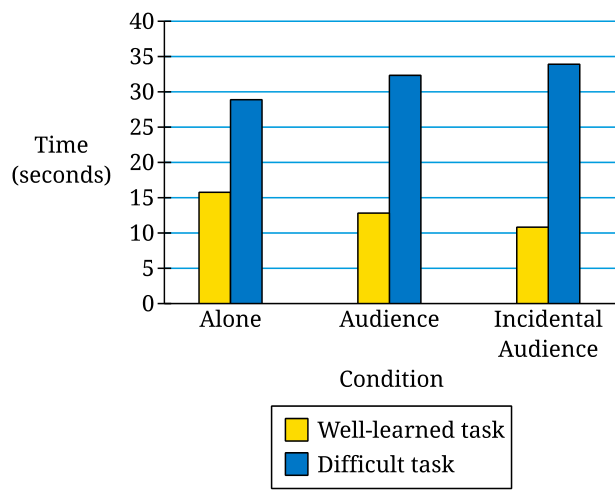
- For the simple and well-learned tasks, researchers found a statistically significant difference in the amount of time participants took to complete the tasks alone compared with the amount of time it