From the free course AP Psychology on Lykke
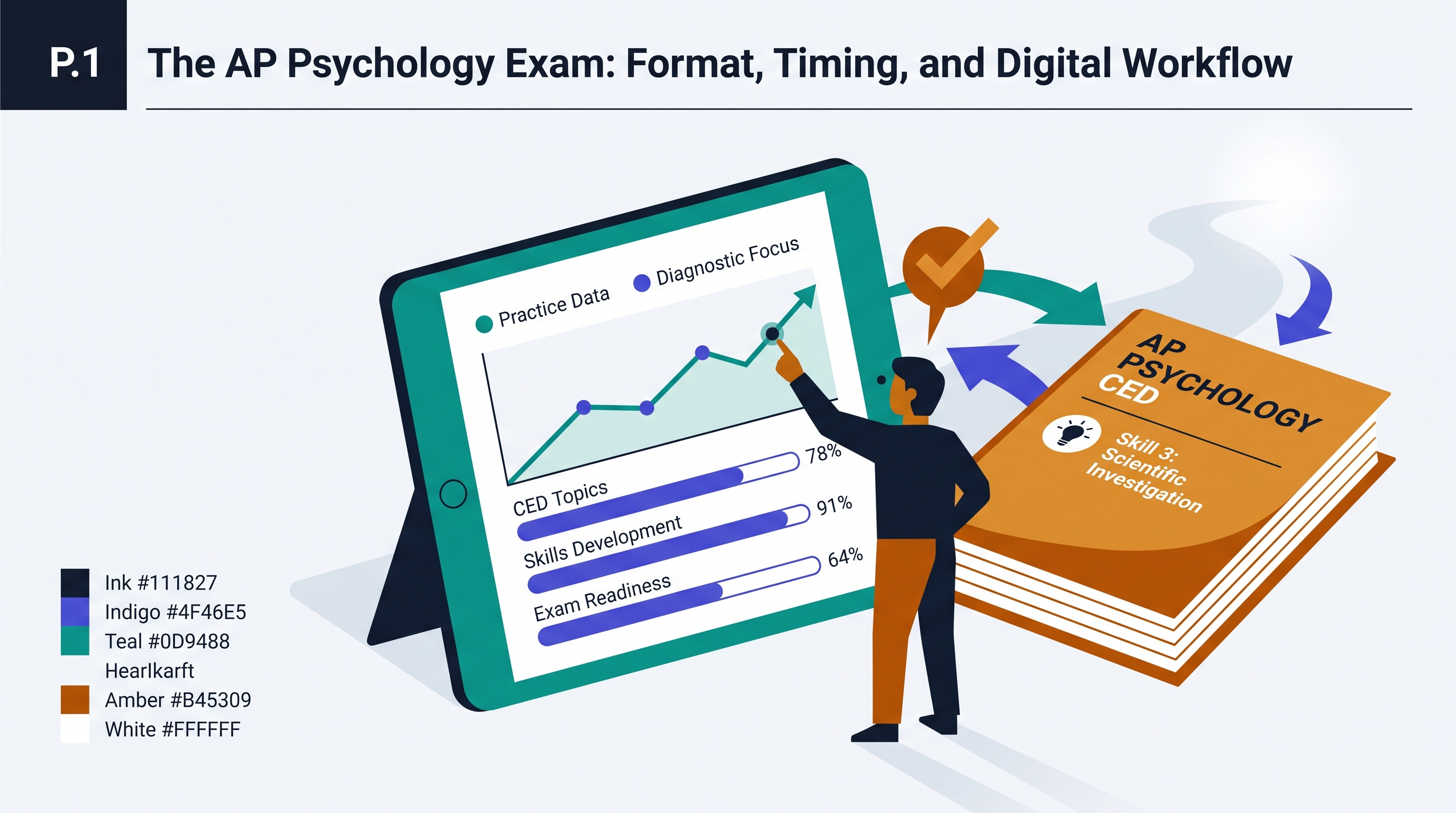
P.1 The AP Psychology Exam: Format, Timing, and Digital Workflow
Key concepts: AP Psychology Course and Exam Description organization · Exam Information section · AP Classroom resources · Question Bank · Student progress tracking · Class section join codes · Digital workflow for AP course resources · Instructional model: plan, teach, practice, assess · Science practices and skills · Course pacing and scheduling
The AP Psychology exam is fully digital: you complete both multiple-choice and free-response work in the Bluebook testing app, and your responses are submitted automatically when the exam ends.
P.1 The AP Psychology Exam: Format, Timing, and Digital Workflow
The AP Psychology exam is fully digital: you complete both multiple-choice and free-response work in the Bluebook testing app, and your responses are submitted automatically when the exam ends. The exam tests not only psychological concepts but also the science practices and skills described in the AP Psychology Course and Exam Description (CED), so knowing how to work digitally matters alongside knowing the content.
Exam structure at a glance
The current published exam format divides your work into two sections. Verify the official instructions for your administration because College Board can update timing or procedures.
| Section | What you do | Current published timing | Approximate exam weighting |
|---|---|---|---|
| Section I | Multiple-choice questions | 90 minutes | 60% |
| Section II | Two free-response questions: one Article Analysis Question (AAQ) and one Evidence-Based Question (EBQ) | 70 minutes | 40% |
In Section I, you apply concepts to unfamiliar scenarios, interpret research situations and data, and distinguish closely related psychological explanations. In Section II, you write complete, evidence-based responses rather than merely listing terms. The AAQ centers on analyzing a research description; the EBQ asks you to build an argument from provided sources.
The CED is the map; AP Classroom is the working laboratory
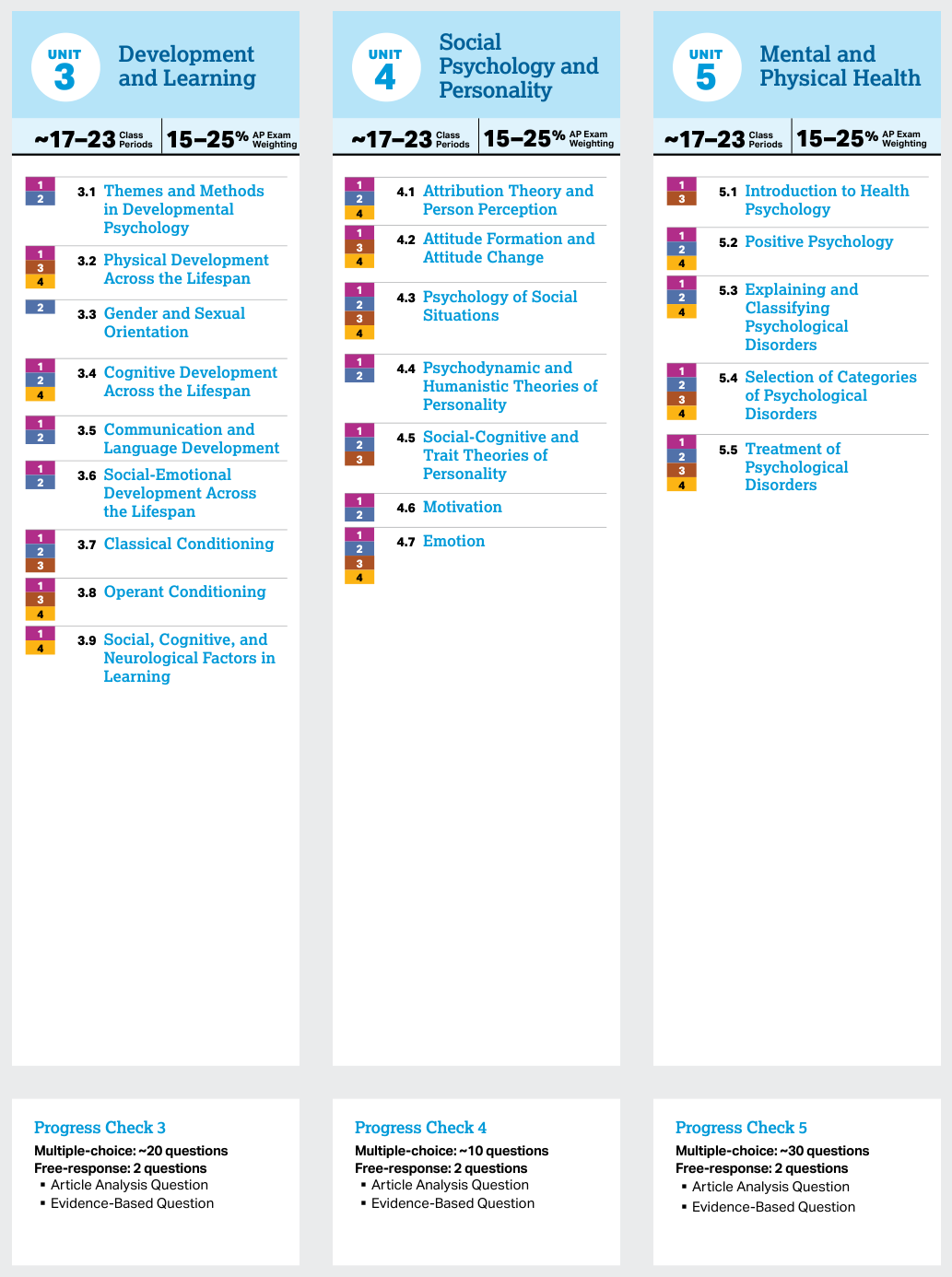
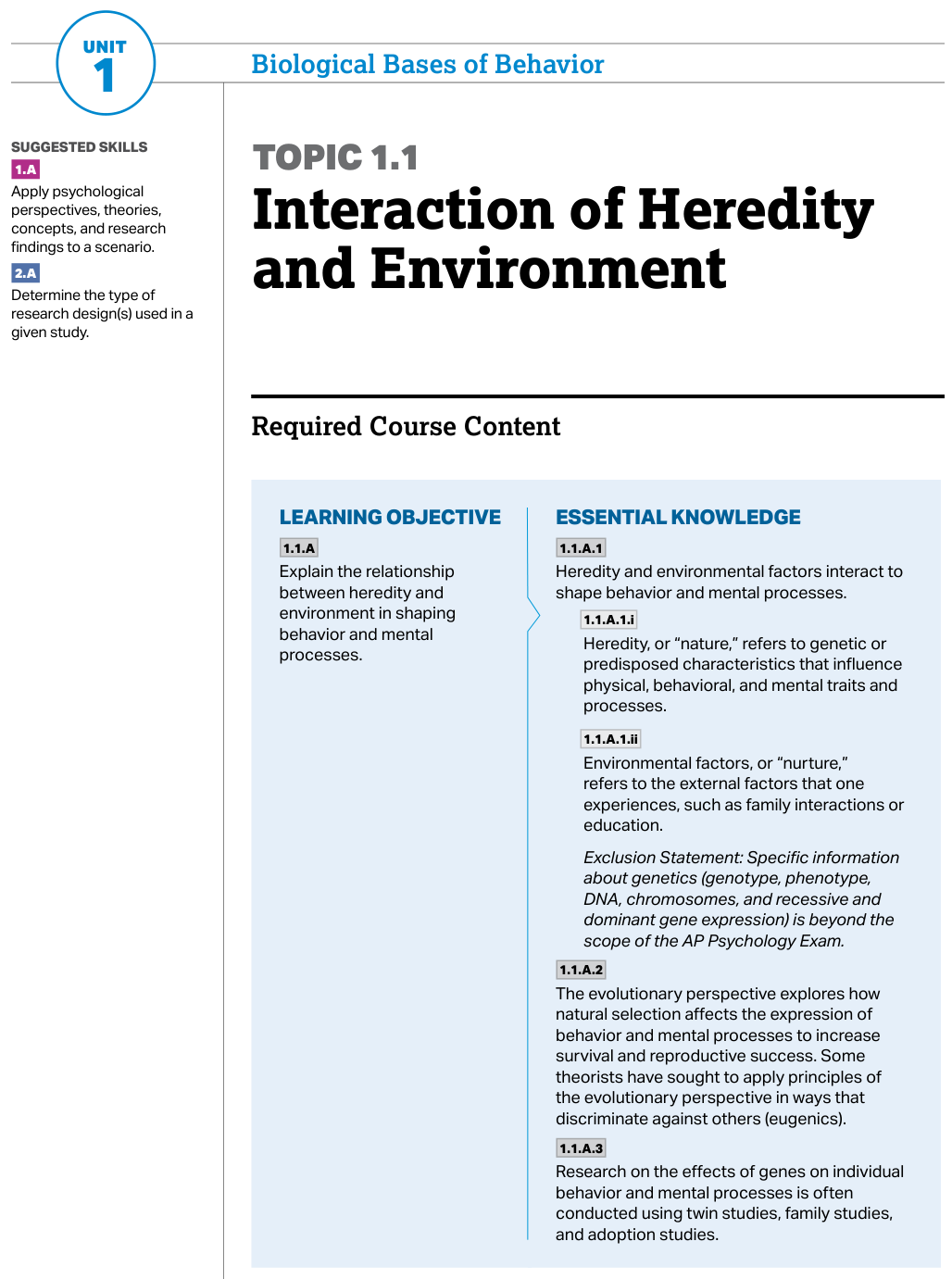
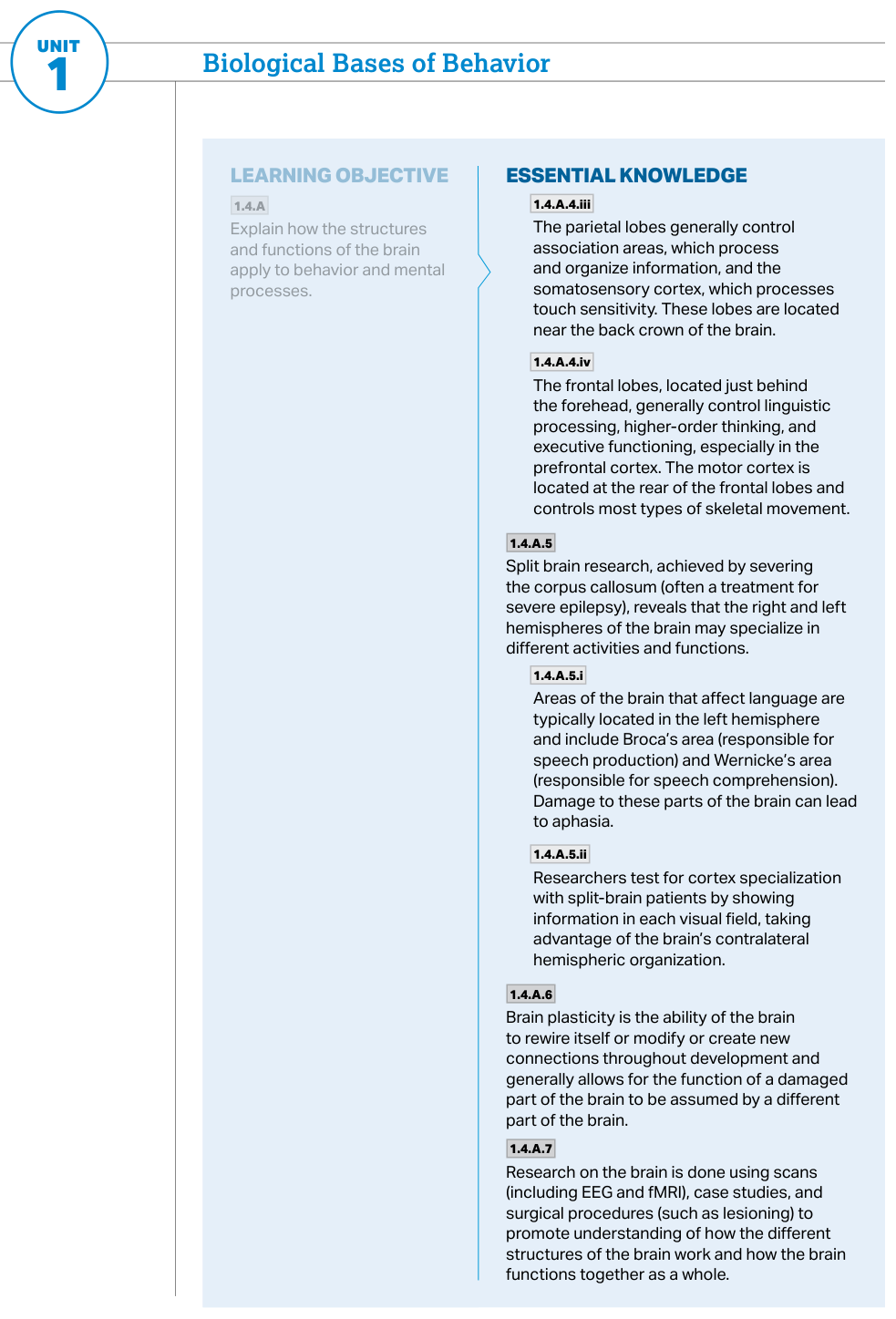
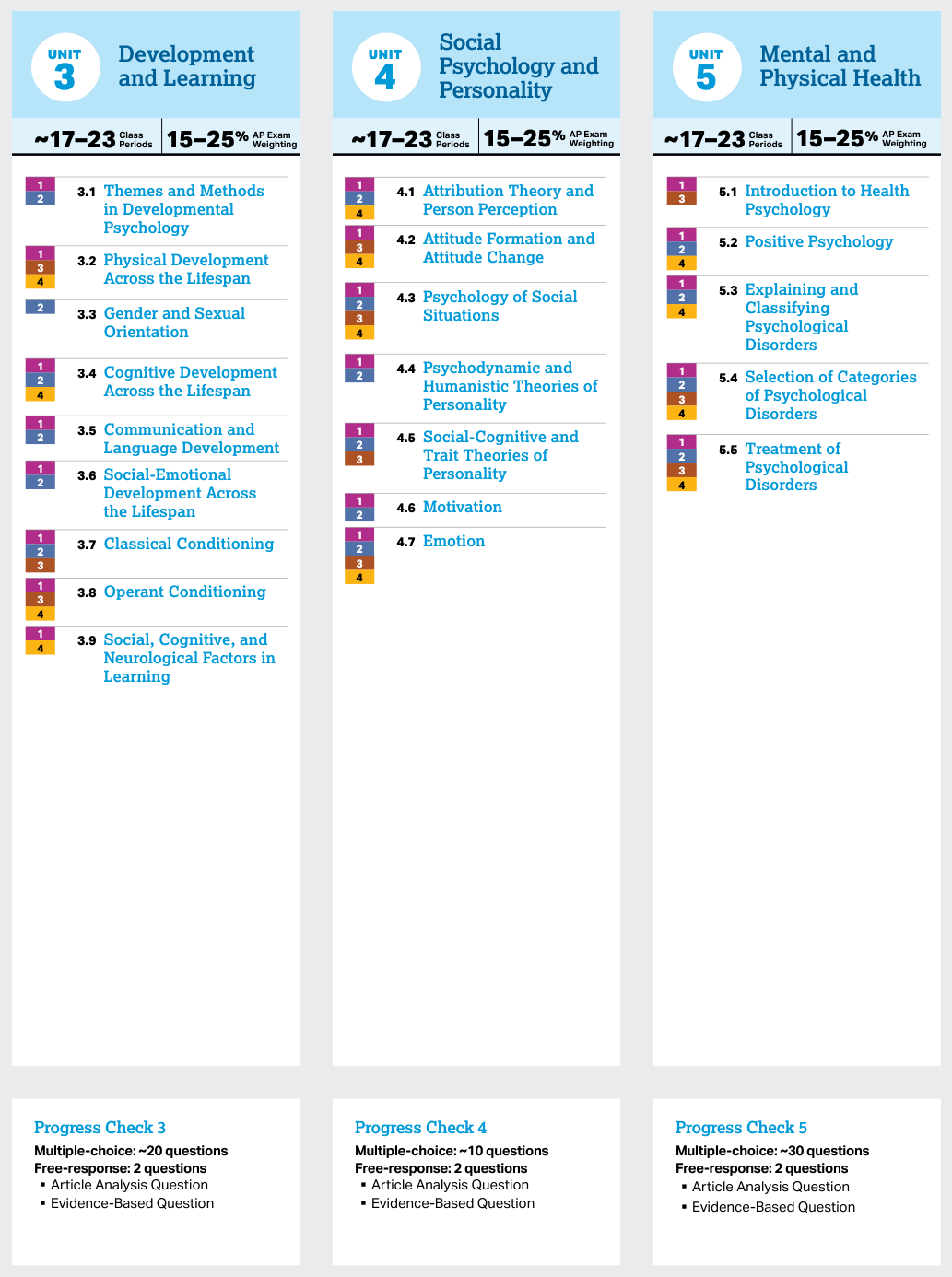
The CED organizes AP Psychology into five units: Biological Bases of Behavior, Cognition, Development and Learning, Social Psychology and Personality, and Mental and Physical Health. Each unit contains required topics, essential knowledge and learning objectives. The publication’s Exam Information section begins on page 147 and connects that framework to assessment expectations.
The CED also describes the course’s science practices and skills. These practices appear alongside content in both exam sections: you might apply a conditioning concept to a new vignette, identify an operational definition in a study, interpret a group difference, or use evidence to support a psychological claim. Content knowledge tells you what a result means; a science practice tells you how to reason with it.
AP Classroom supplies the digital tools that turn the CED into an ongoing practice system:
- Unit Guides identify required content, skills, sequencing, pacing guidance and exam tips.
- Topic Questions provide short, just-in-time checks while you are learning a topic.
- Progress Checks provide formative multiple-choice and free-response practice, including rationales and scoring information. Their results should guide improvement, not serve as letter grades.
- Reports show individual progress, unit patterns and class trends so areas of difficulty can be addressed.
- Question Bank is a searchable library of AP questions that teachers can use to build custom practice assignments.
One coherent workflow: plan, teach, practice, assess
A useful AP Psychology workflow has four connected phases:
- Plan: Use the Unit Guide and Unit at a Glance to identify the essential knowledge, related topics, science practices and realistic pacing. Use the Instructional Approaches section to select strategies for teaching concepts and skills.
- Teach: Build understanding with explanations, examples, discussion, demonstrations and resources such as AP Daily. Keep the psychological concept connected to the skill that makes it usable in an exam scenario.
- Practice: Move from supported work to independent work. Use AP Daily, Topic Questions, teacher-created Question Bank assignments and Progress Checks to practice applying concepts, analyzing research and interpreting evidence.
- Assess: Examine answer rationales, response quality and Reports. Identify whether an error came from missing content, confusing two concepts, misreading evidence or failing to explain reasoning; then adjust teaching and practice accordingly.
This is a feedback loop, but it remains one model: assessment produces information that improves the next plan, teaching move or practice task. Practice is not an optional extra between teaching and assessment—it is the bridge that converts recognition of a concept into reliable application.
Pacing and access
The Course at a Glance suggests approximately $17$–$23$ class periods for each unit, with each unit representing approximately $15%$–$25%$ of the exam. These are planning recommendations, not rigid deadlines. Adjust them for student needs, instructional priorities and schedules such as block periods, shortened weeks or alternate calendars.
A student who needs more time with research methods may require additional guided practice before a Progress Check. A class meeting for an extended block might combine explanation, a Topic Question set and feedback, while shorter meetings may distribute those steps across several days. The goal is not identical pacing; it is sufficient opportunity to build conceptual understanding and mastery of skills.
Joining AP Classroom and tracking progress
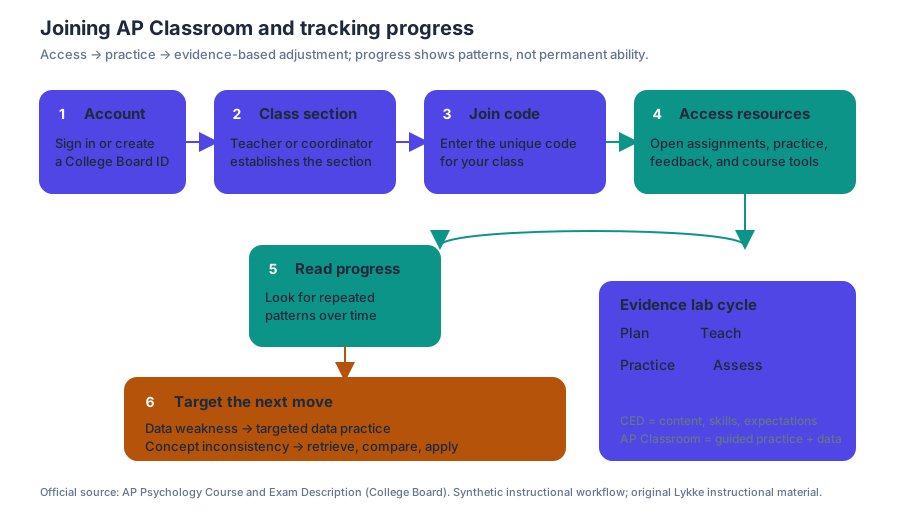
Access begins with an account and a class section. Teachers and students sign in to or create College Board accounts. The teacher or AP coordinator establishes the class section, and you join it with the unique join code provided to you. When you join your first class section, AP Classroom may request additional information.
After joining, you can access assigned resources and view your progress over time. Use that record diagnostically: a repeated weakness in data interpretation calls for targeted data practice, while inconsistent performance on a concept may call for retrieval, comparison and a new application example. Progress tracking is useful because it shows patterns—not because one score permanently defines your ability.
Key idea: The CED defines the content, skills and exam expectations; AP Classroom supplies guided practice, custom questions, feedback and progress data. Together, they support a plan → teach → practice → assess cycle that turns psychological knowledge into evidence-based exam performance.
Source Materials
- Ap Psychology Course And Exam Description
- Ap Psychology Course At A Glance
- AP Psychology CED: Student Responses and Scoring Commentary
- AP Psychology Exam Questions
- Free-Response Questions
- Free-Response Questions - Set 1
- Free-Response Questions - Set 2
- AP Psychology Course and Exam Description Course Framework V.1 |
- AP Psychology Course and Exam Description Course Framework V.1 | 34
- AP Psychology Course and Exam Description Course Framework V.1 | 40
- AP Psychology Course and Exam Description Course Framework V.1 | 22
- Figure — Scoring Statistics – Set 2 (p. 1)