From the free course AP Psychology on Lykke
2.2 Thinking, Problem-Solving, Judgments, and Decision-Making
Key concepts: Thinking and cognition · Problem-solving · Judgment and decision-making · Schemas · Assimilation · Accommodation · Algorithms · Heuristics · Representativeness heuristic · Critical thinking
A schema is a mental framework that helps you organize and interpret information, but it can also steer you toward a fast—and mistaken—conclusion. When you decide that an unfamiliar animal is “probably a dog” because it has four legs and a wagging tail, your thinking is already using concepts, prototypes, and schemas.
2.2 Thinking, Problem-Solving, Judgments, and Decision-Making
A schema is a mental framework that helps you organize and interpret information, but it can also steer you toward a fast—and mistaken—conclusion. When you decide that an unfamiliar animal is “probably a dog” because it has four legs and a wagging tail, your thinking is already using concepts, prototypes, and schemas.
From concepts to schemas
A concept is a mental category used to group related objects, events, or ideas. Concepts form the basis of thought (2.2.A.1). A prototype is the ideal or most typical example of a concept: a golden retriever may fit many people’s prototype of “dog” more readily than a dachshund, even though both belong to the same concept.
A schema organizes information about a person, object, event, or situation. Your “restaurant schema,” for example, may include entering, receiving a menu, ordering, eating, paying, and leaving. Schemas make thought efficient because you do not have to analyze every situation from the beginning, but they can also create expectations that distort judgment.
When new information arrives, you can modify your schemas in two different ways (2.2.A.2):
| Process | What happens | Example |
|---|---|---|
| Assimilation | You fit new information into an existing schema without changing the schema. | You meet a friendly person from a country you know little about and fit the experience into your existing “friendly stranger” schema. |
| Accommodation | You change an existing schema so it can incorporate new information. | You learn that a familiar-looking animal is actually an alpaca and revise your animal-category schema. |
Misconception check: Assimilation does not mean “changing the schema.” Assimilation preserves the existing framework while adding information; accommodation changes the framework itself. If a new experience forces you to revise what you believed, the answer is accommodation.
Solving problems: algorithms and heuristics
Problem-solving is the process of generating, organizing, planning, and carrying out actions directed toward a goal. An algorithm is a systematic, step-by-step procedure that reliably produces a solution when the procedure applies (2.2.A.3). Following every step in a device’s troubleshooting guide is algorithmic: it may be slow or inefficient, but it is dependable when the guide correctly matches the problem.
An algorithm does not necessarily test every possible solution. It follows an organized procedure that leads to a correct answer under the right conditions. By contrast, a heuristic is a mental shortcut used to make a judgment (2.2.A.4). Heuristics save time and mental effort, but they increase the chance of error.
The representativeness heuristic involves judging something according to how much it resembles a stereotype or perceived typical example. If a quiet person who enjoys puzzles is described as more likely to be a librarian than a salesperson, you may be relying on representativeness while ignoring the actual number of people in each occupation. The availability heuristic instead relies on how easily an example comes to mind: after seeing several news reports about plane crashes, you might overestimate how often they occur.
Judgment and decision-making errors
A mental set is a tendency to approach a problem using a strategy that worked before (2.2.A.5). It helps when the old strategy fits the new problem, but it becomes an obstacle when you keep using it after the conditions have changed. A circumstance can also shape judgment through priming, in which an earlier stimulus influences a later response, and framing, in which the wording or presentation of equivalent choices changes the decision.
Several cognitive processes can hinder good decision-making (2.2.A.6). The gambler’s fallacy is the mistaken belief that an independent random event becomes “due” because a different outcome has occurred repeatedly. The sunk-cost fallacy is continuing an unsuccessful plan because you have already invested time, money, or effort in it. Past investment cannot be recovered, so it should not determine the value of the next choice.
Worked example: A student chooses a difficult elective because “everyone says it is useful,” then notices that the course is a poor fit but refuses to switch because two weeks have already been spent studying for it. The shortcut based on others’ opinions may reflect social information or framing; the refusal to reconsider because of the time already spent is specifically the sunk-cost fallacy. A strong explanation identifies the decision process and shows how it distorted the choice.
Critical thinking and formal operational thought
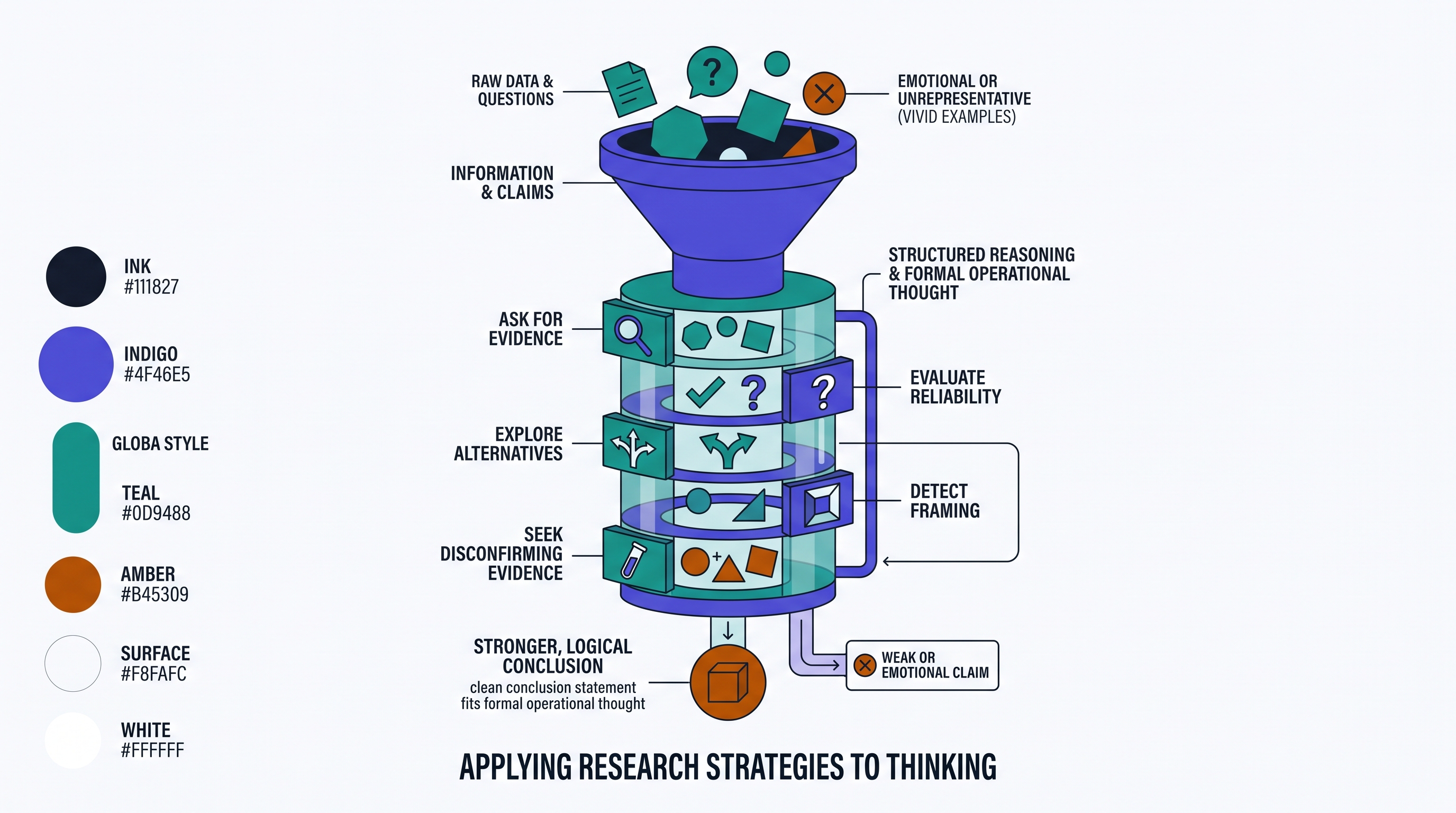
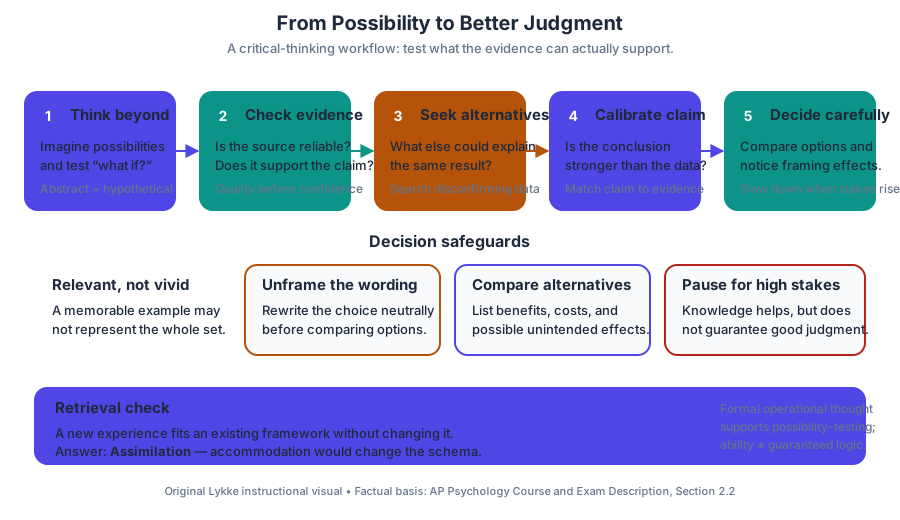
Critical thinking means evaluating evidence to support, refute, or modify an established or provided claim, policy, or norm. Instead of asking only, “Does this claim sound familiar?” you ask what evidence supports it, whether the evidence is reliable, what alternative explanations exist, and whether the conclusion is stronger than the data justify.
Formal operational thought includes the ability to think abstractly and hypothetically. This allows you to reason about possibilities that are not immediately visible—for example, testing what would happen if a policy changed, evaluating an abstract principle such as fairness, or comparing several explanations for the same result. Formal operational reasoning can support critical thinking, but having the ability does not guarantee that every judgment will be logical.
People do not always make good decisions, even when they possess the relevant knowledge. Research-based strategies therefore matter: slow down when a decision is important, compare alternatives, check whether wording is framing your response, search for disconfirming evidence, and distinguish a genuinely relevant fact from an emotionally vivid but unrepresentative example.
Retrieval check: A new experience fits an existing framework without changing it. Is this assimilation or accommodation?
Answer: Assimilation. Accommodation would require changing the schema to incorporate the new information.
Source Materials
- Ap Psychology Course And Exam Description
- Ap Psychology Course At A Glance
- AP Psychology CED: Student Responses and Scoring Commentary
- AP Psychology Exam Questions
- Free-Response Questions
- Free-Response Questions - Set 1
- Free-Response Questions - Set 2
- Part A Steve is in the kitchen happily making breakfast for his four children, who are all playing
- Part A Steve is in the kitchen happily making breakfast for his four children, who are all playing