From the free course AP Psychology on Lykke
2.7 Forgetting and Other Memory Challenges
Key concepts: Forgetting curve · Encoding failure · Proactive interference · Retroactive interference · Retrieval cues · Psychodynamic repression · Misinformation effect · Amnesia · Constructive memory · Memory failure and errors
Memory does not disappear at a steady rate. After you learn something, forgetting is usually rapid at first and then slows, leaving a smaller amount of information that remains relatively stable.
2.7 Forgetting and Other Memory Challenges
Memory does not disappear at a steady rate. After you learn something, forgetting is usually rapid at first and then slows, leaving a smaller amount of information that remains relatively stable. This pattern is called the forgetting curve and shows why time is a significant factor in memory failure (2.7.A.1).
The forgetting curve: steep loss, then leveling off
Imagine studying a list of unfamiliar names. You may forget many of them within the first day, but the names that survive several days are more likely to remain available later. The curve therefore drops sharply soon after learning and gradually levels off rather than continuing downward at the same rate.
The curve does not prove that every memory follows an identical schedule. It identifies a general pattern: time increases the opportunity for forgetting, especially when the original learning was weak or later retrieval receives little support.
Why memory fails
Encoding failure occurs when information never enters memory effectively in the first place. If you glance at a new locker combination while thinking about something else, later forgetting may not reflect loss of a stored memory; you may simply have failed to encode the combination.
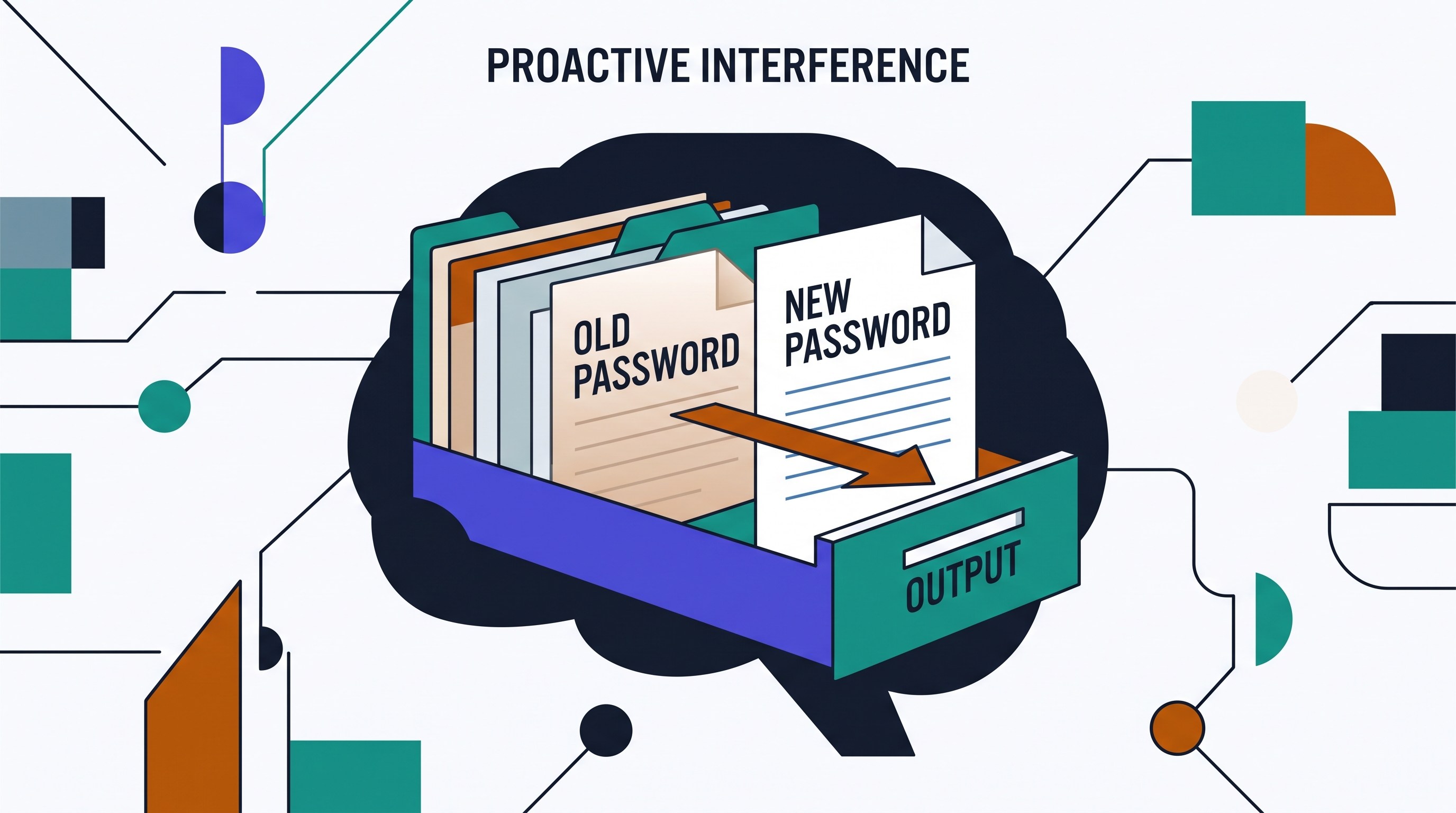
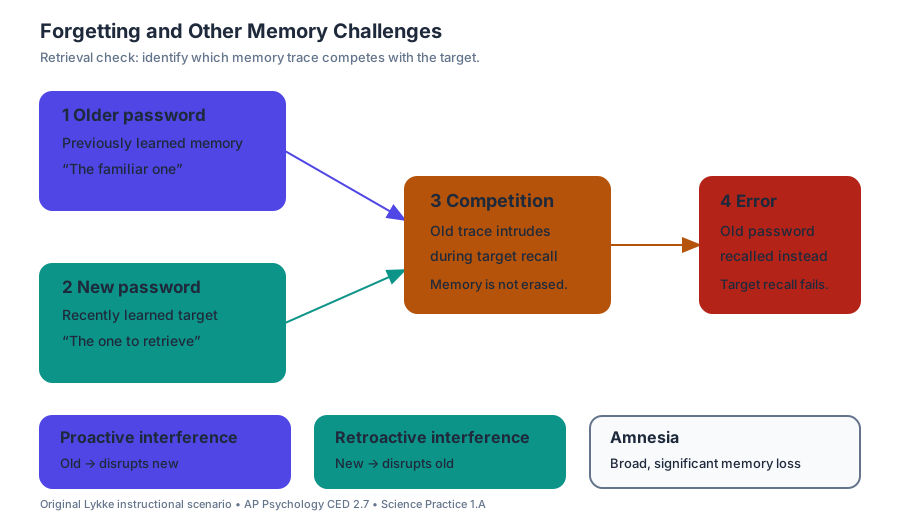
Interference occurs when memories compete with one another. Proactive interference happens when an older memory disrupts learning or recalling newer information. For example, after changing your phone password, you may keep entering the old password. Retroactive interference moves in the opposite direction: newer learning disrupts an older memory, such as learning a new address and then struggling to recall your previous address (2.7.A.2).
| Memory problem | Direction of interference | Original example |
|---|---|---|
| Proactive interference | Old information disrupts new information | The old password interferes with remembering the new password |
| Retroactive interference | New information disrupts old information | The new password interferes with remembering the old password |
A memory can also be stored but difficult to access because a useful retrieval cue is missing. A cue is a prompt or association that helps activate stored information. The “tip-of-the-tongue” experience illustrates this problem: you feel that you know a word, but the needed access route is temporarily unavailable (2.7.A.2).
Forgetting, repression, and memory distortion
From a psychodynamic perspective, repression is the proposed process by which distressing information or memories are pushed out of awareness to protect the ego from emotional threat (2.7.A.3). This is a theoretical explanation, not permission to assume that every forgotten unpleasant event was repressed.
Memory errors can also arise after an event. The misinformation effect occurs when misleading information presented after an event alters a person’s later memory of that event. If a witness sees a cyclist fall and later hears that the cyclist “crashed into the metal barrier,” that wording may influence the witness to remember a barrier that was not clearly present.
Source amnesia means remembering information but forgetting where it came from. Constructive memory means that remembering is an active process in which stored details can be combined with expectations, later information, or imagination. Imagination inflation can make an imagined event feel more familiar or plausible, increasing confidence without guaranteeing accuracy (2.7.A.4).
Key distinction: Confidence is not the same as accuracy. A vivid, detailed memory can still be reconstructed incorrectly.
Worked application
A student learns French vocabulary on Monday, studies Spanish vocabulary on Tuesday, and on Wednesday remembers fewer French words. The best explanation is retroactive interference because newer Spanish learning is disrupting access to older French learning. If the student never paid attention to the French list on Monday, the better explanation would be encoding failure; if the student remembers the word only after seeing a classroom poster, the poster functioned as a retrieval cue.
Misconception check
Common error: treating all forgetting as decay, as though memories simply vanish because time passes. Time matters according to the forgetting curve, but memory failure can also result from encoding failure, proactive interference, retroactive interference, inadequate retrieval cues, repression, misinformation, or constructive memory processes.
Retrieval check
A learner remembers an old email password instead of a newly created one. Which mechanism is operating, and why?
Answer: Proactive interference: the older password is interfering with recall of the newer password. This application demonstrates Science Practice 1.A, Apply psychological perspectives, theories, concepts, and research findings to a scenario. Amnesia, by contrast, refers broadly to significant memory impairment or loss rather than an ordinary password error.