From the free course AP Psychology on Lykke
P.8 The Evidence-Based Question: Claim, Evidence, and Sourcing
Key concepts: Evidence-Based Question (EBQ) · Science Practice 4: Argumentation · Defensible claims · Evidence-based reasoning · Accurate interpretation of evidence · Relevant and specific evidence · Source citation and sourcing · Psychological arguments · Scientific research evidence · AP Psychology scoring rubrics
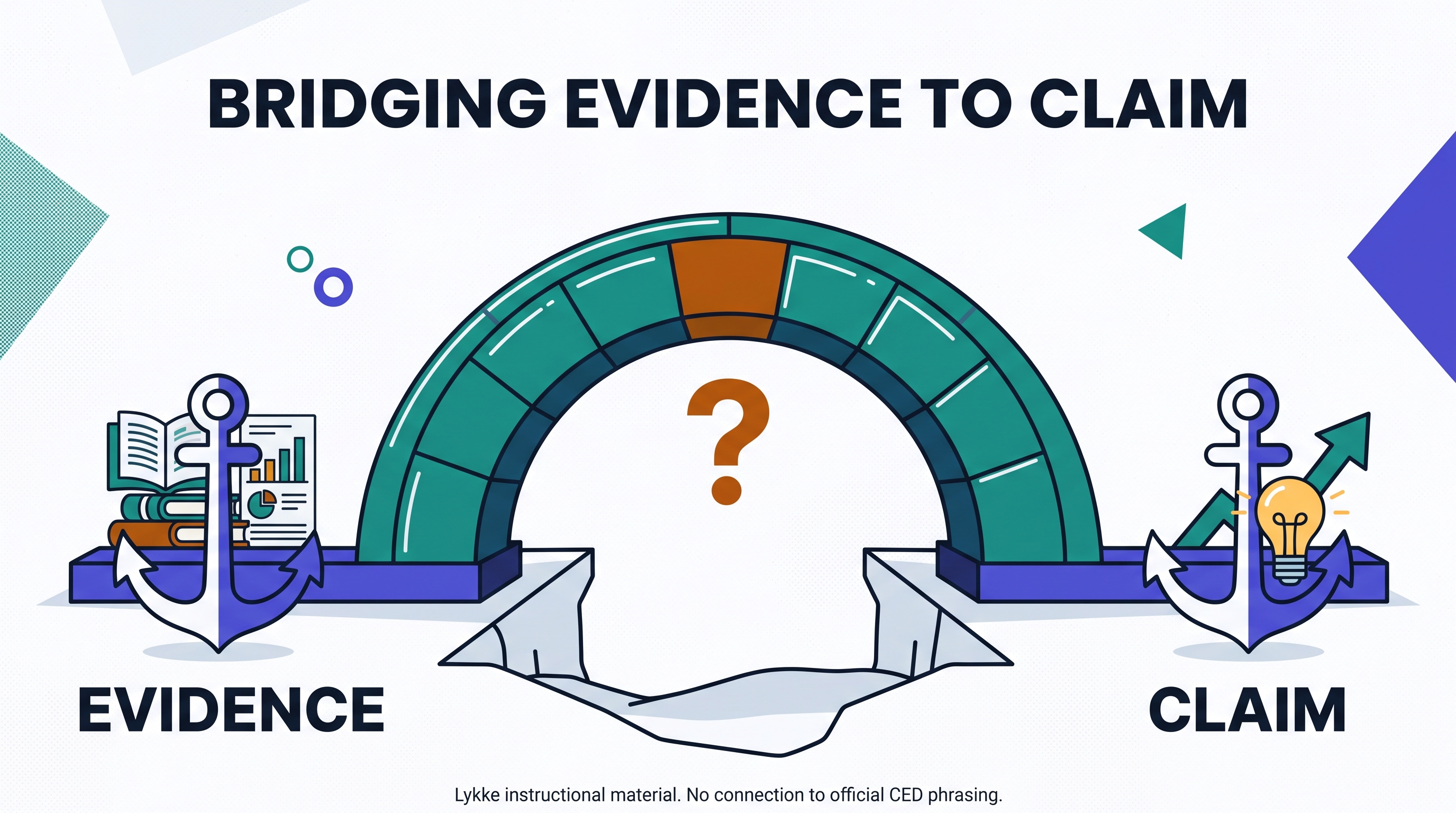
An Evidence-Based Question (EBQ) asks you to build a defensible psychological argument from research sources—not merely repeat what a study found. The central move is:
P.8 The Evidence-Based Question: Claim, Evidence, and Sourcing
An Evidence-Based Question (EBQ) asks you to build a defensible psychological argument from research sources—not merely repeat what a study found. The central move is:
Claim → specific evidence → psychological reasoning
A strong response answers both what the evidence shows and why that finding supports, refutes, or modifies the claim.
Science Practice 4: Argumentation
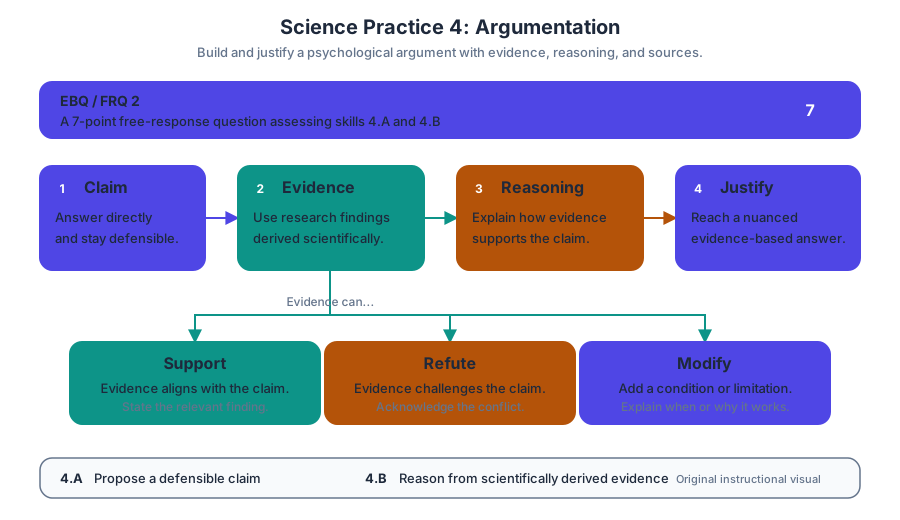
Science Practice 4: Argumentation means developing and justifying psychological arguments using evidence. Its two skills are:
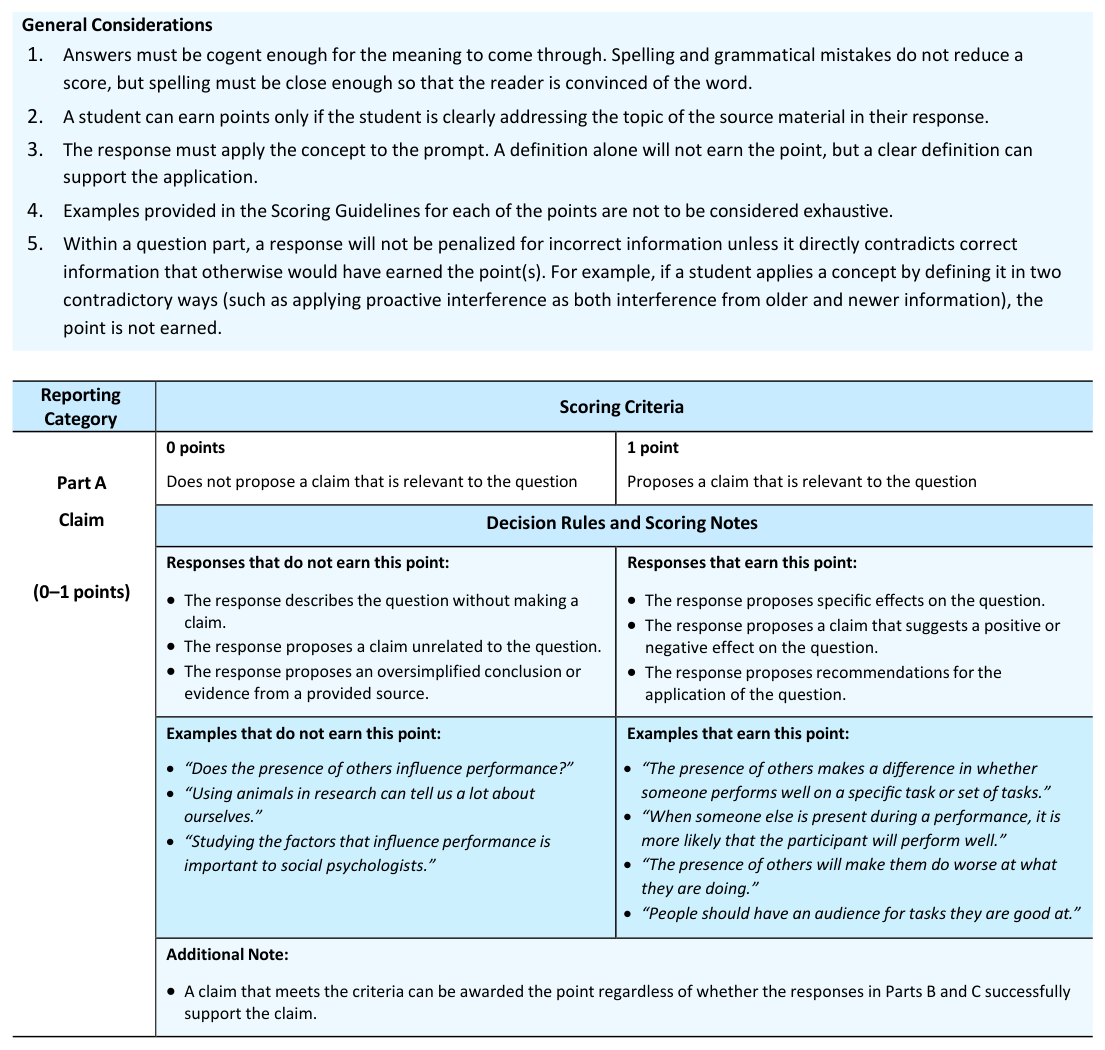
- 4.A: Propose a defensible claim. Your claim must answer the question directly and allow reasonable support from the sources.
- 4.B: Provide reasoning grounded in scientifically derived evidence. You use research findings to support, refute, or modify a claim, policy, or norm, and explain nuances such as when or why a policy works.
The EBQ assesses these skills through FRQ 2, a 7-point free-response question.
The seven-point architecture
| EBQ part | Points | What you must do |
|---|---|---|
| Part A: Claim | 1 | State a specific, defensible claim |
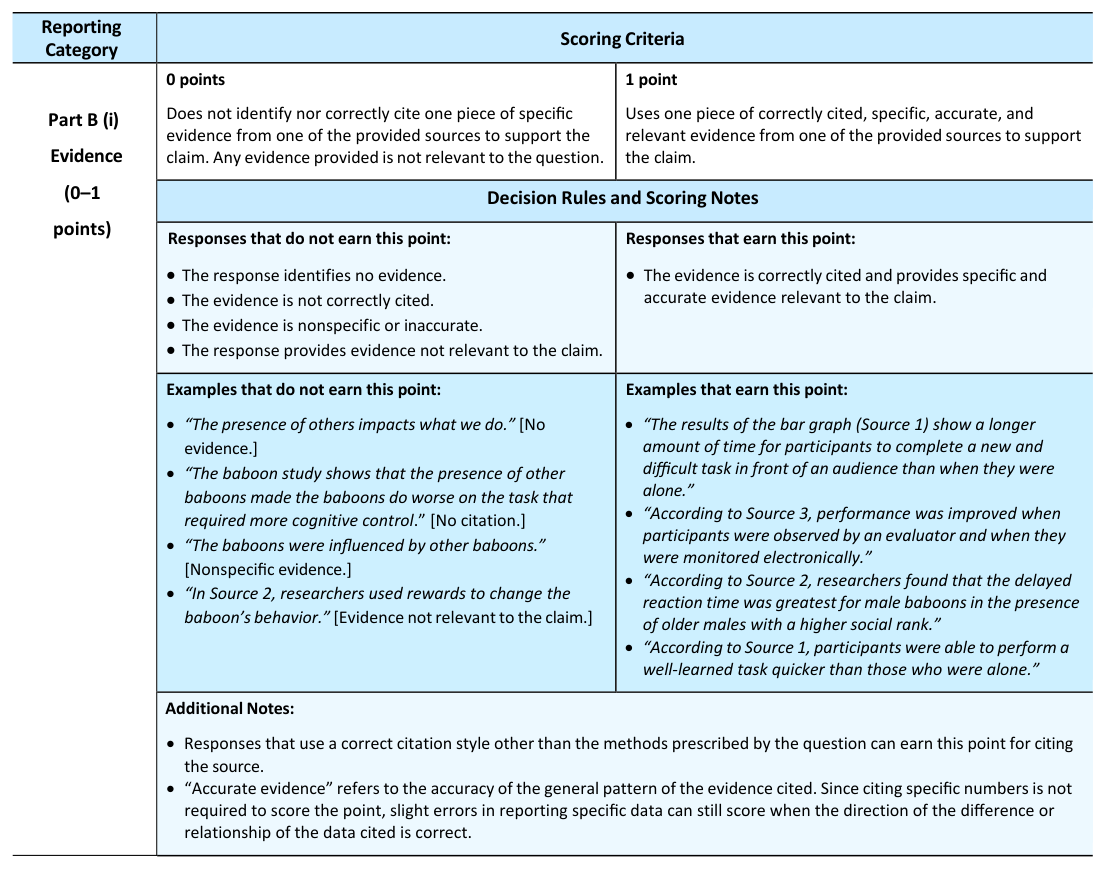
| Part B(i): Evidence | 1 | Cite one specific, accurate, relevant piece of evidence |
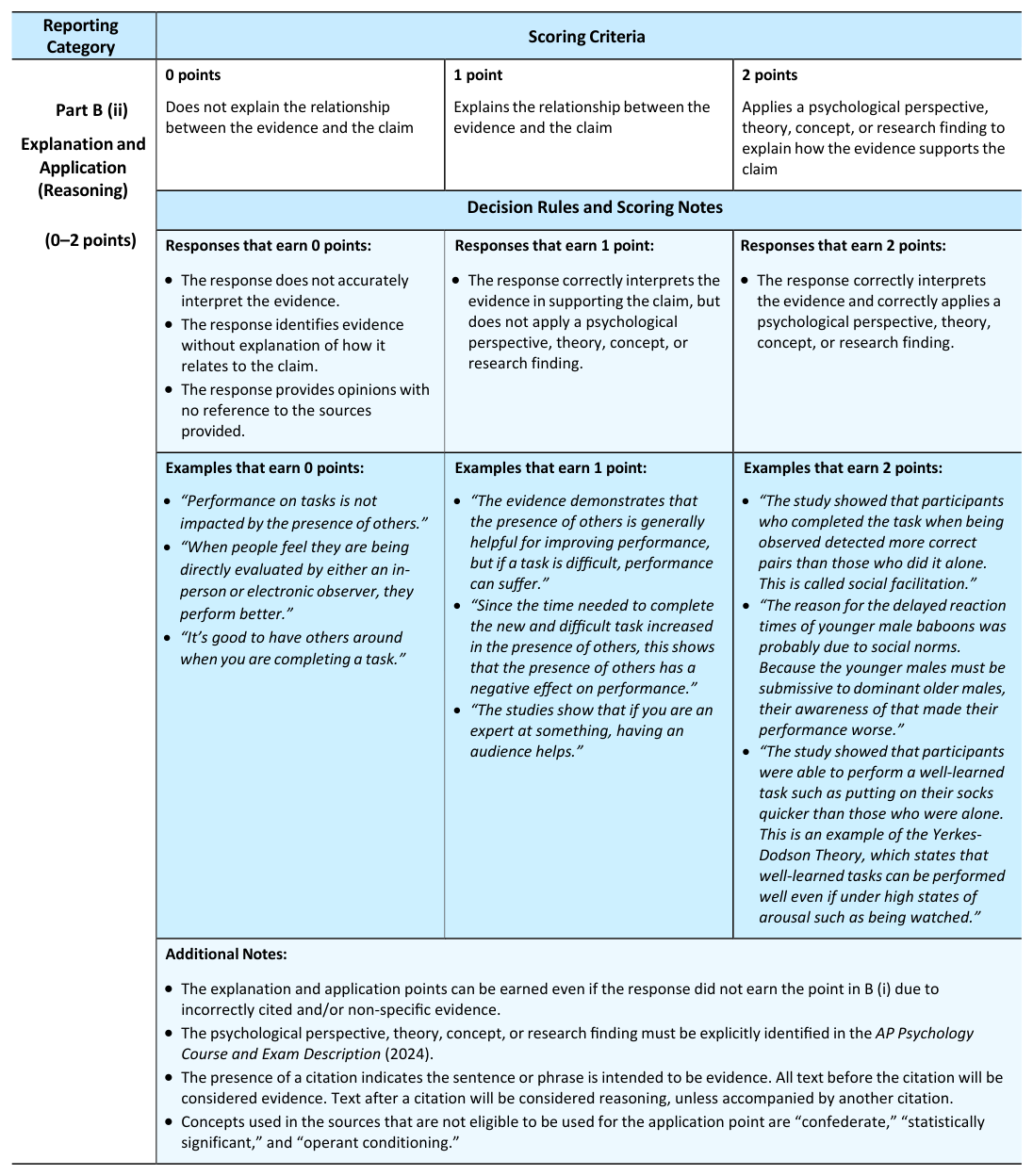
| Part B(ii): Reasoning | 2 | Explain how that evidence supports the claim using psychology |
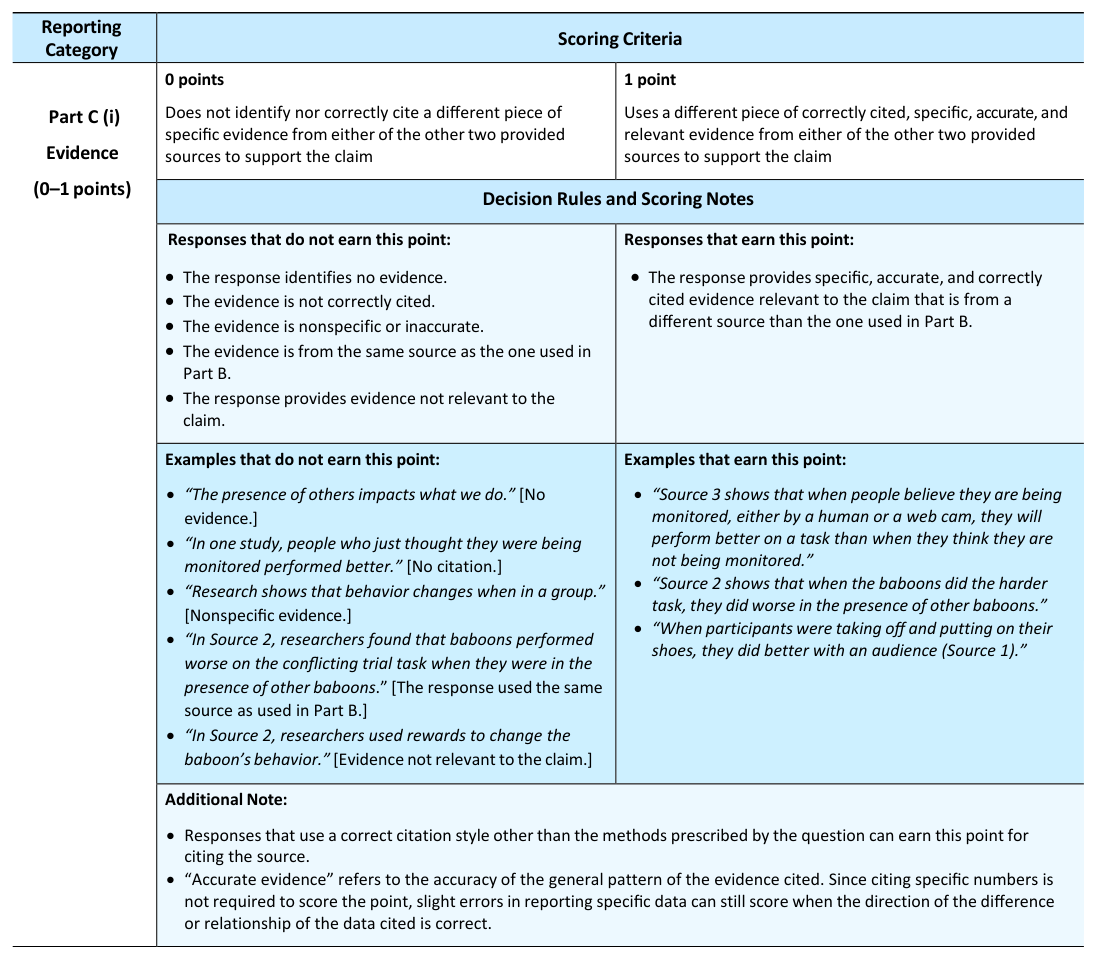
| Part C(i): Evidence | 1 | Cite a second specific, accurate, relevant piece of evidence |
| Part C(ii): Reasoning | 2 | Explain how the second evidence supports the claim using psychology |
Two evidence points and four reasoning points do not reward repetition. Each source detail must be connected to the claim through an accurate psychological concept, theory, perspective, or research finding.
Step 1: Write a defensible claim
A defensible claim is a direct answer that is specific enough to argue. It may agree, disagree, or qualify the proposition.
Original instructional example: Suppose the question asks whether secondary schools should begin at $9{:}00$ a.m.
“Secondary schools should begin at $9{:}00$ a.m. because later start times may increase student sleep and reduce daytime sleepiness.”
This claim is defensible because it identifies a policy and predicts psychological outcomes. By contrast:
“Secondary school start time should be $9{:}00$ a.m. because I believe this is best for teenagers.”
That is an unsupported opinion. It expresses a preference but gives no research-based reason that another reader could evaluate.
Step 2: Select evidence that earns the point
Evidence must be cited, specific, accurate, and relevant.
“Sources say secondary school start time should be $9{:}00$ a.m.”
This does not earn the evidence point because “sources” is not a usable citation and the statement gives no research detail. Identify the source explicitly:
“According to Source 1, $28%$ of students reported falling asleep in school.”
You may cite parenthetically—“$28%$ of students reported falling asleep in school (Source 1)”—or embed the citation in the sentence—“Source 1 reports that $28%$ of students fell asleep in school.”
What fails as evidence?
- No evidence: “Later start times are good.”
- Opinion only: “I think teenagers deserve more sleep.”
- Vague evidence: “The study showed better results.”
- Irrelevant evidence: citing a finding about athletic performance when the claim concerns sleep.
- Inaccurate evidence: changing a percentage, confusing groups, or reversing the study’s result.
A precise number alone is not automatically a complete argument. “$28%$ of students reported falling asleep in school” provides evidence, but you still must interpret what that number means.
Step 3: Turn evidence into reasoning
Reasoning is the bridge between the finding and the claim. It identifies the psychological mechanism that makes the evidence meaningful.
A one-point explanation might say:
“Because a substantial portion of students reported falling asleep in school, a later start time could improve sleep and potentially reduce daytime sleepiness.”
That explains the direction of the relationship. A stronger two-point explanation connects the finding to psychology:
“Source 1’s finding that $28%$ of students reported falling asleep in school supports a later start time because insufficient sleep can impair alertness and attention. Beginning school later could increase available sleep, which may improve daytime cognitive functioning and reduce the likelihood of falling asleep during class.”
The second response does more than announce a conclusion. It links the evidence to sleep, alertness, attention, and cognitive functioning.
Warning: “This proves the policy works” is not reasoning. That phrase announces a conclusion without explaining the psychological connection; state the mechanism or concept that links the finding to the claim.
A compact worked model
Original instructional source set: Source 1 reports that students at schools beginning at $9{:}00$ a.m. obtained more sleep than students at schools beginning at $8{:}00$ a.m. Source 2 reports that sleepier students made more attention errors on a sustained-attention task.
Claim — Part A: Schools should begin at $9{:}00$ a.m. because later start times may improve sleep and attention.
Evidence — Part B(i): Source 1 found that students at $9{:}00$ a.m. schools obtained more sleep.
Reasoning — Part B(ii): More sleep may reduce sleepiness and support attention, so the Source 1 finding supports the claim that a later start could improve students’ classroom functioning.
Evidence — Part C(i): Source 2 found that sleepier students made more attention errors.
Reasoning — Part C(ii): This finding connects sleep to cognitive performance: if a later start reduces sleepiness, students may make fewer attention errors. The evidence supports the policy, although it does not prove that start time is the only cause of improved performance.
Retrieval check
A response states, “Source 2 found that sleepier students made more attention errors,” and stops. Which component is missing?
Answer: Reasoning. The response cites accurate evidence, but it must explain how sleepiness and attention errors connect to the proposed claim about a later school start.
Source Materials
- Ap Psychology Course And Exam Description
- Ap Psychology Course At A Glance
- AP Psychology CED: Student Responses and Scoring Commentary
- AP Psychology Exam Questions
- Free-Response Questions
- Free-Response Questions - Set 1
- Free-Response Questions - Set 2
- Figure — Sample Responses Q2 - Set 1 (p. 2)
- Figure — Sample Responses Q2 - Set 1 (p. 3)
- Figure — Sample Responses Q2 - Set 1 (p. 4)
- Figure — Sample Responses Q2 - Set 1 (p. 5)
- Figure — Chief Reader Report - Set 1 (p. 1)