From the free course AP Psychology on Lykke
4.7 Emotion
Key concepts: Emotional expression and interpretation · Social norms and experiences · Universality of emotions · Cross-cultural recognition of basic emotions · Secure attachment · Insecure attachment · Avoidant attachment · Anxious attachment · Disorganized attachment · Temperament and caregiver attachment
A person can feel intense anger yet display a calm face, or smile during a stressful greeting because the situation calls for politeness. Emotion is not only a private feeling; it also involves bodily arousal, interpretation, expression, and social communication.
4.7 Emotion
A person can feel intense anger yet display a calm face, or smile during a stressful greeting because the situation calls for politeness. Emotion is not only a private feeling; it also involves bodily arousal, interpretation, expression, and social communication. The central question is therefore: Which parts of emotional expression may be shared across humans, and which parts are shaped by culture and experience?
How emotions are displayed and interpreted
An emotional expression is an observable signal—such as a facial movement, posture, gesture, tone of voice, or action—that communicates an emotional state. You interpret another person’s emotion by combining these signals with the situation. A clenched jaw might suggest anger, concentration, or physical discomfort; the surrounding context helps you decide.
Display rules are social norms about when, where, and how strongly people should express emotion. An elicitor is the event or situation that triggers an emotional response. Both can vary across cultures and among different genders, ages, or socioeconomic classes within the same culture. For example, two people may experience disappointment after receiving the same news, but one may openly cry while another follows a learned norm of remaining composed in public.
Worked application: Imagine that Ren receives disappointing feedback in a crowded workplace. Ren feels sadness, but lowers their voice, smiles briefly, and says, “Thank you—I’ll revise it.” The feedback is the elicitor. Ren’s sadness is the internal experience. The restrained smile and controlled voice reflect a display rule governing public expression. An examiner would reward you for separating what Ren feels from what Ren displays.
Universality and cultural variation
Research has examined whether emotional expressions are universally common. Basic emotions that may be recognized across cultures include anger, disgust, sadness, happiness, surprise, and fear. However, research on the universality of emotions shows mixed results. The accurate conclusion is not that every culture expresses and interprets emotion identically, nor that emotion is entirely invented by culture.
A useful comparison is:
| Question | Possible biological contribution | Possible social contribution |
|---|---|---|
| What is experienced? | Some emotional responses may be common across humans. | Experiences and learning shape what situations feel important. |
| What triggers it? | Certain events may reliably produce arousal or feeling. | Cultures teach which events are appropriate emotional elicitors. |
| What is displayed? | Facial and bodily patterns may communicate emotion. | Display rules regulate intensity, timing, and public expression. |
| How is it interpreted? | Some expressions may be recognized across cultures. | Context, norms, identity, and experience influence interpretation. |
Misconception check: “If an emotion has a biological basis, everyone must show it in exactly the same way.” Incorrect. Biological similarities may help explain why some emotions are recognized across cultures, while display rules and social experiences shape whether, when, and how those emotions are expressed. Also avoid the opposite error: mixed universality findings do not mean that emotions are purely cultural.
Four theories of emotion
The major theories differ in the order they assign to bodily arousal, interpretation, and conscious feeling:
- James-Lange theory: You experience physiological arousal first, then interpret that arousal as an emotion. In simplified form: event → bodily response → felt emotion.
- Cannon-Bard theory: The event produces physiological arousal and conscious emotional experience at the same time.
- Schachter-Singer two-factor theory: Emotion depends on physiological arousal plus a cognitive label based on the situation. The same arousal can be interpreted differently in different contexts.
- Facial-feedback hypothesis: Facial movements can influence emotional experience; changing the face may contribute to the feeling being reported.
Original worked scenario: A cyclist nearly collides with a car. Their heart races, they notice the danger, and they feel fear. James-Lange emphasizes the sequence from racing heart to fear. Cannon-Bard predicts fear and arousal occurring together. Schachter-Singer emphasizes the cyclist’s interpretation of the arousal as danger. Facial feedback predicts that facial tension may contribute to the experienced fear.
Attachment and emotional relationships
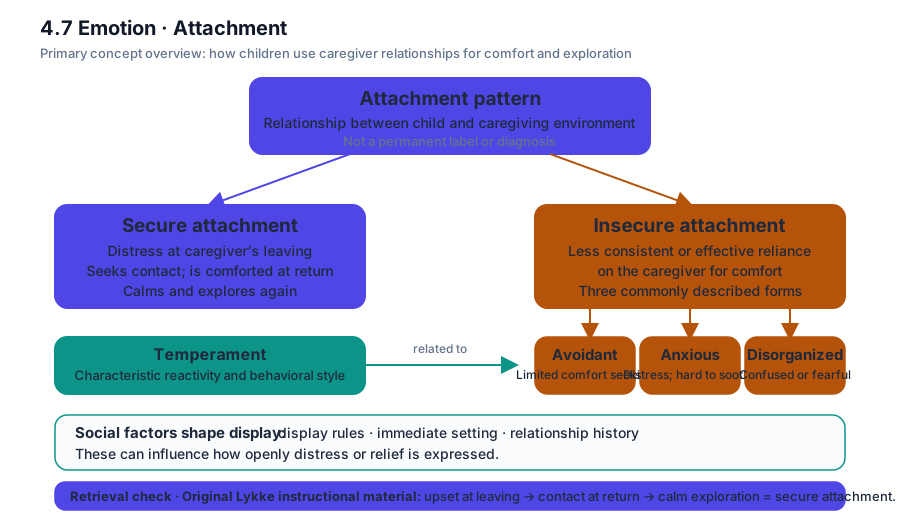
Attachment is an emotional bond between a child and caregiver. A secure attachment is shown when a child uses the caregiver as a dependable base, may show distress during separation, and is comforted when the caregiver returns. Insecure attachment involves less consistent or less effective reliance on the caregiver and includes avoidant, anxious, and disorganized forms.
An avoidant pattern may involve limited seeking of comfort. An anxious pattern may involve strong distress and difficulty being soothed. A disorganized pattern may show confused, contradictory, or fearful responses. Temperament, a child’s characteristic emotional reactivity and behavioral style, is related to how children attach to caregivers; attachment reflects the relationship between the child and caregiving environment, not a permanent label or diagnosis.
Retrieval check: A child is upset when a caregiver leaves, seeks contact when the caregiver returns, and gradually calms while exploring again. Which attachment pattern is most consistent with this description, and what two social factors could still influence how the child displays emotion?
Answer: The pattern is most consistent with secure attachment. Display rules and experiences—including cultural expectations, the immediate setting, and the child’s relationship history—could influence how openly the child expresses distress or relief.