From the free course AP Psychology on Lykke
1.6 Sensation
Key concepts: Sensation as the detection and transduction of environmental stimuli · The relationship between biological structures and psychological outcomes · Air molecules and pitch perception · Taste receptors and supertasting · Skin receptors and the sensation of heat · The role of the thalamus in sensory processing · The exception that smell does not follow the typical thalamic relay pathway · Learning Objective 1.6.A and its associated Essential Knowledge points · Learning Objective 1.6.B · Interpreting quantitative or qualitative inferential data from tables, graphs, charts, figures, or diagrams
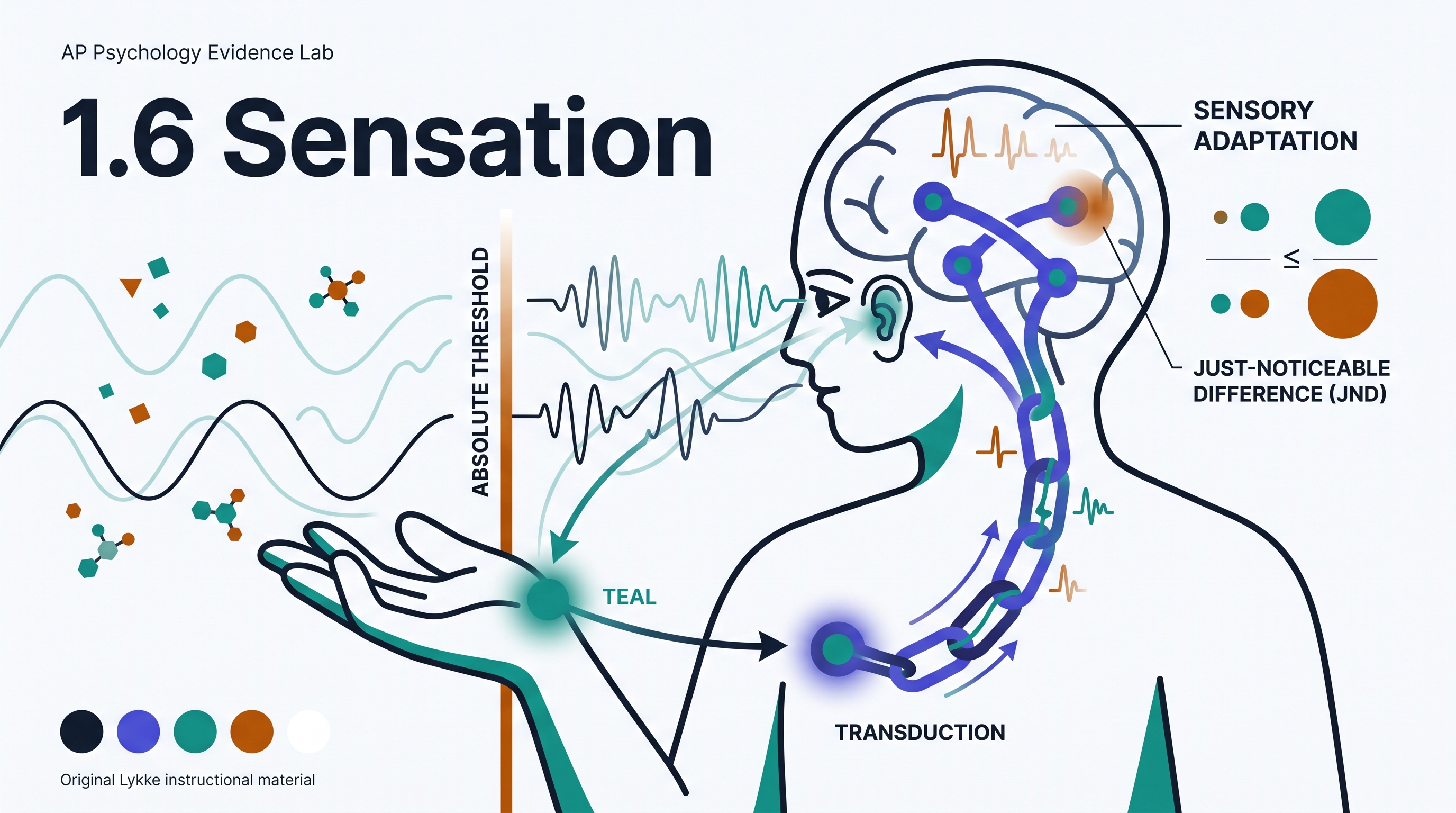
Air molecules never arrive labeled “high” or “low,” yet their patterns of vibration become your experience of pitch. Sensation is the process of detecting environmental information and transducing—converting—physical stimulation into neurochemical messages that the brain can process.
1.6 Sensation
Air molecules never arrive labeled “high” or “low,” yet their patterns of vibration become your experience of pitch. Sensation is the process of detecting environmental information and transducing—converting—physical stimulation into neurochemical messages that the brain can process.
1.6.A.1: Sensation detects information that reaches a threshold and transduces stimuli into neural messages. The absolute threshold is the minimum stimulation detected at least 50% of the time.
From physical stimulus to psychological experience
A sensory system begins with a physical event: vibrating air, light entering the eye, chemicals binding to receptors, or pressure and temperature changing at the skin. Specialized receptor cells respond to that event, convert it into neural activity, and send information toward the brain. The resulting psychological experience—such as hearing a note, tasting bitterness, or feeling heat—is therefore connected to biology but is not identical to the stimulus itself.
Consider a quiet tone. If you hear it on roughly half of its presentations, it is near your absolute threshold for hearing. If the tone becomes more intense, detection becomes more reliable. The threshold is not a magical boundary that every person crosses at exactly the same stimulus level; it is a statistical criterion based on detection frequency.
Change detection: JND, Weber’s law, and adaptation
A just-noticeable difference, or difference threshold, is the smallest change in stimulation that you can detect. Weber’s law states that the required change is proportional to the starting intensity: adding a small amount to a faint sound may be noticeable, while the same absolute addition to a very loud sound may not be.
Worked example: You can distinguish a $1$-kilogram object from a $1.02$-kilogram object, so the detectable change is $0.02$ kilograms, or $2%$ of the original. If the starting object weighs $10$ kilograms and the same proportion applies, you would need a change of about $0.20$ kilograms to notice the difference. The important inference is proportional, not merely numerical.
Sensory adaptation is reduced sensitivity after continuous exposure to an unchanging stimulus. The refrigerator hum may disappear from awareness, not because the sound stops, but because the sensory system becomes less responsive to its constant presence. Adaptation allows attention to shift toward new or changing information.
Biological structures become specific experiences
In audition, vibrating air molecules create pressure waves. The wave’s frequency—how rapidly the air pressure pattern repeats—is related to perceived pitch: higher frequency is generally experienced as a higher pitch. The auditory receptors in the inner ear transduce those vibrations into neural signals; the brain then interprets the signal as a sound with a particular pitch.
In taste, chemicals dissolve in saliva and activate taste receptors. Differences in receptor sensitivity help explain why one person may experience a vegetable as mildly bitter while another experiences it as intensely bitter. A supertaster has unusually high taste sensitivity, especially for certain bitter compounds; this is a biological difference linked to a psychological outcome, not a claim that the person is simply being “picky.”
In the skin, thermoreceptors respond to changes associated with warmth or cold. Their neural signals contribute to the sensation of heat. The experience depends on receptor activity and brain processing, so the same physical temperature can feel different depending on context, adaptation, and the state of the body.
Sensory pathways and interaction
The thalamus acts as a major relay station for most sensory information, directing incoming signals toward appropriate areas of the cerebral cortex. A critical exception is olfaction, or smell: smell information reaches olfactory brain regions without first following the typical thalamic relay route. Do not memorize “all senses pass through the thalamus”; smell is the assessment-relevant exception.
Your senses also work together through sensory interaction (1.6.A.3). Flavor combines taste and smell, so congestion can make food seem bland. This cooperation shows why a psychological experience cannot always be explained by one receptor system in isolation. In unusual cases, cross-sensory experiences such as synesthesia illustrate how stimulation in one sensory pathway can be experienced alongside another sensory quality.
Misconception check: Sensation is not the same as perception. Sensation is detection and transduction; perception is the brain’s processing and interpretation of those neural messages. Also, sensory adaptation does not mean the receptor has permanently stopped working—it means sensitivity to an unchanging stimulus has diminished.
Learning Objective and skills boundary
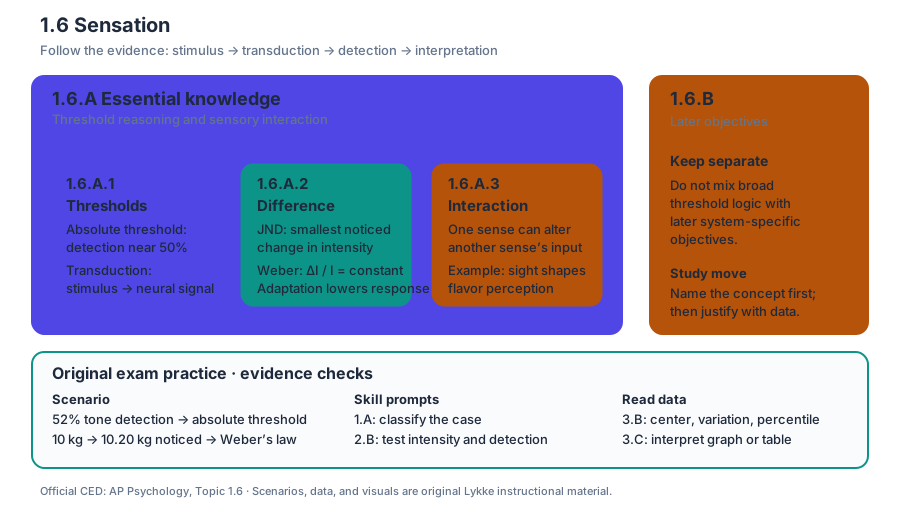
Learning Objective 1.6.A asks you to explain how sensation relates to behavior and mental processes. Its three essential-knowledge anchors are 1.6.A.1—thresholds and transduction; 1.6.A.2—just-noticeable differences, sensory adaptation, and Weber’s law; and 1.6.A.3—sensory interaction. The next learning-objective set, 1.6.B, is separated from 1.6.A: keep the threshold-and-transduction reasoning distinct from the later sensory-system-specific objectives.
For 1.A, apply a concept to a scenario: identify whether the case shows an absolute threshold, adaptation, or sensory interaction. For 2.B, evaluate whether a proposed experiment appropriately manipulates stimulus intensity and measures detection. For 3.B, calculate or interpret measures such as central tendency, variation, or percentile rank in sensory data. For 3.C, interpret a graph, table, or diagram—for example, infer that a detection rate near $50%$ marks an absolute threshold.
Retrieval check: A listener detects a faint tone on $52%$ of trials. A second listener notices a change only when a $10$-kilogram load increases by $0.20$ kilograms. Which concepts are illustrated? Answer: The first result estimates an absolute threshold under 1.6.A.1; the second illustrates a proportional difference threshold consistent with Weber’s law under 1.6.A.2.
Source Materials
- Ap Psychology Course And Exam Description
- Ap Psychology Course At A Glance
- AP Psychology CED: Student Responses and Scoring Commentary
- AP Psychology Exam Questions
- Free-Response Questions
- Free-Response Questions - Set 1
- Free-Response Questions - Set 2
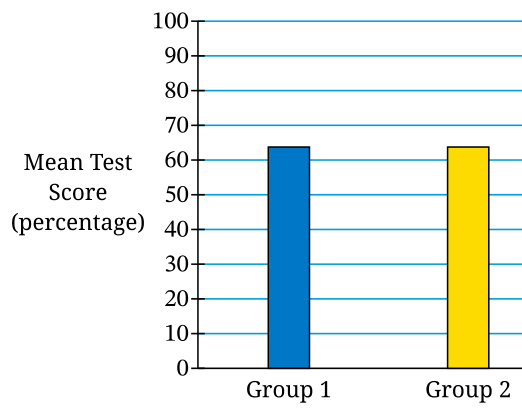
- Group 2’s test scores were not significantly different from group 1’s test scores. The mean test score for group 2 (65%) was about 1 percent higher than the mean test score for group 1 (64%). The data