From the free course AP Psychology on Lykke
3.6 Social-Emotional Development Across the Lifespan
Key concepts: Bronfenbrenner’s ecological systems theory · Parenting styles · Infant attachment styles · Temperament · Separation anxiety · Contact comfort and Harlow’s research · Peer relationships and play · Adolescent egocentrism · Social clock and emerging adulthood · Adult relationships and family-like support
Social development is shaped by a moving web of relationships, culture, biology, and time—not by parenting or personality alone. Bronfenbrenner’s ecological systems theory describes that web and helps you explain why the same behavior can have different meanings in different families, communities, and historical…
3.6 Social-Emotional Development Across the Lifespan
Social development is shaped by a moving web of relationships, culture, biology, and time—not by parenting or personality alone. Bronfenbrenner’s ecological systems theory describes that web and helps you explain why the same behavior can have different meanings in different families, communities, and historical settings.
The social environment as nested systems
Imagine Mira, a ten-year-old who has become quiet at school. Her immediate relationships, the connection between home and school, a parent’s work schedule, cultural expectations, and a recent family move may all contribute. The useful question is not “Which single person caused this?” but “Which layers of Mira’s environment are interacting?”
| System | What it includes | Example for Mira |
|---|---|---|
| Microsystem | Groups and relationships with direct contact | Family, teachers, friends, classroom |
| Mesosystem | Relationships between microsystems | A parent communicating with Mira’s teacher |
| Exosystem | Indirect factors affecting the individual | A caregiver’s work schedule or school-board decision |
| Macrosystem | Cultural values, events, and conditions affecting people around the individual | Beliefs about independence, education, or family roles |
| Chronosystem | Effects of time, transitions, historical events, and changing social conditions | A move, parental divorce, economic disruption, or growing up during a major public crisis |
The chronosystem is not simply Mira’s current age or life stage. It concerns how development changes across time. A family move may affect her differently in elementary school than during adolescence, and a historical change in technology, employment, or public health may alter opportunities for both Mira and her caregivers.
Parenting and early attachment
The three named parenting styles differ in both control and responsiveness. Authoritarian caregivers emphasize obedience and enforce strict rules with relatively little warmth or explanation. Authoritative caregivers set clear limits while also offering warmth, reasoning, and responsiveness. Permissive caregivers show warmth but provide few rules or expectations. Cultural differences influence how these patterns affect caregivers and children; a behavior that signals respectful guidance in one cultural context may be interpreted differently in another.
Attachment is an enduring emotional bond between an infant and caregiver. In a secure pattern, the infant explores while the caregiver is nearby, becomes distressed by separation, and is comforted when the caregiver returns. An avoidant infant may show limited reunion response and appear to avoid or ignore the caregiver. An anxious or resistant infant may become highly distressed, seek contact, and resist comforting after reunion. A disorganized infant may display contradictory or confused behavior, such as approaching and then suddenly withdrawing.
Temperament, a person’s relatively consistent emotional reactivity and self-regulation, influences how early bonds form. It does not determine attachment by itself: caregiver responsiveness, context, and culture also matter. Separation anxiety—heightened fear or distress when away from a caregiver or near a stranger—can reveal the importance of that relationship, although its timing and intensity vary.
Harry Harlow’s monkey research challenged the idea that attachment is explained only by feeding. When infant monkeys could obtain food from a wire surrogate but comfort from a soft surrogate, they spent more time clinging to the soft figure. The finding illustrates contact comfort: soothing physical closeness can be central to attachment beyond the satisfaction of biological needs.
Key insight: Food can meet a need; contact comfort can organize a relationship.
Peer relationships across development
Young children begin social interaction through parallel play, playing beside one another with limited coordination. Later, pretend play allows children to share roles, rules, and imagined situations. These forms of play show changing social coordination without requiring the child to understand relationships in adult terms.
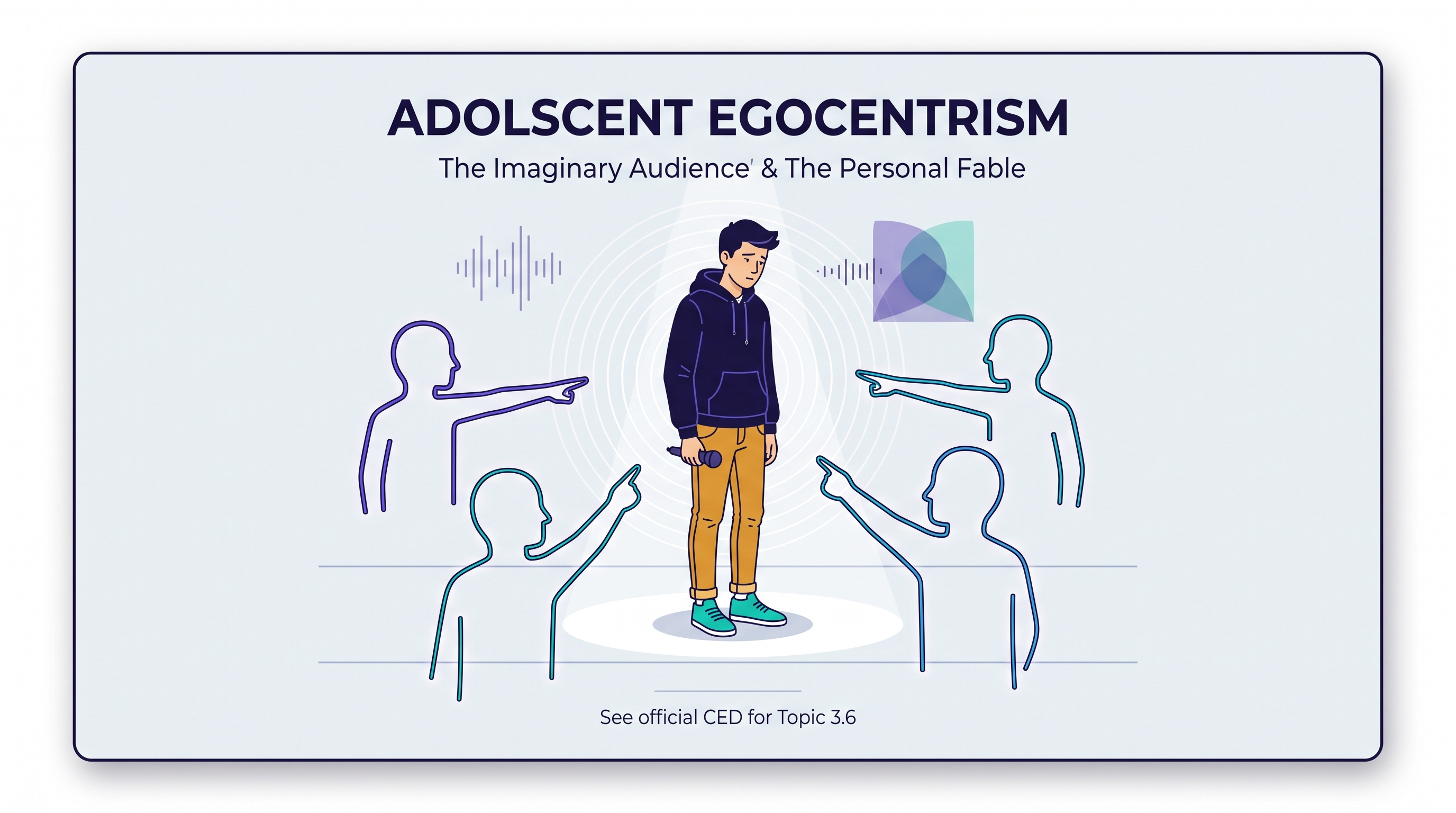
As adolescents age, peer relationships generally become more influential. Adolescent egocentrism can appear as an imaginary audience, the belief that others constantly notice one’s appearance or actions, and a personal fable, the belief that one’s experiences are uniquely intense or that ordinary risks will not apply personally.
Adulthood, culture, and continuing bonds
The social clock is the culturally shaped timetable for major life events such as leaving home, entering a long-term partnership, becoming a parent, or beginning a career. Some cultures recognize emerging adulthood, a transition between adolescence and settled adulthood in which identity, education, work, and relationships are still developing. Therefore, adulthood does not begin at exactly the same age or follow the same sequence everywhere.
Adult relationships can create families or family-like networks that provide mutual support and care. Earlier attachment patterns may influence expectations in adult relationships, but they are not unchangeable predictions; later relationships and social conditions can reshape those expectations.
Worked application and misconception check
Original scenario: After her parents’ separation, Mira moves to a new city during a period when one parent begins night-shift work. She remains affectionate with her caregiver but becomes hesitant around unfamiliar adults, while her new school emphasizes independent participation. The move and changing work schedule belong to the exosystem and chronosystem; her caregiver and school are part of the microsystem; and the school-family relationship is the mesosystem. Her cautious reunion behavior could suggest an insecure attachment pattern, but one observation cannot classify her attachment.
Misconception check: “Authoritarian means uncaring, and authoritative means permissive.” Not exactly. Authoritarian and authoritative caregivers both set limits; the key difference is the balance of responsiveness, explanation, and control. Likewise, an attachment style is not a permanent diagnosis or a label to assign from one behavior.
Retrieval check
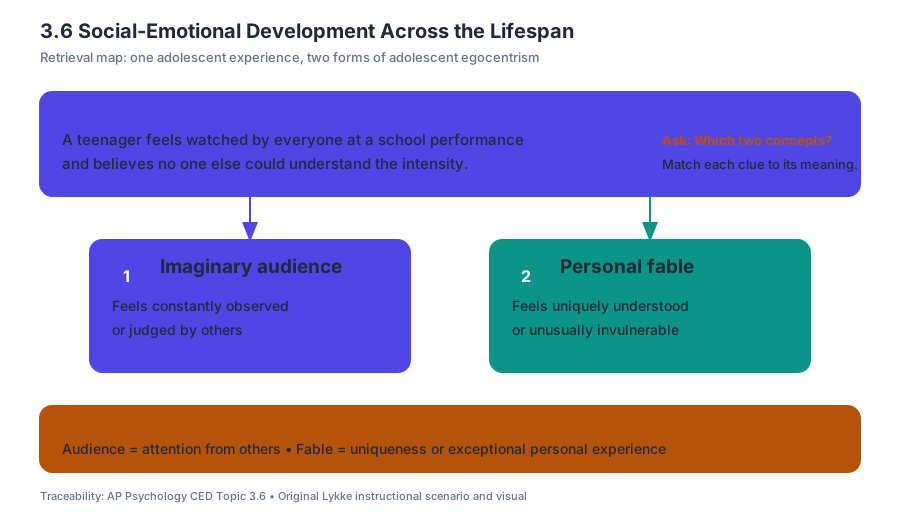
A teenager feels watched by everyone at a school performance and believes no one else could understand the intensity of the experience. Which two concepts apply? Answer: the imaginary audience and the personal fable. The first concerns feeling constantly observed; the second concerns feeling uniquely understood or unusually invulnerable.

Source Materials
- Ap Psychology Course And Exam Description
- Ap Psychology Course At A Glance
- AP Psychology CED: Student Responses and Scoring Commentary
- AP Psychology Exam Questions
- Free-Response Questions
- Free-Response Questions - Set 1
- Free-Response Questions - Set 2
- Part A Claire’s sports team made it to the championship basketball game. To play the game, the