From the free course AP Psychology on Lykke
3.4 Cognitive Development Across the Lifespan
Key concepts: Cognitive development across the lifespan · Piaget’s theory of cognitive development · Schemas · Assimilation · Accommodation · Continuous and discontinuous development · Fluid intelligence · Crystallized intelligence · Executive functioning · Cognitive decline in older adulthood
A child who once searches for a hidden toy only where it was last seen eventually understands that the toy still exists—even when it disappears behind a blanket.
3.4 Cognitive Development Across the Lifespan
A child who once searches for a hidden toy only where it was last seen eventually understands that the toy still exists—even when it disappears behind a blanket. That change is cognitive development: the growth and reorganization of capabilities used for thinking, remembering, reasoning, and solving problems across the lifespan. Cognitive-development theories help you explain not only what a person does, but also the mental processes that make the behavior possible.
Learning Objective 3.4.A: Explain how theories of cognitive development apply to behavior and mental processes.
Piaget: schemas change through experience
Jean Piaget described a schema as a mental framework for organizing and interpreting information. You might have a schema for “dog,” “classroom,” or “fairness.” When you encounter new information, two related processes adjust your schemas:
- Assimilation means fitting a new experience into an existing schema.
- Accommodation means changing an existing schema, or creating a new one, when the old schema no longer works.
Imagine that a toddler has a “small, four-legged animal” schema based on seeing a dog. The child calls a cat “dog.” That is assimilation: the new animal is being interpreted through the existing schema. After noticing that cats meow, climb, and look different, the child creates a more precise category. That revision is accommodation.
Piaget viewed development as both continuous and discontinuous. Continuous change is gradual: vocabulary, coordination, or problem-solving skill can improve little by little. Discontinuous change involves qualitatively different ways of thinking, often described as stages. According to 3.4.A.1, children develop schemas through processes such as assimilation and accommodation, and cognitive-development theories explain observable behavior and mental processes.
Piaget’s stages and the limits of stage claims
In the sensorimotor stage, from infancy through toddlerhood, children learn largely through sensory experiences and physical actions. A major achievement is object permanence, the understanding that an object continues to exist when it cannot currently be seen. In the preoperational stage, from toddlerhood through early childhood, children become proficient at using mental symbols and engage in pretend play.
Piaget’s stage descriptions are useful patterns, not rigid deadlines. Later research using simpler instructions, familiar materials, and tasks that reduce language demands has found that some abilities may appear earlier than Piaget proposed. The important reasoning is not “Piaget was completely wrong,” but that performance depends on both developing capability and the situation used to measure it.
Vygotsky: thinking grows through social support
Lev Vygotsky emphasized that children are social learners. According to 3.4.A.2, cognitive growth occurs through interaction with more knowledgeable people within sociocultural contexts—the language, practices, expectations, and tools of a community.
The zone of proximal development is the range between what a child can do independently and what the child can do with effective assistance. Scaffolding is temporary support from a teacher, caregiver, or more skilled peer. For example, a child who cannot yet solve a puzzle alone may succeed when an adult first points out the corner pieces, then gradually withdraws help. Piaget would emphasize the child’s changing cognitive structure; Vygotsky would emphasize guided participation and social interaction.
Adult cognition: two kinds of intelligence, different trajectories
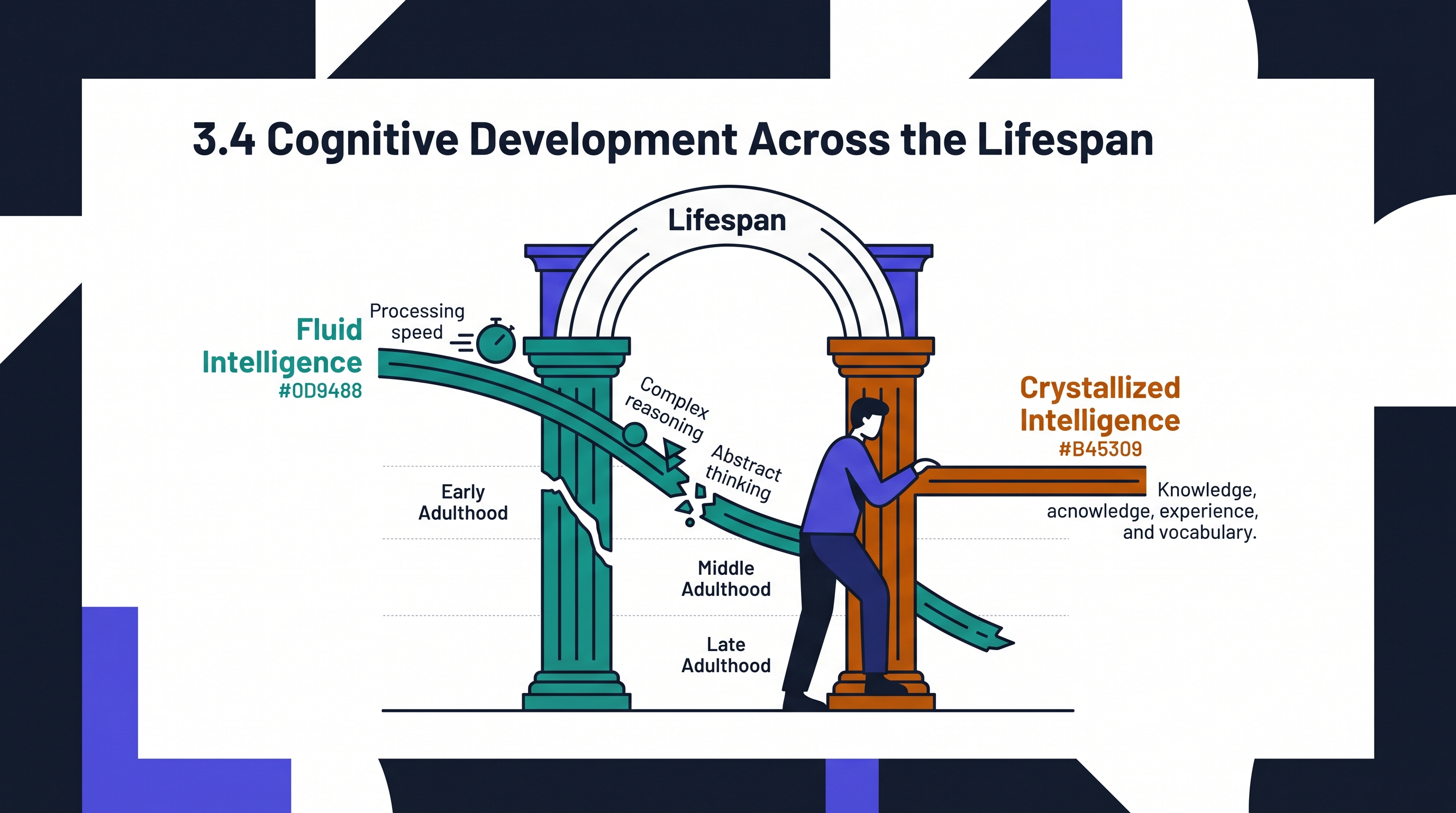
Cognitive capabilities continue to change throughout adulthood, but not all abilities change in the same direction. Crystallized intelligence is accumulated knowledge, vocabulary, and learned skills; it tends to remain relatively stable throughout adulthood. Fluid intelligence is the ability to solve novel problems, detect patterns, and reason quickly without relying mainly on previously learned information; it tends to wane as people age.
These are population-level tendencies, not predictions about every individual. Education, health, activity, environment, and practice contribute to individual variability. Change can also be gradual, such as slower processing over time, or qualitative, such as the serious changes in memory and reasoning associated with dementia. Research has examined whether interventions, including multivitamin use, can delay some cognitive decline; one cited study tested whether taking a multivitamin affected executive functioning. A study can test that claim, but its result must be interpreted from the actual evidence rather than assumed.
Worked application and misconception check
A six-year-old uses pretend play, struggles with a task requiring a perspective different from their own, and solves a puzzle after an adult demonstrates the first step. A strong analysis identifies preoperational characteristics from Piaget, while the successful puzzle performance illustrates Vygotsky’s scaffolding within the child’s zone of proximal development. The same behavior can therefore be explained using more than one theory, provided each theory contributes a distinct mechanism.
Common misconception: “Development happens only in fixed stages.” Stage theories describe discontinuous shifts, but cognitive development also involves continuous learning, social support, biological change, and environmental influence. Another error is treating crystallized intelligence as identical to fluid intelligence: accumulated knowledge may remain stable even while novel-problem solving becomes more difficult.
Retrieval check
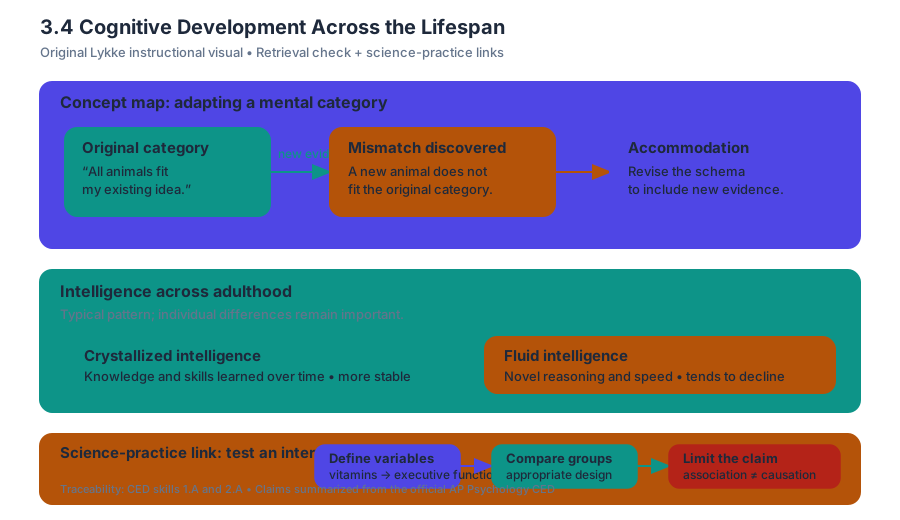
A child changes an animal category after discovering that a new animal does not fit the original category. Which process occurred, and which intelligence generally remains more stable across adulthood?
Answer: The child used accommodation. Crystallized intelligence generally remains more stable, whereas fluid intelligence tends to decline with age.
Science-practice links: Skill 1.A requires applying psychological concepts to a new scenario; skill 2.A requires identifying how a research design can answer a question about development. When evaluating an intervention such as multivitamin use and executive functioning, define the variables, compare groups appropriately, and avoid claiming that an observed association proves causation.