From the free course AP Psychology on Lykke
3.9 Social, Cognitive, and Neurological Factors in Learning
Key concepts: Social learning theory · Insight learning · Latent learning · Biological preparedness · One-trial learning · Classical conditioning of emotional responses · Counterconditioning · Social clock · Biological basis of hunger · Expectancy theory as an excluded topic
Explain observational learning, latent learning and insight, and identify when a behaviour is better explained by them than by conditioning.
3.9 Social, Cognitive, and Neurological Factors in Learning
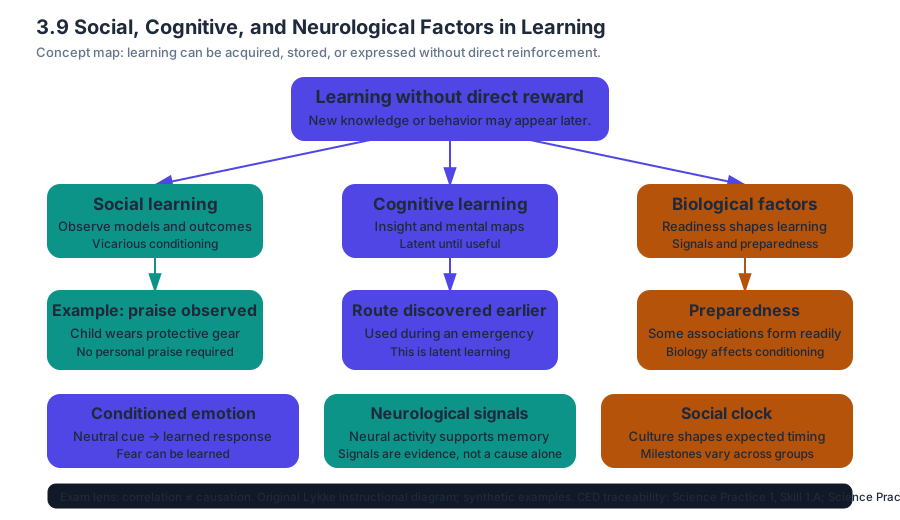
A person can learn without being rewarded, punished, or personally burned by a mistake: watching someone else succeed, suddenly seeing a solution, or quietly building a mental map can all change behavior. Social, cognitive, and neurological factors in learning explain why behavior cannot always be reduced to a direct association between an action and its consequence.
Social learning: learning by watching
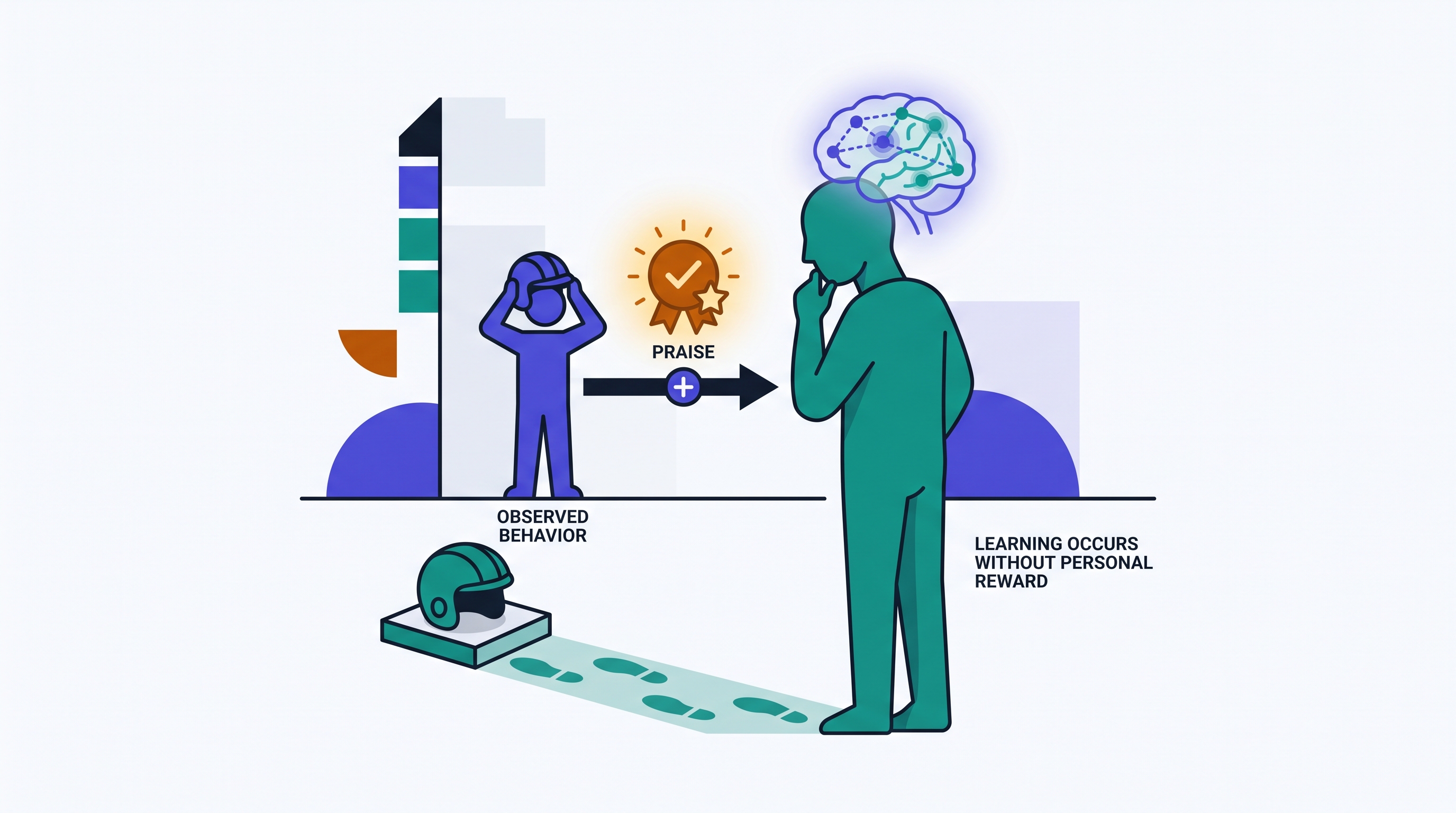
Social learning theory proposes that learning can occur through observation rather than through personal experience with a consequence. When you watch a model—someone whose behavior you observe—you may copy the behavior, especially when the model appears similar to you. This indirect process is called vicarious conditioning: you observe another person receive a consequence and adjust your own behavior accordingly. This directly reflects Essential Knowledge 3.9.A.1 and Learning Objective 3.9.A.
Worked example: Maya watches an older teammate calmly ask a coach for clarification. The coach responds positively, so Maya later uses the same strategy. Maya did not personally experience the coach’s response before copying the behavior; observation supplied the information. If the older teammate is similar to Maya in age, role, or background, that similarity may make the model more influential.
Cognitive learning: when the mind does more than associate
Insight learning occurs when a problem’s solution appears suddenly, without an association, consequence, or model being present. Imagine a person trying several unsuccessful ways to reach an object on a high shelf, then abruptly realizing that two available objects can be stacked. The solution is not explained by copying a model or by gradually strengthening a rewarded response; the relationships among the objects become clear.
Latent learning occurs when information is learned without reinforcement but is not immediately visible in behavior. It is a cognitive learning theory because it emphasizes internal knowledge rather than a directly observable consequence. A person may explore a building without a goal and later navigate efficiently when an exit is needed. The stored knowledge is often represented as a cognitive map, a mental representation of spatial relationships.
Do not confuse latent learning with social learning. Latent learning can occur through exploration without reinforcement, whereas social learning can occur through observing a model, including observing that model receive a consequence. Neither requires you to discover the behavior through direct trial-and-error reinforcement.
Biological preparedness and one-trial learning
Biological preparedness is an organism’s predisposition to learn some stimulus-response pairings more readily than others. Taste aversion demonstrates both preparedness and one-trial learning: an association can form after a single pairing and is not necessarily strengthened by repeated pairings. If an animal becomes ill after eating a particular food, it may avoid that taste later, even after only one exposure.
The important reasoning move is to identify the exception. Ordinary repeated-pairing logic does not explain why one experience can produce a durable taste aversion. The organism’s biology makes some associations especially easy to acquire.
Classically conditioned emotional responses
Emotional responses can also become classically conditioned. A previously neutral stimulus may become linked with fear, anxiety, or another emotional reaction after being paired with an emotionally significant event. This finding supports interventions such as counterconditioning, in which a conditioned emotional response is gradually replaced by a more adaptive response. The treatment application must be understood clinically; a psychological concept is not a diagnostic test.
Neurological influences on learning and motivation
Learning and behavior also depend on bodily signals. Ghrelin typically signals hunger, whereas leptin signals satiety, or fullness. The hypothalamus is the primary brain region involved in regulating hunger and satiety signals in conjunction with the pituitary gland. These signals help explain why behavior changes with internal physiological conditions, not only with external consequences.
Culture also shapes behavior through the social clock: culturally influenced expectations about when major life milestones should occur. One community may expect a person to complete education, begin a career, form a partnership, or become a parent relatively early; another may treat the same milestones as appropriate later or in a different sequence. The social clock describes shared timing expectations, not a universal biological schedule.
AP reasoning checkpoint
For Science Practice 1, Skill 1.A, Concept Application, apply a psychological concept to the exact behavior described. For Science Practice 2, Skill 2.B, Research Methods and Design, identify what a study actually tests rather than assuming that a correlation proves a cause.
Misconception check: “If no reward appears, no learning occurred.” That statement is incorrect. Insight learning, latent learning, and observational learning show that learning may occur without direct reinforcement or personal experience with a consequence.
Retrieval check: A child watches a similar child receive praise for wearing protective equipment, then begins wearing it without being praised personally. What process is illustrated? Answer: Social learning through observation, specifically vicarious conditioning. If the child explored a safety route earlier but used it only when an emergency occurred, that would instead illustrate latent learning.
The scope boundary matters: expectancy theory is outside the scope of the AP Psychology Exam. Focus the explanation on social learning, insight, latent learning, preparedness, conditioned emotional responses, neurological signals, and the culturally shaped social clock.
Source Materials
- Ap Psychology Course And Exam Description
- Ap Psychology Course At A Glance
- AP Psychology CED: Student Responses and Scoring Commentary
- AP Psychology Exam Questions
- Free-Response Questions
- Free-Response Questions - Set 1
- Free-Response Questions - Set 2
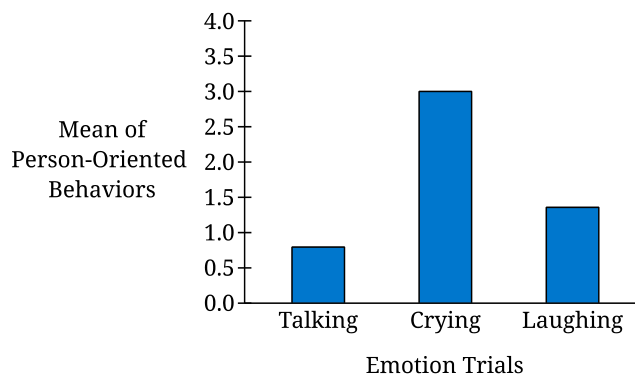
- The results show that the crying trial elicited significantly more person-oriented behaviors than the laughing and talking trials. The mean of person-oriented behaviors when the owner and stranger-res