From the free course AP Psychology on Lykke
3.8 Operant Conditioning
Key concepts: Operant conditioning · Reinforcement schedules · Continuous reinforcement · Partial (intermittent) reinforcement · Interval schedules · Ratio schedules · Fixed schedules · Variable schedules · Response–consequence association · Graphs of operant-conditioning response patterns
Operant conditioning is learning in which the consequences that follow a behavior change the future likelihood of that behavior. If checking a phone produces an interesting message, checking may become more frequent; if a doorbell stops an irritating sound, pressing the button may become more frequent.
3.8 Operant Conditioning
Operant conditioning is learning in which the consequences that follow a behavior change the future likelihood of that behavior. If checking a phone produces an interesting message, checking may become more frequent; if a doorbell stops an irritating sound, pressing the button may become more frequent.
Learning Objective 3.8.A: Explain how operant conditioning applies to behavior and mental processes.
A reinforcer is a consequence that strengthens a response. A punisher is a consequence that weakens a response. “Positive” means something is added; “negative” means something is removed. These words describe the direction of the consequence, not whether it is good or bad.
| Consequence | What changes? | Effect on behavior | Example |
|---|---|---|---|
| Positive reinforcement | Something pleasant is added | Behavior increases | A correct answer earns praise |
| Negative reinforcement | Something unpleasant is removed | Behavior increases | Buckling a seat belt silences a warning |
| Positive punishment | Something unpleasant is added | Behavior decreases | A late assignment receives a penalty |
| Negative punishment | Something pleasant is removed | Behavior decreases | A privilege is taken away after rule-breaking |
The most common error is calling every unpleasant consequence “negative reinforcement.” Negative reinforcement increases behavior because it removes something aversive. Punishment decreases behavior. For example, taking an aspirin to remove a headache is negative reinforcement if it makes you more likely to take aspirin when a headache begins; it is not punishment.
Reinforcement schedules
A reinforcement schedule specifies when reinforcement is delivered. The schedule can determine the strength of the association between a response and its consequence, as stated in Essential Knowledge 3.8.A.5. The two broad categories are continuous reinforcement and partial reinforcement.
Continuous reinforcement delivers reinforcement after each and every correct behavior (3.8.A.5.i). If a child receives a sticker every time the child correctly sorts a card, the connection between sorting and receiving a sticker can form quickly. However, behavior learned under continuous reinforcement may weaken quickly when the reward suddenly stops.
Partial, or intermittent, reinforcement delivers reinforcement only some of the time. Because the learner cannot always predict when the next reward will arrive, behavior learned on a partial schedule often persists longer when reinforcement is absent. Partial schedules differ along two dimensions identified in Essential Knowledge 3.8.A.5.ii:
- Interval: reinforcement depends on the passage of time.
- Ratio: reinforcement depends on the number of responses.
- Fixed: the rule is predictable.
- Variable: the rule changes or is unpredictable.
The four partial schedules
| Schedule | What determines reinforcement? | Original example | Typical response pattern |
|---|---|---|---|
| Fixed-interval | A fixed amount of time must pass | A weekly quiz rewards preparation near the known Friday deadline | A scalloped graph: slow responding just after reinforcement, then faster responding as the deadline approaches |
| Variable-interval | An unpredictable amount of time must pass | Checking for an unexpected email | Steady, moderate responding |
| Fixed-ratio | A fixed number of responses is required | A worker earns a bonus after assembling every tenth package | Rapid responding, often followed by a brief pause after reinforcement |
| Variable-ratio | An unpredictable number of responses is required | A game rewards after an unpredictable number of attempts | High, steady responding with little pause |
To read a response-pattern graph, first ask whether reinforcement depends on time or response count. Then ask whether the rule is predictable or unpredictable. A steep rise followed by a short pause suggests fixed-ratio reinforcement; a relatively steady high rate suggests variable-ratio reinforcement; a scallop strongly signals fixed-interval reinforcement.
Worked application
Imagine a café gives a free drink after every eighth purchase. The reward depends on the number of responses, so the schedule is a ratio schedule. Because the number eight is predictable, it is fixed-ratio. You would predict bursts of purchasing followed by a short pause after the free drink.
Now imagine that a café gives a free drink after an unpredictable number of purchases. The schedule remains ratio-based, but it is variable-ratio. Because the next reward cannot be predicted from time or from a known response count, you would expect persistent, rapid purchasing with little post-reward pause.
Misconception check: “Fixed” does not mean reinforcement happens every time. It means the rule is predictable. Reinforcing every response is continuous reinforcement; reinforcing after every tenth response is fixed-ratio partial reinforcement.
Retrieval check
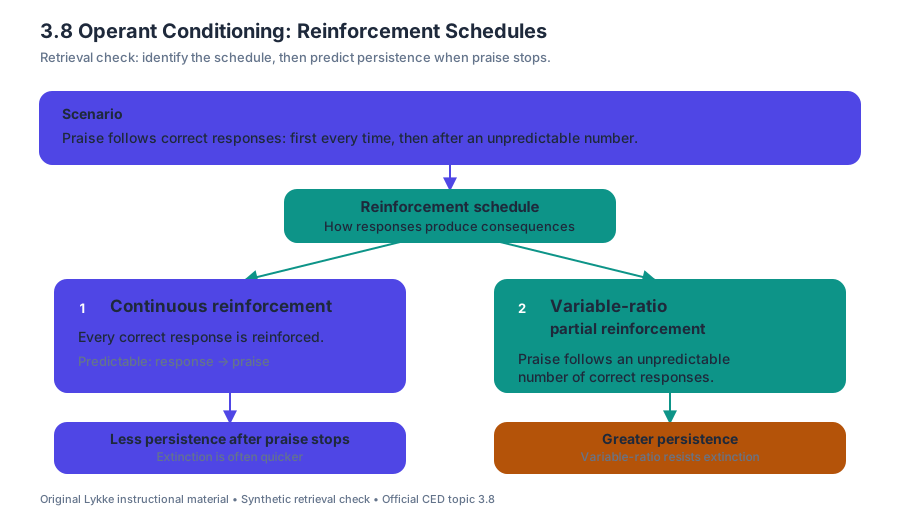
A student receives praise after every correct response during practice, then praise after an unpredictable number of correct responses. Identify the first and second schedules, and state which schedule is likely to produce greater persistence when praise stops.
Answer: The first is continuous reinforcement because every correct response is reinforced. The second is variable-ratio partial reinforcement because reinforcement depends on an unpredictable number of responses. The variable-ratio schedule is expected to produce greater persistence when reinforcement is discontinued.