From the free course AP Psychology on Lykke
5.3 Explaining and Classifying Psychological Disorders
Key concepts: Psychological disorders · Dysfunction · Distress · Deviation from social norms · Diagnosis and classification of psychological disorders · Specialized training and evidence-based diagnosis · International Classification of Mental Disorders (ICD) · Biological perspective · Biopsychosocial model · Interaction models
A behavior can be unusual without being a psychological disorder. Clinical classification asks a harder question: does the pattern create dysfunction, distress, or a serious deviation from social norms, and how should cultural context affect that judgment?
5.3 Explaining and Classifying Psychological Disorders
A behavior can be unusual without being a psychological disorder. Clinical classification asks a harder question: does the pattern create dysfunction, distress, or a serious deviation from social norms, and how should cultural context affect that judgment?
Three lenses for identifying a disorder
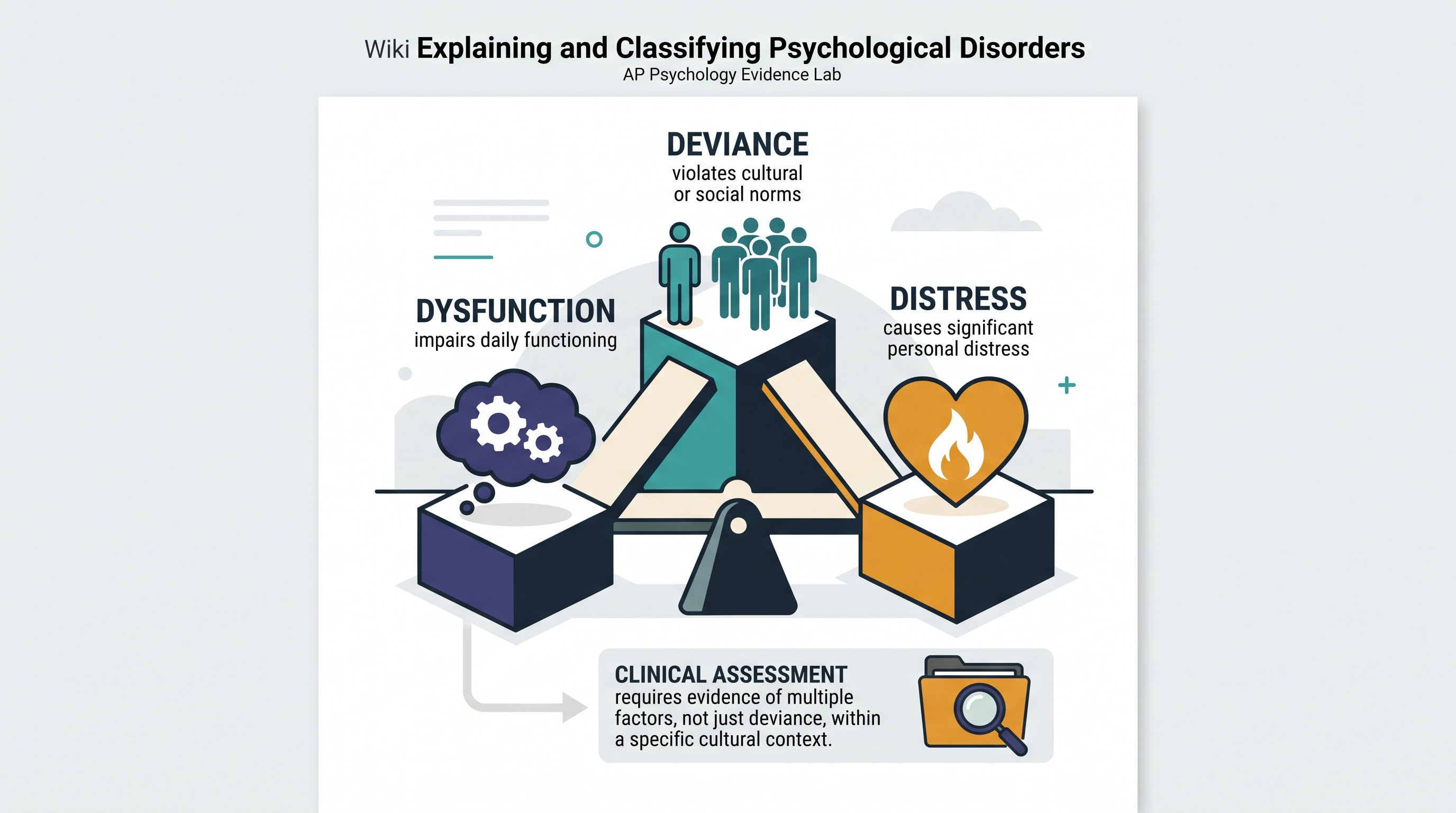
Dysfunction means that a psychological pattern seriously interferes with important activities such as work, relationships, self-care, or judgment. Distress means that the person experiences significant suffering or impairment. Deviation from social norms means that behavior differs sharply from the expectations of a particular society or culture. These factors work together rather than operating as automatic yes-or-no tests (5.3.A.1).
Imagine that Ren repeatedly checks a door lock for hours each night. The behavior is unusual, but the strongest clinical clues are its consequences: Ren cannot sleep, arrives late to work, and feels intense anxiety when trying to stop. The pattern shows dysfunction and distress. By contrast, a harmless cultural practice may differ from a local majority’s customs without indicating disorder; difference alone is not dysfunction.
Misconception check: “Any behavior outside the social norm is abnormal in the clinical sense.” That error treats one culture’s expectations as a universal measuring stick. A sound interpretation asks who defines the norm, whether the behavior causes impairment or suffering, and whether discrimination or misunderstanding is producing the apparent problem.
Diagnosis helps—and can harm
A diagnosis is a trained professional’s evidence-based classification of a pattern of behavior and mental processes. Classification can bring benefits: it can organize symptoms, guide treatment, improve communication among professionals, support access to services, and help researchers compare findings. It can also produce harms, including stigma, stereotyping, discrimination, and the tendency to treat a label as a complete description of a person (5.3.A.2).
The consequences depend on the disorder, the individual, and the surrounding culture. Racism, sexism, ageism, and other forms of discrimination can bias who gets diagnosed, which behaviors are interpreted as symptoms, and whose reports are believed. A classification should therefore be interpreted with cultural humility and evidence—not used as a shortcut for judging character.
Evidence-based classification systems
Psychological diagnosis requires specialized training and evidence-based diagnostic tools; it is not a self-test or an exercise in guessing what is “wrong” with a real person. The Diagnostic and Statistical Manual of Mental Disorders, developed by the American Psychiatric Association, provides a classification system used in many clinical settings. The International Classification of Mental Disorders, developed by the World Health Organization, provides an international classification system. These systems are revised as research and clinical practice advance (5.3.A.3).
The DSM-5-TR and ICD organize diagnostic information, but they do not replace professional judgment. A careful clinician considers the pattern, duration, severity, impairment, context, available evidence, and possible alternative explanations. Research data must also be interpreted cautiously: a correlation between a biological marker and a disorder does not by itself prove that the marker caused the disorder.
Why psychologists combine perspectives
Most psychologists use an eclectic approach, meaning that they combine more than one psychological perspective when diagnosing and treating clients (5.3.B.1). A biological perspective may examine physiological or genetic influences (5.3.B.8). A psychological perspective may consider thoughts, emotions, learning history, or personality. A social or cultural perspective may examine relationships, community conditions, cultural expectations, and discrimination.
The biopsychosocial model assumes that psychological problems can involve biological, psychological, and social or cultural factors (5.3.C.1). The diathesis-stress model is a related interaction model: a predisposition, or diathesis, combines with stressful experiences to increase the likelihood that a disorder will develop (5.3.C.2).
Worked application: Suppose Kai develops persistent panic symptoms after moving into an unsafe and socially isolated environment. A biological explanation might investigate inherited vulnerability or physiological sensitivity. A psychological explanation might examine learned fear and catastrophic interpretations of bodily sensations. A social explanation might examine isolation and chronic threat. The biopsychosocial interpretation does not choose one explanation merely because it sounds simplest; it asks how these factors may interact.
The reasoning skills in a clinical scenario
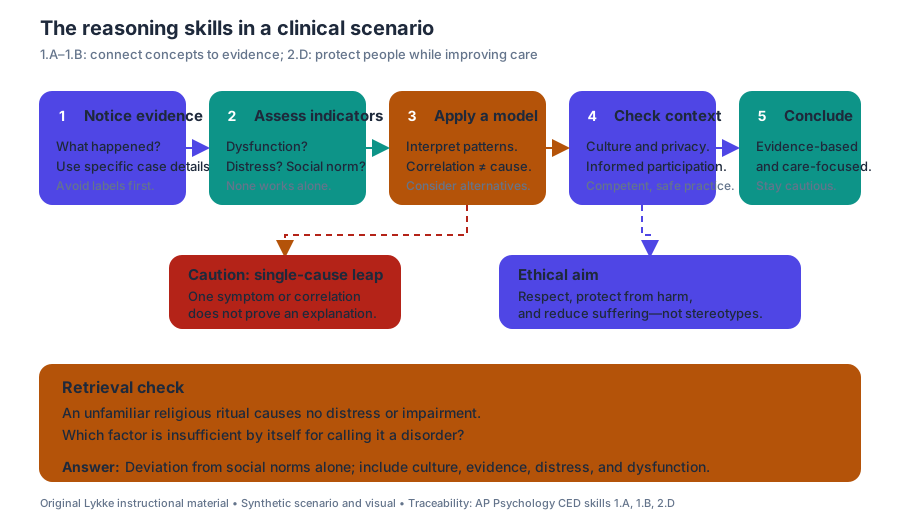
For 1.A, apply a psychological concept to the details of an unfamiliar case: identify whether dysfunction, distress, or deviation from social norms is present, then connect the term to specific evidence. For 1.B, interpret the case through a perspective or model and avoid treating one correlation or one symptom as proof of a single cause.
For 2.D, evaluate ethical practice: look for respect, informed participation where applicable, privacy, protection from harm, culturally responsive interpretation, and appropriate professional competence. Diagnosis should reduce suffering and improve care, not become a tool for labeling people based on stereotypes.
Retrieval check: A person follows an unfamiliar religious ritual that differs from the local majority’s customs but causes no distress or impairment. Which identification factor is insufficient by itself for calling the behavior a disorder?
Answer: Deviation from social norms alone is insufficient. You must also consider dysfunction, perceived distress, cultural context, evidence, and possible discrimination before drawing a clinical conclusion.