From the free course AP Psychology on Lykke
P.7 Article Analysis Question Practice
Key concepts: Misinformation effect · Source monitoring and memory accuracy · Source credibility perception · Research-method identification · Interpreting mean differences · Ethical guidelines in psychological research · Generalizability and sample size · Argumentation using research evidence · Informed consent and confidentiality · Big Five conscientiousness and morality
A strong Article Analysis response does more than name a psychological term: it connects a study feature, a result, or an ethical decision to the evidence in the article.
P.7 Article Analysis Question Practice
A strong Article Analysis response does more than name a psychological term: it connects a study feature, a result, or an ethical decision to the evidence in the article. The central habit is claim → evidence → explanation. If a prompt asks what a mean difference indicates, defining mean is not enough; you must explain what the difference between the groups shows.
The evidence chain: misinformation, credibility, and memory
The misinformation effect occurs when misleading information introduced after an event influences later memory for that event. Source monitoring—deciding where a remembered detail came from—helps explain why this happens. A participant may remember a detail but confuse its source, treating a misleading summary as if it came from the original event.
Source credibility changes this process. When participants distrust a summary, they may monitor its source more carefully and resist incorporating its misleading details. Pena, Klemfuss, Loftus, and Mindthoff (2017), in Psychology of Consciousness: Theory, Research, and Practice, 4(4), 337–347, reported that participants who were distrustful of the summary resisted more misinformation than participants who were not distrustful.
Misconception check: “The participants had inaccurate memories because they forgot everything.” That conclusion is too broad. The relevant issue is whether misleading post-event information was accepted during source monitoring. A person can remember the event reasonably well yet misattribute a later detail to the original event.
Read a mean difference as a comparison
A mean is an arithmetic average, calculated by adding scores and dividing by the number of scores. In an AAQ response, however, writing “the mean is the average score” usually earns little or no credit when the prompt asks for interpretation. You must state what the group comparison indicates.
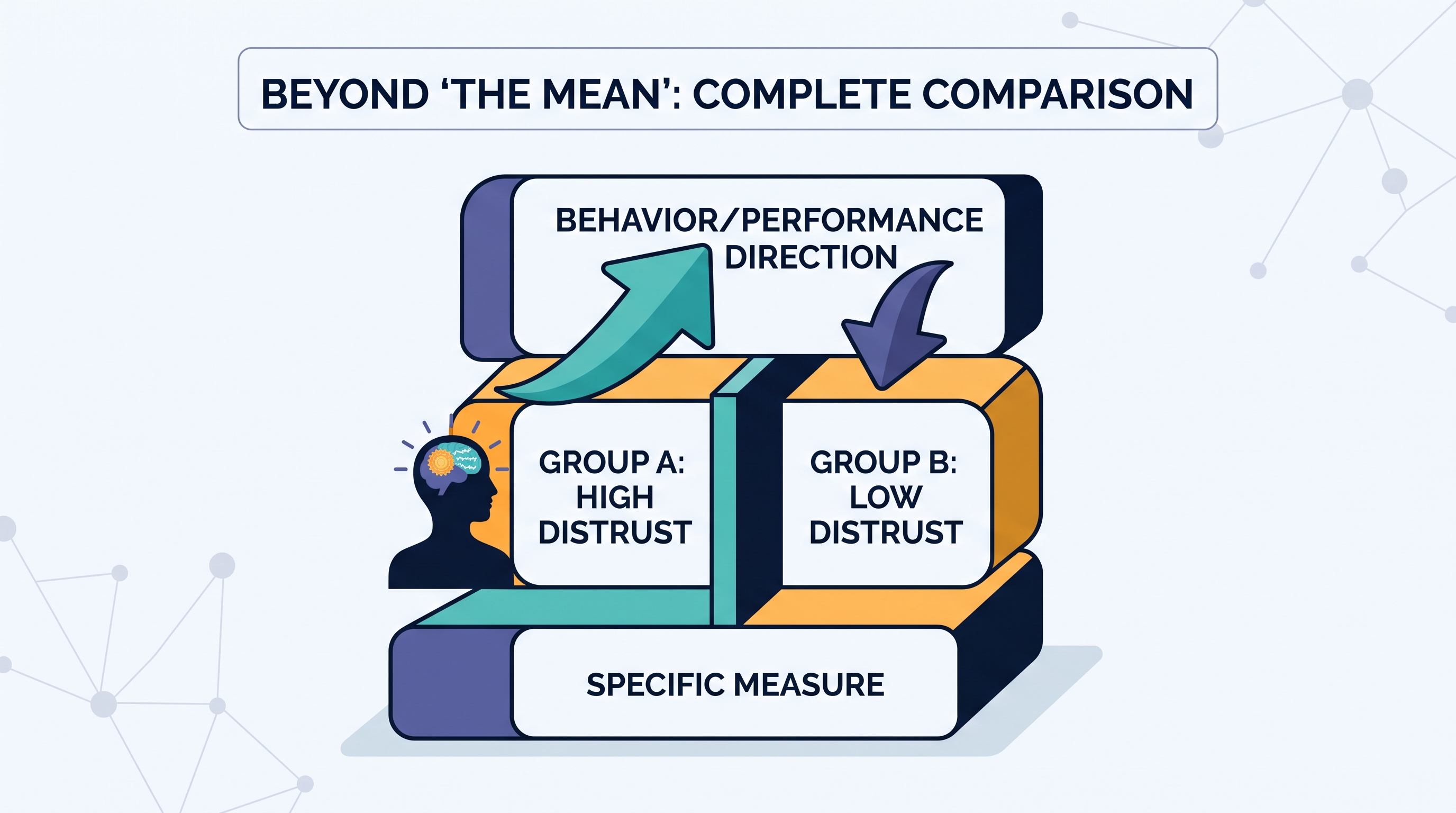
For example, suppose the low-misinformation group had a higher mean number of correct responses among participants distrustful of the summary than among participants who were not distrustful. The correct interpretation is: participants who were distrustful of the summary resisted more misinformation than participants who were not distrustful. The word higher must identify the direction of the difference, and the response must name what behaviour or performance the score represents.
Research method, ethics, and generalizability
When researchers assign participants to conditions and manipulate the amount of misinformation, the design is an experiment. A questionnaire may appear inside an experiment; the presence of a questionnaire does not automatically make the entire study correlational. Identify the design from manipulation and assignment, not from one instrument used to collect data.
Informed consent means obtaining participants’ agreement to take part after giving appropriate information about participation. Confidentiality means protecting participants’ identifying information and not revealing responses in a way that identifies them. Do not substitute a different ethical guideline merely because it is generally relevant: if the article explicitly describes consent, use informed consent as the evidence-based answer.
Generalizability concerns whether findings can reasonably apply beyond the people who participated. A sample of $127$ students may limit generalizability because the participants may not represent older adults, children, or people from different educational and cultural backgrounds. Avoid claiming that a study is generalizable merely because its participants are “diverse”; connect your judgment to the sample’s actual size and composition.
A trait application must also remain precise. A low level of conscientiousness, one of the Big Five personality traits, is associated in the passage with being less organized or responsible. Do not replace that description with morality, kindness, or intelligence.
Original AAQ practice: source credibility and memory accuracy
Synthetic scenario — original Lykke instructional material. Researchers recruited $127$ university students to watch a brief fictional security video. Afterward, participants read either a low-misinformation or high-misinformation summary. Before completing a recognition test, each participant rated how trustworthy the summary seemed. The researchers randomly assigned participants to the two summary conditions. In the low-misinformation condition, participants who distrusted the summary had a mean of $18$ correct responses, whereas participants who did not distrust it had a mean of $14$. The researchers obtained informed consent and stored responses without names.
Answer the following parts in complete sentences.
Part A — Research method. Identify the research method used.
Part B — Research variable. Identify the independent variable.
Part C — Statistic interpretation. Interpret the difference between the two means in the low-misinformation condition.
Part D — Ethical guideline. Identify one ethical guideline explicitly demonstrated in the scenario.
Part E — Generalizability. Explain why the findings may not generalize broadly.
Part F — Argumentation. Explain how the result supports the claim that source credibility affects resistance to misinformation. Include the relevant memory concept.
Answer key and criterion-level guidance
- Part A — Research method: The study is an experiment because the researchers manipulated the summary condition and randomly assigned participants to conditions. Skill connection: 2.A, identifying research design.
- Part B — Research variable: The independent variable is the amount of misinformation in the summary: low misinformation versus high misinformation. Skill connection: 2.B, identifying variables and operational definitions.
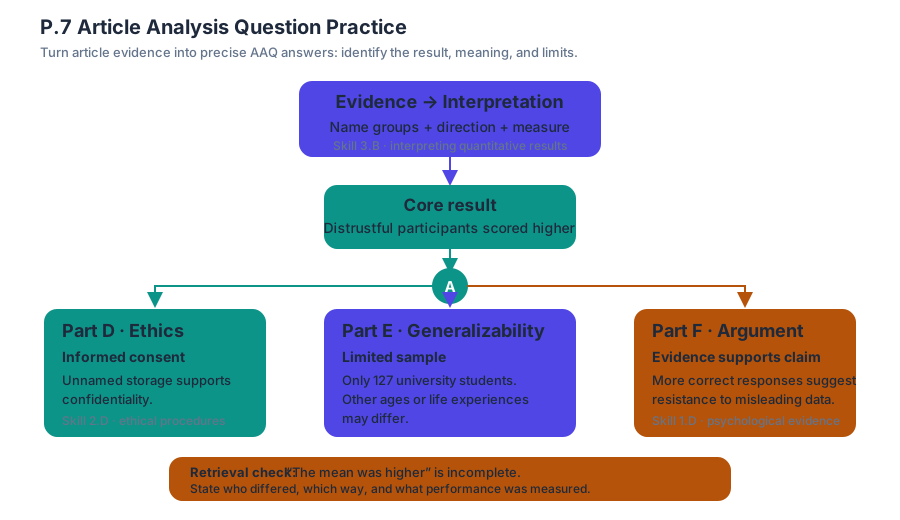
- Part C — Statistic interpretation: In the low-misinformation condition, participants who distrusted the summary averaged $18$ correct responses, compared with $14$ for participants who did not distrust it. Therefore, distrustful participants resisted more misinformation or produced more accurate recognition responses. A response that only defines “mean” misses the comparison. Skill connection: 3.B, interpreting quantitative results.
- Part D — Ethical guideline: The researchers obtained informed consent. The unnamed storage also demonstrates attention to confidentiality, because responses were not linked to participants’ names. Skill connection: 2.D, evaluating ethical procedures.
- Part E — Generalizability: Generalizability is limited because the sample consisted of only $127$ university students. The findings may not apply to people of different ages, educational backgrounds, or life experiences. Skill connection: 2.C, evaluating generalizability.
- Part F — Argumentation: The result supports the claim because distrustful participants had more correct responses, indicating that they resisted more misleading information. This pattern is consistent with stronger source monitoring: participants may have distinguished the original video information from the less-credible summary. Skill connection: 1.D, supporting an argument with psychological evidence.
Final retrieval check: Why is “the mean was higher” incomplete as an AAQ response? Answer: It does not identify what the higher mean indicates; you must name the groups, the direction of the difference, and the behaviour or performance measured.