From the free course AP Psychology on Lykke
3.1 Themes and Methods in Developmental Psychology
Key concepts: Developmental psychology · Chronological development across the lifespan · Thematic issues in development · Stability and change · Nature and nurture · Continuous development · Discontinuous stages of development · Cross-sectional research design · Experiments in developmental psychology · Learning and memory across development
Developmental psychology examines how behavior and mental processes unfold across the lifespan. You can study development in chronological order—for example, infancy, childhood, adolescence, adulthood, and later life—or through themes that continue across many ages.
3.1 Themes and Methods in Developmental Psychology
Developmental psychology examines how behavior and mental processes unfold across the lifespan. You can study development in chronological order—for example, infancy, childhood, adolescence, adulthood, and later life—or through themes that continue across many ages. A question such as “How does memory change with age?” is chronological; “Does personality remain stable or change?” is thematic.
The enduring questions
The official essential knowledge for 3.1.A.1 identifies three central themes: stability versus change, nature versus nurture, and continuous versus discontinuous development. These are not three competing answers that psychology has permanently settled; they are lenses for asking what evidence means.
| Developmental theme | The key question | Worked interpretation |
|---|---|---|
| Stability versus change | Does a characteristic remain relatively consistent, or does it transform with experience and age? | A cautious child may become more socially confident, while some individual differences remain recognizable. |
| Nature versus nurture | How do inherited factors and environmental experiences contribute to development? | Language requires biological capacity, but interaction, instruction, and culture shape what language a person acquires. |
| Continuous versus discontinuous development | Does development occur gradually, or through qualitatively different stages? | Increasing vocabulary may look continuous; movement into a new kind of reasoning may appear discontinuous. |
A single person can show both stability and change. Memory retention and sensory acuity may fluctuate with age, while people also continue formal and informal learning through a substantial portion of the lifespan. Therefore, “development” does not mean only childhood growth, and “change” does not automatically mean improvement.
Research designs: comparing ages or following people
To investigate development, you must distinguish cross-sectional from longitudinal research. A cross-sectional study compares different age groups at one point in time. A longitudinal study measures the same individuals repeatedly across time.
| Design | What researchers do | Strength | Limitation |
|---|---|---|---|
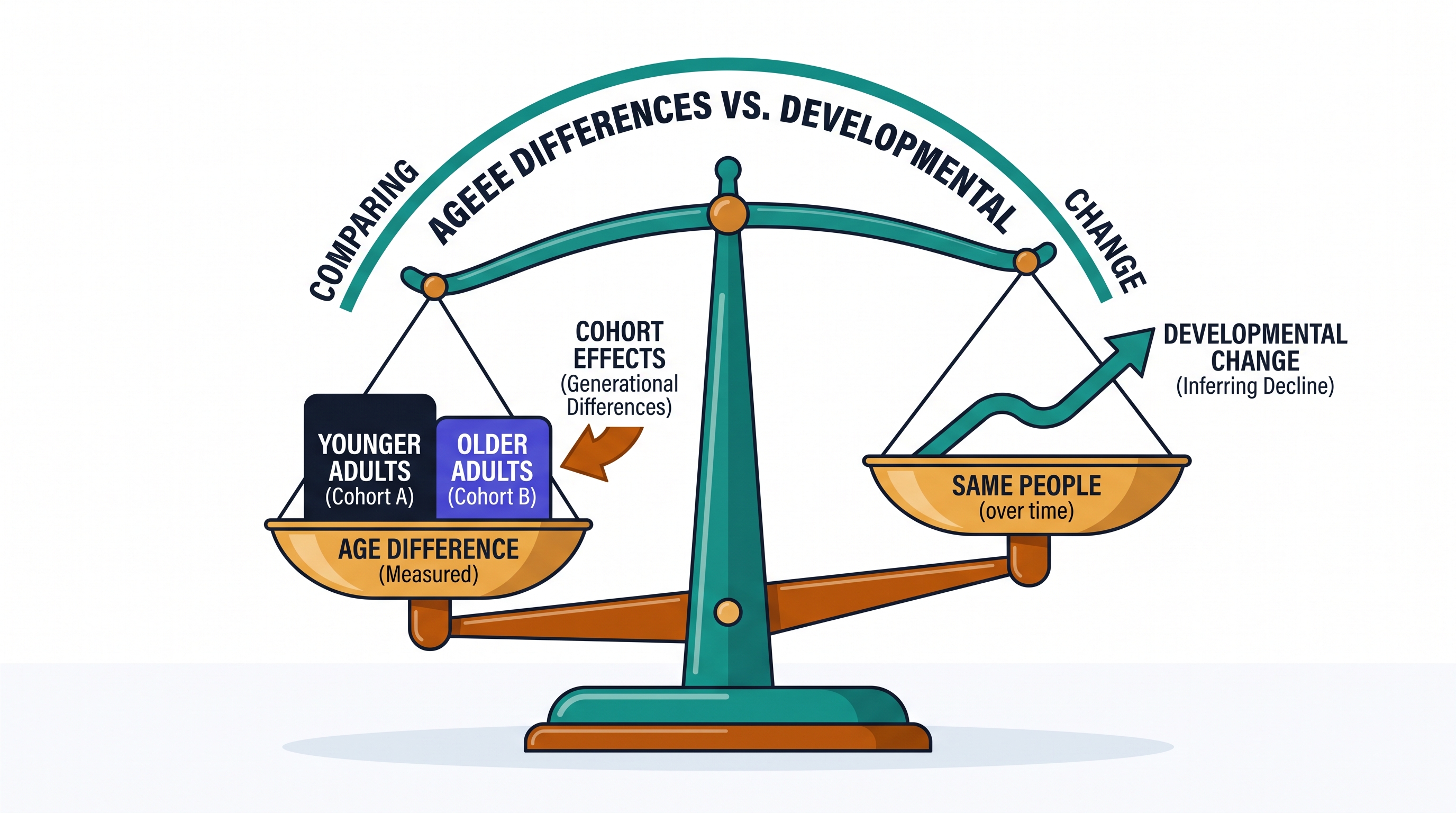
| Cross-sectional | Compare separate age groups during the same period | Efficiently reveals age-group differences | Age differences may reflect cohort effects—different historical or cultural experiences—not development itself |
| Longitudinal | Test the same participants at multiple time points | Shows individual change over time | Takes years, risks participant attrition, and may be influenced by practice from repeated testing |
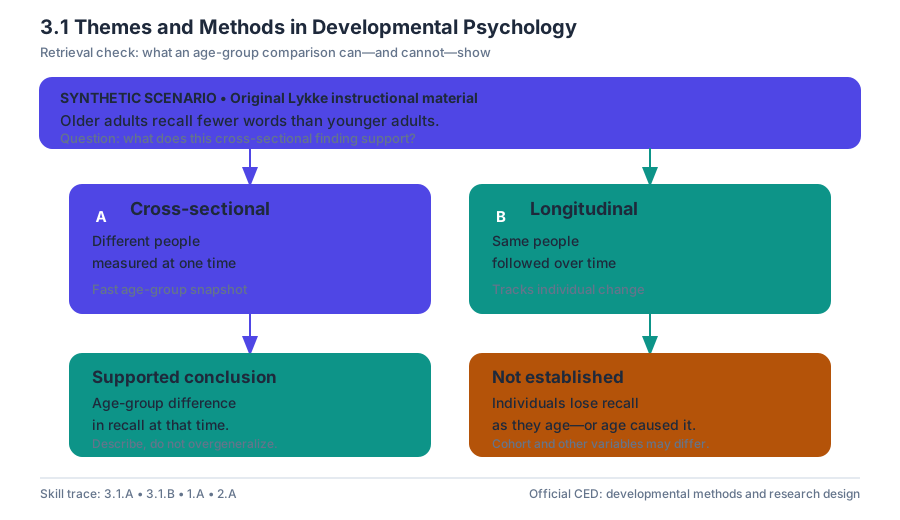
Worked example: A researcher tests word recall in 10-year-olds, 30-year-olds, and 70-year-olds during one week. The 70-year-old group recalls fewer words. The design is cross-sectional, so the result establishes an age-group difference in recall at that time. It does not establish that the same individuals lose recall as they age, and it does not prove that chronological age caused the difference; education, health, technology use, or cohort experience could also contribute.
If the researcher instead tested the same participants every five years, the study would be longitudinal. That design would better address stability and change within individuals, but repeated exposure to the word-recall task could itself affect later performance.
What research can—and cannot—establish
Experiments can establish cause-and-effect relationships because researchers manipulate an independent variable and observe its effect on a dependent variable, ideally with random assignment and control of confounds. Developmental research often cannot experimentally manipulate the crucial cause: directly assigning children to different long-term environments, parenting conditions, or educational opportunities would be unethical.
This ethical limit does not make developmental research unscientific. Researchers can use observations, interviews, tests, surveys, cross-sectional comparisons, longitudinal follow-ups, and naturally occurring differences. Each method contributes evidence, but each supports only the conclusions its design justifies.
Applying the method to a scenario
Imagine that parents report their babies’ hunger cues, while researchers observe feeding behavior and compare reports across several age groups. The developmental question is not merely “What happens first?” It may also ask whether caregivers become more accurate with experience, whether infant signals are biologically organized, and whether interpretation changes through learning.
For an exam scenario, reason in this order:
- Identify whether researchers compare different people once (cross-sectional) or the same people repeatedly (longitudinal).
- Identify the developmental theme: stability/change, nature/nurture, or continuous/discontinuous development.
- State the strongest justified conclusion.
- Name the conclusion the design does not license.
Misconception check: “A cross-sectional study proves what happens to people as they grow older.” Incorrect. It compares age groups; it does not track within-person change. Also avoid the opposite error: longitudinal research shows change in the sampled individuals, but without a representative sample it may not generalize to everyone.
Retrieval check
A cross-sectional study finds that older adults recall fewer words than younger adults. What can the researcher conclude, and what can the researcher not conclude?
Answer: The finding shows an age-group difference in word recall at that time, but it does not establish that individuals lose recall as they age or that age caused the difference. This is because the groups may differ in cohort experiences or other variables, and the researchers did not follow the same people over time.
Skill trace: 3.1.A asks you to explain how enduring themes inform developmental psychology. 3.1.B asks you to describe how cross-sectional and longitudinal designs inform understanding of behavior and mental processes. In an applied question, 1.A requires applying psychological perspectives, theories, concepts, or research findings to a scenario, while 2.A requires determining the research design used in a study.
Source Materials
- Ap Psychology Course And Exam Description
- Ap Psychology Course At A Glance
- AP Psychology CED: Student Responses and Scoring Commentary
- AP Psychology Exam Questions
- Free-Response Questions
- Free-Response Questions - Set 1
- Free-Response Questions - Set 2
- AP Psychology Course — AP Central
- AP Psychology — AP Students
- Khan Academy — AP Psychology
- AP Psychology Units — Save My Exams
- AP Psychology Study Guides — Fiveable