From the free course AP Psychology on Lykke
3.5 Communication and Language Development
Key concepts: Communication and language development · Cooing as an early language-development stage · Pointing as a means of communication · Phonemes · Morphemes · Semantics · Rule-governed language · Development of formal language
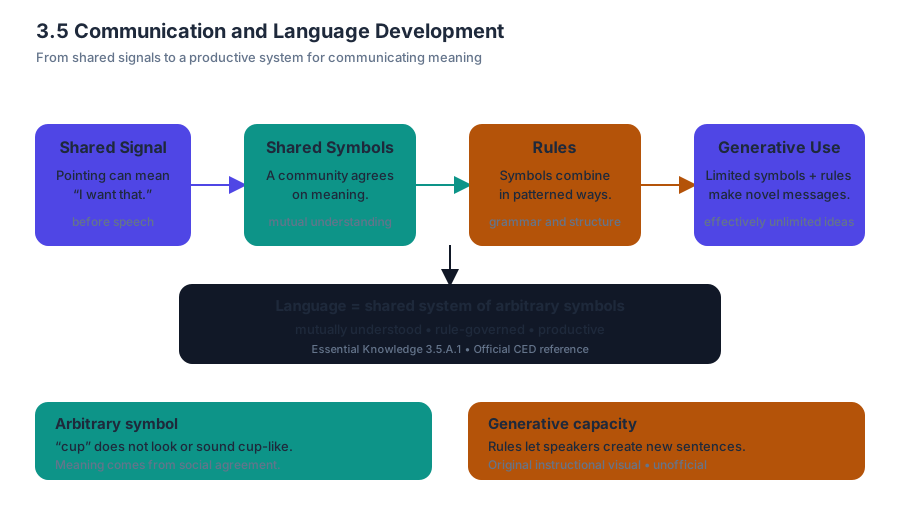
A toddler who points toward a cup may be communicating a complete message before saying a single word: I want that. Language develops from these early shared signals into a flexible system that lets you express an effectively unlimited number of ideas.
3.5 Communication and Language Development
A toddler who points toward a cup may be communicating a complete message before saying a single word: I want that. Language develops from these early shared signals into a flexible system that lets you express an effectively unlimited number of ideas.
Language is a shared system of arbitrary symbols that people mutually understand, combine according to rules, and use productively to communicate meaning. Essential Knowledge 3.5.A.1
The symbols are arbitrary because the sound or shape of a word does not naturally resemble its meaning: there is nothing inherently cup-like about the word cup. A community gives the symbol meaning by agreeing to use it consistently. Language is also generative, meaning that a limited set of symbols and rules can produce an unlimited number of novel sentences.
From gestures to speech
Communication begins before formal spoken language. Across cultures, children use nonverbal manual gestures, especially pointing, to direct another person's attention, request an object, share interest, or identify something meaningful. Pointing is not merely a motor action; its communicative meaning depends on the shared understanding between the child and another person.
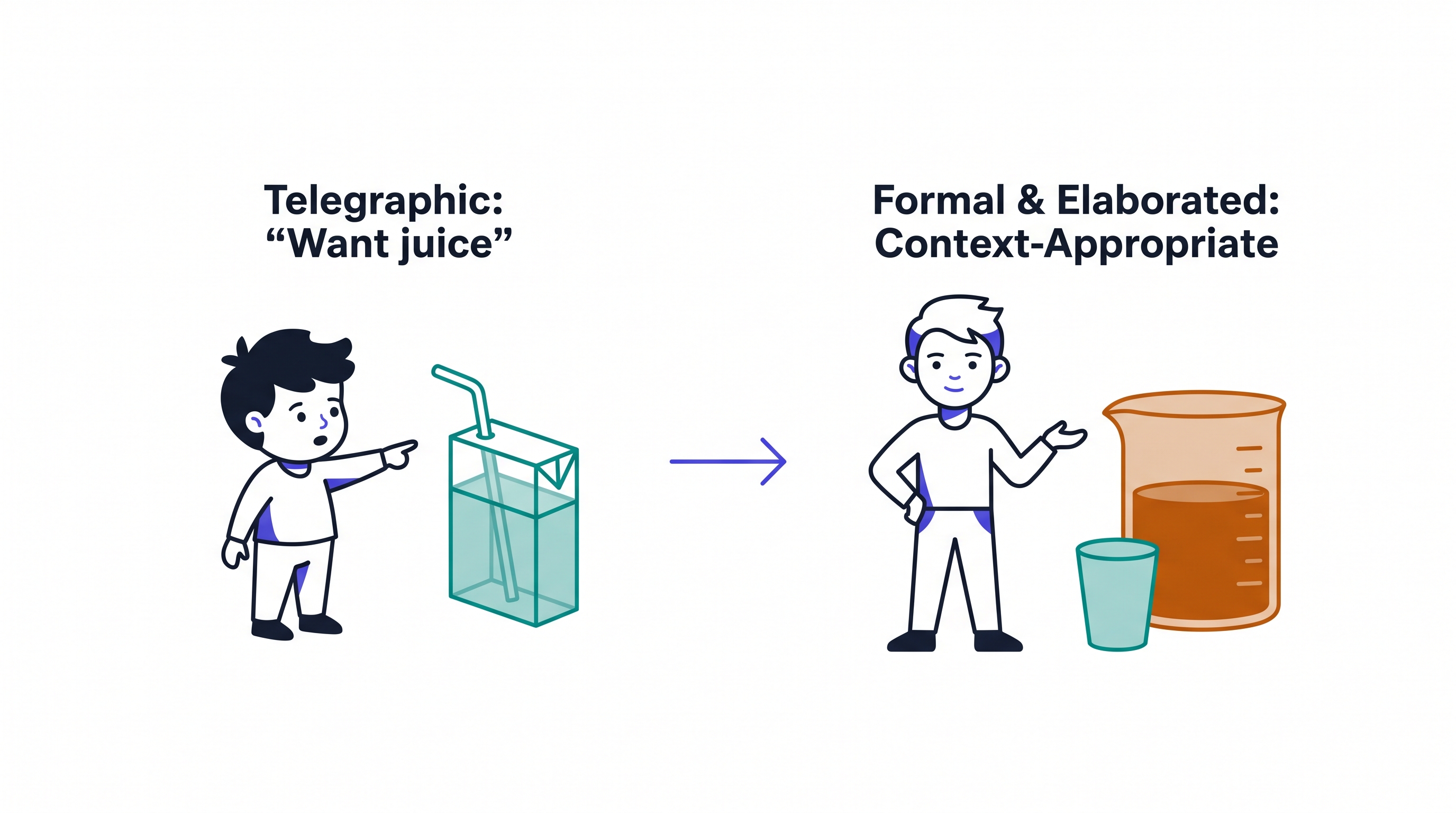
Formal language develops through recognizable stages. During cooing, infants produce vowel-like sounds. Babbling adds repeated consonant-vowel combinations, such as ba-ba. During the one-word stage, a single word can express a broader message—for example, milk may mean “I want milk.” Telegraphic speech combines a few content words, as in “want cookie” or “Daddy go,” while omitting many grammatical words and endings.
Development does not stop at telegraphic speech. Children gradually move toward grammatically complete and more precise sentences by adding function words, verb endings, complex syntax, and a larger vocabulary. They also learn to adjust language to an audience and setting: a child may use informal language with a friend but a more formal register, complete syntax, specialized vocabulary, and clearer grammatical structure in an academic presentation or professional conversation. This is development of formal language: not simply using “fancier” words, but coordinating vocabulary, syntax, grammatical completeness, and context so the message fits its purpose.
The building blocks of language
Language components work together rather than operating as isolated labels.
| Component | Meaning | Example |
|---|---|---|
| Phoneme | The smallest distinctive sound in a language | The sounds /k/ and /t/ distinguish cat from cap |
| Morpheme | The smallest unit that carries meaning | Un- and happy in unhappy |
| Semantics | The meaning of words and sentences | Understanding that “The dog chased the ball” differs from “The ball chased the dog” |
| Grammar | The rule-governed system for forming acceptable expressions | Rules for word forms and sentence construction |
| Syntax | The rules for arranging words in sentences | “The child pointed” follows a different structure from “Pointed the child” |
A phoneme does not have meaning by itself; it changes meaning by contrasting with another sound. A morpheme does carry meaning, while semantics concerns what words and combinations mean. Grammar includes the broader rule system, including syntax, which specifically governs word order and sentence structure.
Rule learning and overgeneralization
Children actively discover language rules, which explains why they sometimes make errors that they could not have copied directly from adults. A child who says “I goed home” has learned that past tense often involves adding -ed but has applied the rule too broadly to an irregular verb. This is overgeneralization: extending a language rule to a case where the language uses an exception.
Overgeneralization is evidence of productive rule learning, not simply poor memorization. The child is generating a new form from an internal rule. As development continues, the child learns which forms are regular, which are exceptions, and how sentence structure changes meaning.
Worked example
A child points at a parked bus and says, “Bus go!” Later, the child tells a teacher, “The bus is leaving because the driver has started the engine.”
The first communication demonstrates pointing, the one-word or early telegraphic pattern, and reliance on shared context. The later statement demonstrates expanded vocabulary, grammatical completeness, verb tense, causal meaning, and a context-appropriate formal register. Both messages communicate, but the second uses a more elaborated rule-governed system.
Misconception check
Misconception: “Language development is just learning more words.”
Vocabulary matters, but language development also involves phonemes, morphemes, semantics, grammar, syntax, and the ability to generate and adapt complete messages. A person can know many words yet still misunderstand syntax or fail to make a message clear for a particular audience.
Retrieval check: A child says “want juice,” while later asking a teacher, “Could I please have some juice after the experiment?” What changed?
Answer: The later message uses formal language: more precise vocabulary, greater grammatical completeness, expanded syntax, and wording suited to the audience and context. Both are meaningful communication, but formal language is elaborated and context-appropriate rather than merely informal or telegraphic.eriwa