From the free course AP Psychology on Lykke
P.9 Evidence-Based Question Practice
Key concepts: Evidence-Based Question (EBQ) · Evidence and reasoning · Authoritative parenting · Assessment scores and score interpretation · Central tendency (mean, median, and mode) · Crystallized intelligence · Age-related cognitive development · Social schemas · Self-esteem · Psychodynamic perspective
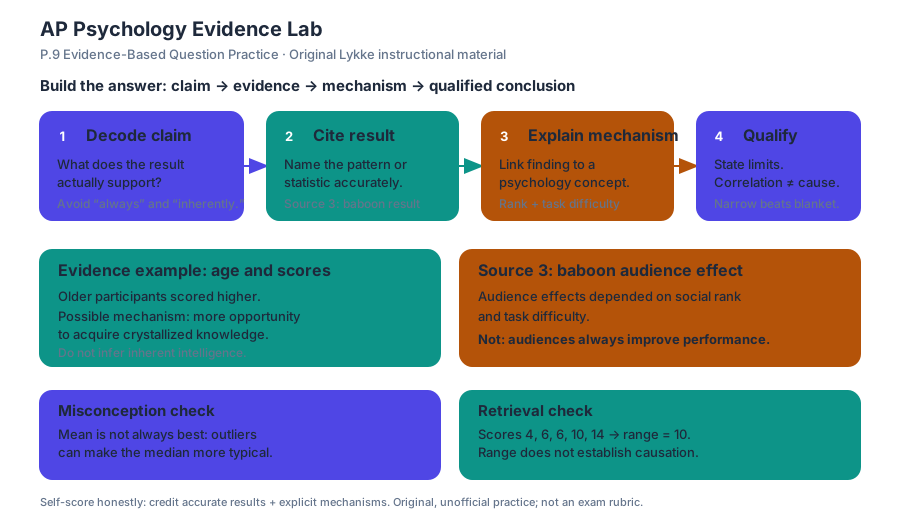
An Evidence-Based Question response earns its points through application: your psychological concept must explain why a specific result supports the claim. A correct term by itself is not reasoning.
P.9 Evidence-Based Question Practice
An Evidence-Based Question response earns its points through application: your psychological concept must explain why a specific result supports the claim. A correct term by itself is not reasoning. For example, writing “authoritative parenting improves development” does not explain what an assessment score means or how the reported data support that statement.
Core distinction: Evidence identifies what the stimulus shows. Reasoning explains how that result supports the claim.
Read the stimulus for the exact task
Before writing, identify the claim you must defend and the part of each source that actually bears on it. A source may contain interesting information that does not answer the question. If a baboon study shows that an observer’s social rank was related to task performance, that evidence may support a claim about audience status—but it does not automatically support the separate claim that animals perform faster on easy tasks or slower on difficult tasks when watched.
A strong sentence therefore contains three links:
- Source detail: “Source 2 reports that lower-ranking baboons changed their response speed when a higher-ranking baboon was present.”
- Psychological concept: “This reflects social evaluation or audience effects.”
- Reasoning: “Because the observer’s rank changes the performer’s response, the result supports the claim that the social characteristics of an audience can influence performance.”
The third link is the point students most often omit. Repeating the stimulus is evidence; naming a concept is terminology; explaining the mechanism connecting both to the claim is reasoning.
Concepts that require precise application
Authoritative parenting and assessment scores
Authoritative parenting combines high responsiveness or warmth with high demands or expectations. An authoritative caregiver may set firm limits while listening to a child, explaining rules, and responding supportively.
An assessment score indicates the degree to which a caregiver’s reported or observed behavior matches that style. It does not prove that the caregiver is always authoritative, establish that the parenting style caused a child’s outcome, or justify judging the caregiver’s entire personality from one score.
For ten caregivers with scores of $3$, $5$, $9$, $9$, and $12$ among the reported values, the range is calculated as:
$$ \text{range}=\text{highest score}-\text{lowest score}=12-3=9 $$
Do not confuse the range with the highest possible assessment score of $15$, the mean, or the number of participants. If a question asks for central tendency, calculate or identify the mean, median, or mode instead: the mean is the arithmetic average, the median is the middle ordered score, and the mode is the most frequent score.
Crystallized intelligence
Crystallized intelligence is knowledge and skills gained through learning and everyday experience. It generally increases with age because accumulated experience tends to grow. A younger student may perform poorly on a crystallized-intelligence test not because of lower general ability, but because the student has had less opportunity to acquire the tested knowledge.
That reasoning is stronger than saying only “age affects intelligence.” It identifies the mechanism: age is related to accumulated learning opportunities, which influence performance on knowledge-based tasks.
Original EBQ practice set
The following three-source set is original, unofficial instructional material. It deliberately combines assessment interpretation, central tendency, authoritative parenting, crystallized intelligence, and audience effects.
Source 1 — Caregiver assessment. Ten primary caregivers completed an assessment of authoritative parenting. Scores were $3$, $5$, $5$, $6$, $7$, $8$, $9$, $9$, $12$, and $12$, where higher scores indicate a greater combination of warmth and behavioral expectations.
Source 2 — Knowledge assessment. Two age groups completed a test of vocabulary acquired through school and everyday experience. The older group scored higher on average. The researchers noted that the older participants had encountered more years of formal instruction and daily information.
Source 3 — Audience and task difficulty. Baboons completed either a simple or difficult response task alone or while observed by another baboon. Performance differences were related to the observer’s social rank. The presence of an audience did not produce one uniform effect: response speed depended on both the difficulty of the task and the social relationship between performer and observer. The finding therefore cannot support the unsupported claim that an audience always makes performance faster.
Prompt: Make a claim about how psychological factors influence behavior or performance. Use specific evidence from at least two sources and apply one psychological concept to explain how the evidence supports your claim.
Criterion-level answer guidance
Claim: Higher scores on an authoritative-parenting assessment indicate more reported or observed use of a warm but demanding parenting style, whereas performance on a knowledge-based test can reflect accumulated experience.
Evidence: Source 1 shows scores ranging from $3$ to $12$, so the range is $9$. Source 2 reports that the older group scored higher on vocabulary and had more years of instruction and everyday learning.
Reasoning: The range demonstrates variation in the caregivers’ degree of authoritative parenting; it does not establish that one score caused a child outcome. Source 2 supports an explanation based on crystallized intelligence because knowledge gained through learning and experience generally accumulates with age. A complete response could also use Source 3: the baboon result supports the narrower claim that audience effects depend on social rank and task difficulty, not the blanket claim that audiences always improve performance.
Misconception check: “The mean is always the best summary” is incorrect. If unusually high or low scores distort the distribution, the median may better represent the typical caregiver. Also, “older participants scored higher, so they are inherently more intelligent” overstates the evidence; the result may reflect greater opportunity to acquire crystallized knowledge.
Retrieval check: A caregiver’s scores are $4$, $6$, $6$, $10$, and $14$. What is the range, and what would the range not establish? Answer: The range is $14-4=10$. It would not establish that parenting style caused a child’s behavior or that every caregiver consistently uses the style.
For self-scoring, award credit only when each cited result is accurate and each psychological concept is tied to the claim through an explicit mechanism. This original practice approximates the logic of official scoring guidance; it is not an official rubric or prediction of an exam score.