From the free course AP Psychology on Lykke
2.4 Encoding Memories
Key concepts: Encoding memories · Memory-improvement methods · Joshua Foer’s Moonwalking with Einstein · Summarizing information · Personal memory strategies · Misinformation effect · Source amnesia · Memory accuracy · Delayed testing and retention
Encoding is the process of transforming incoming information into a form your memory system can use later. Reading a biology article once may produce a feeling of familiarity, but effective encoding asks a harder question: What did you do with the information while you encountered it?
2.4 Encoding Memories
Encoding is the process of transforming incoming information into a form your memory system can use later. Reading a biology article once may produce a feeling of familiarity, but effective encoding asks a harder question: What did you do with the information while you encountered it?
Key idea: Strong encoding creates multiple retrieval paths by connecting new information to meaning, images, organization, and your own prior knowledge.
From exposure to usable memory
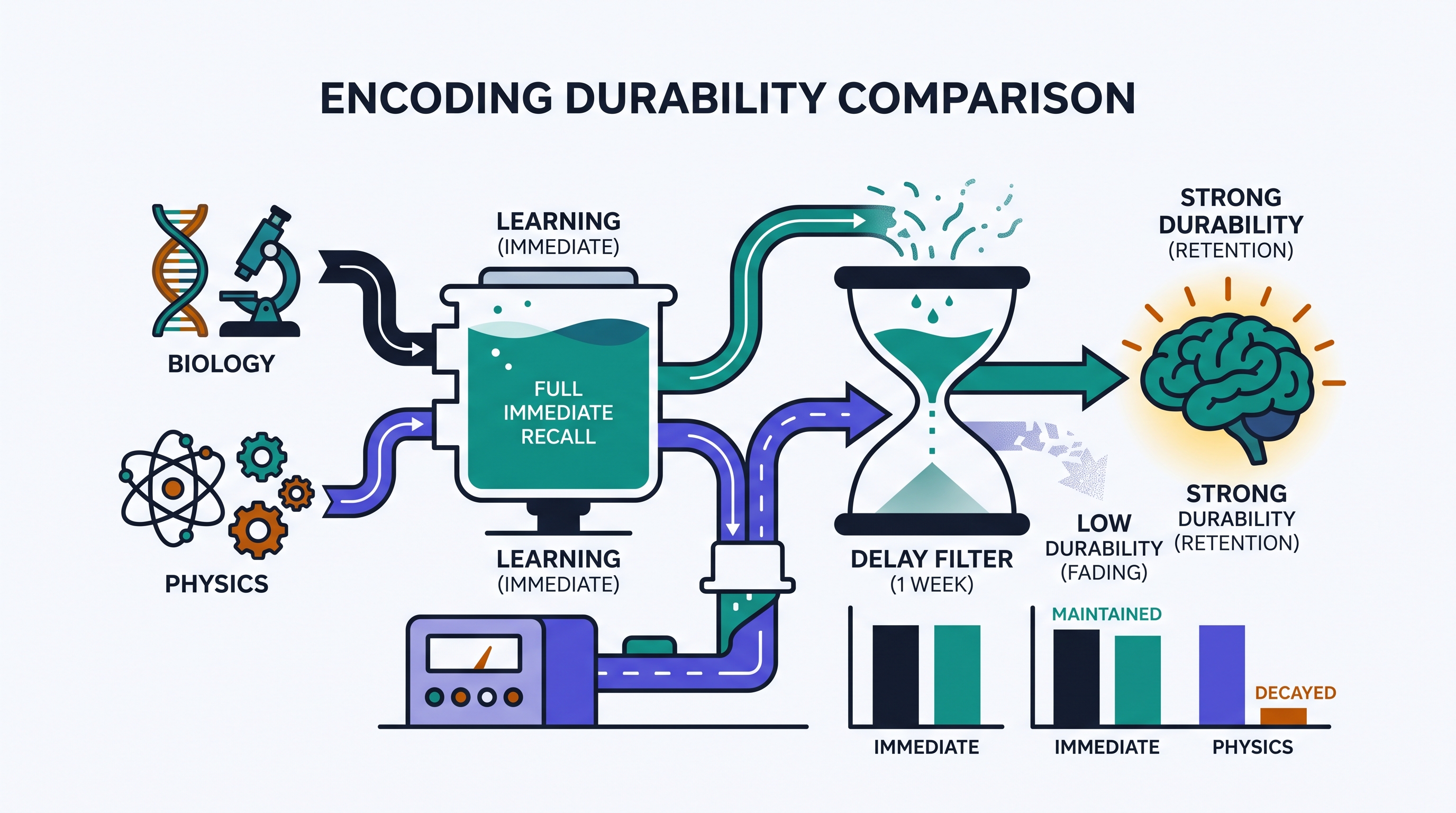
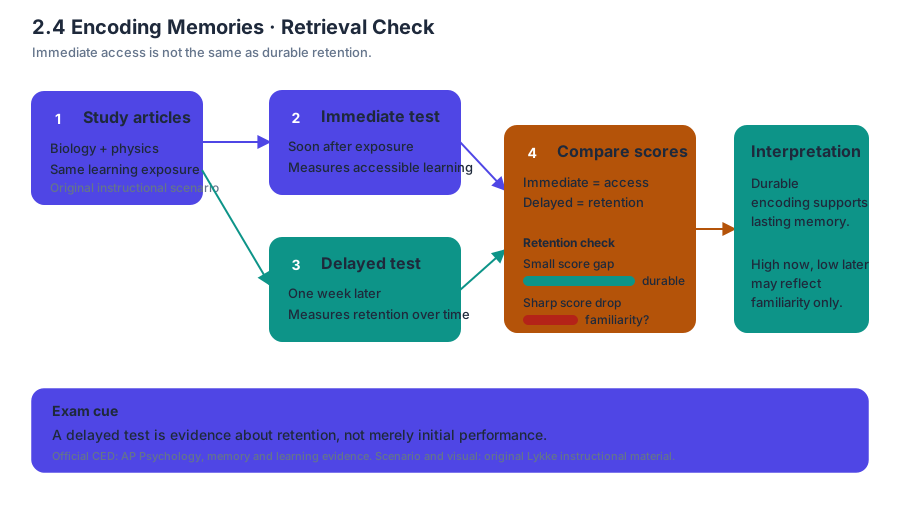
Suppose you read a physics article immediately before taking a quiz. You may recognize several terms, yet perform poorly a week later because recognition during immediate testing can reflect temporary accessibility rather than durable learning. A delayed test—such as comparing performance immediately after reading biology and physics articles with performance one week later—reveals whether the encoding method supported long-term retention.
Elaborative encoding means connecting new information with meaning, examples, explanations, or existing knowledge. Maintenance rehearsal repeats information without adding meaning; it can keep information active briefly, but it is usually weaker for durable learning. When you explain why a concept works, invent an example, or connect it to something you already know, you are giving the memory more retrieval cues.
Organization improves encoding by arranging information into a structure. A summary, outline, concept map, or set of related categories helps you see relationships rather than storing isolated sentences. A useful summary is not a copied paragraph: it compresses the central claim, preserves essential relationships, and uses your own wording.
Visual imagery and mnemonic devices add memorable routes to information. In Moonwalking with Einstein, Joshua Foer describes memory methods associated with deliberate imagery and organized mental locations. A method such as placing vivid images along a familiar route can make otherwise abstract or unrelated items easier to retrieve. The image does not magically “store” the list; it supplies distinctive cues that you can use later.
Comparing encoding strategies
| Strategy | What you do | Why it can help later |
|---|---|---|
| Repetition alone | Repeat a definition several times | Keeps information active, but may create shallow familiarity |
| Elaborative rehearsal | Explain the idea, cause, consequence, or example | Builds meaningful connections |
| Summarizing | State the main ideas in your own words | Organizes and compresses information |
| Imagery or mnemonic | Attach information to vivid images or locations | Creates distinctive retrieval cues |
| Spaced learning | Study across separated sessions | Requires repeated re-encoding over time |
| Massed learning | Study in one concentrated session | May improve immediate performance but often fades more quickly |
The most useful personal strategy depends on the material. For a list of biological structures, a labeled diagram and an invented image may help. For a physics explanation, writing a short causal summary and then explaining it without looking may be more effective. Your strategy should therefore match the question you expect to answer, not merely make the material feel familiar.
Worked example: choosing an encoding method
Original instructional scenario: Jordan must learn how a sensory receptor converts physical energy into neural signals. Jordan first rereads the definition six times. Next, Jordan writes: “The receptor detects stimulus energy, and transduction converts that energy into neural signals.” Jordan then draws a stimulus-to-receptor-to-neural-signal diagram, explains the process using the example of light entering the eye, and reviews the explanation on three separate days.
The strongest encoding occurs in the last steps. Jordan uses elaboration by connecting the definition to an example, organization by arranging the process in a sequence, visual imagery through the diagram, and spacing through separated reviews. If a delayed question asks Jordan to explain the mechanism, these connected cues should support retrieval better than repetition alone. The appropriate conclusion is not that one strategy guarantees perfect memory; it is that the strategy provides richer encoding and should be tested with delayed performance.
Accuracy: encoding is not the only vulnerability
A person can remember confidently and still remember inaccurately. The misinformation effect occurs when misleading information encountered after an event becomes incorporated into a later memory of that event. Source amnesia is remembering information while forgetting where it came from. For example, you might remember that a classroom demonstration involved a red object but confuse whether you saw the red object yourself or heard a classmate mention it afterward.
These effects matter when evaluating eyewitness testimony and study notes. A later suggestion can alter the report of an earlier event, and a vivid fact from a video, conversation, or textbook may be recalled without its source. Better encoding—such as recording the original details and their source—can reduce confusion, but it cannot make memory infallible.
Misconception check: “If I can recall something quickly immediately after studying, it must be encoded permanently.”
Correction: Immediate fluency can reflect short-term accessibility. A delayed test provides stronger evidence that the information was encoded for later retrieval.
Retrieval check
Question: Why would a researcher compare immediate and one-week delayed test performance after students read biology and physics articles?
Answer: The immediate test measures accessible learning soon after exposure, whereas the delayed test examines retention over time. If a strategy produces high immediate scores but sharply lower one-week scores, it may have created familiarity without durable encoding. This comparison directly tests whether the encoding approach supports lasting memory rather than only short-term performance.
Source Materials
- Ap Psychology Course And Exam Description
- Ap Psychology Course At A Glance
- AP Psychology CED: Student Responses and Scoring Commentary
- AP Psychology Exam Questions
- Free-Response Questions
- Free-Response Questions - Set 1
- Free-Response Questions - Set 2
- Part A Dr. Dawson is a psychologist who believes that students who read motivational statements before a test will experience lower levels of anxiety as compared with students who read neutral stateme