From the free course AP Psychology on Lykke
5.1 Introduction to Health Psychology
Key concepts: Stress and its effects on behavior and mental processes · Eustress and distress · Stressors, including traumatic events and daily hassles · Stress-related susceptibility to illness · General Adaptation Syndrome · Alarm reaction and the fight-or-flight response · Resistance and exhaustion phases of stress · Problem-focused coping · Emotion-focused coping · Stress-management strategies such as deep breathing and meditation
Stress is not automatically harmful: the same pressure that sharpens your attention before a performance can, when prolonged or overwhelming, increase vulnerability to illness. Health psychology examines how behavior and mental processes interact with physical health and wellness, including how stress, coping, and…
5.1 Introduction to Health Psychology
Stress is not automatically harmful: the same pressure that sharpens your attention before a performance can, when prolonged or overwhelming, increase vulnerability to illness. Health psychology examines how behavior and mental processes interact with physical health and wellness, including how stress, coping, and physiological responses shape what happens in the body. [5.1.A]
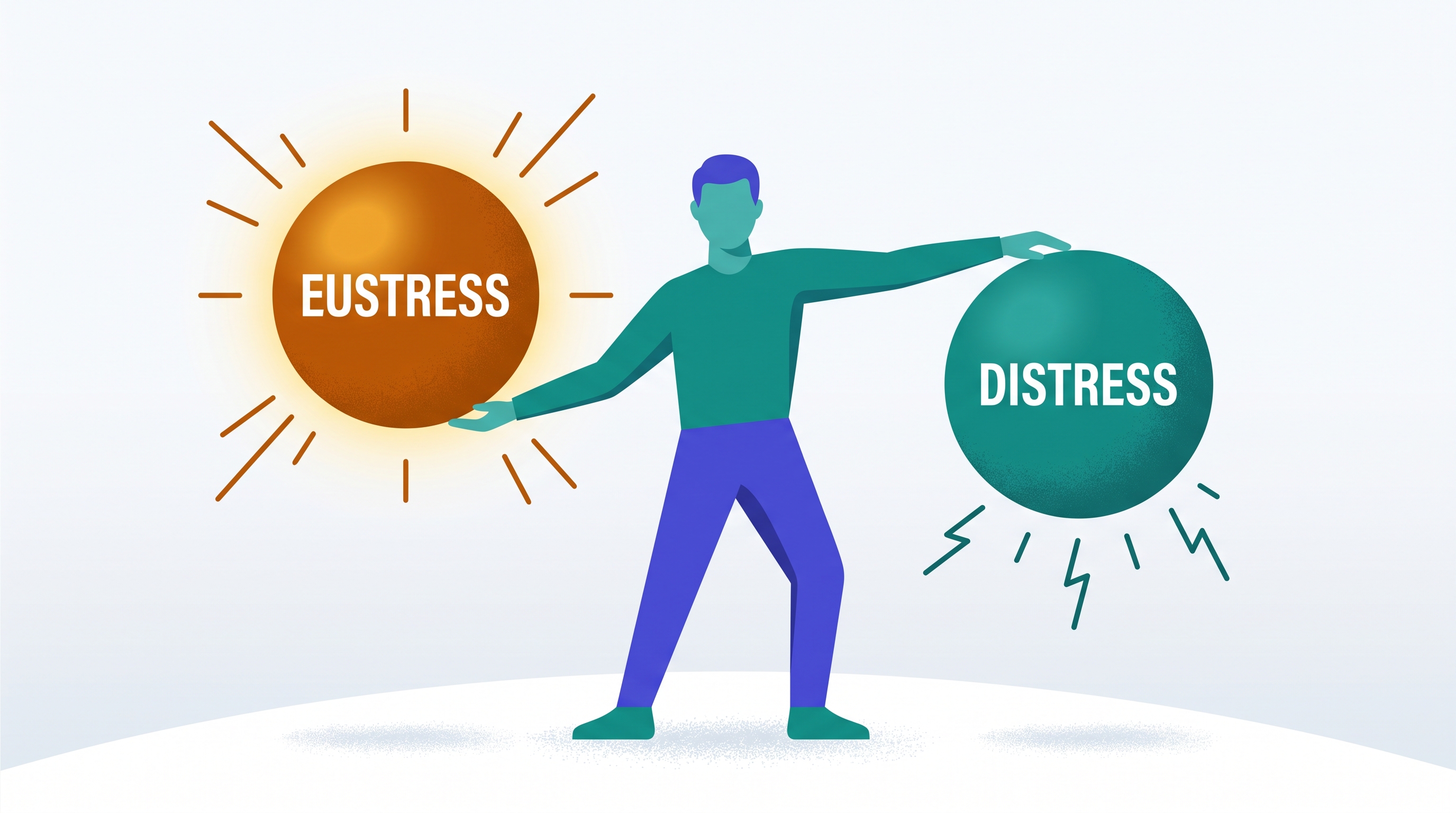
Key distinction: Eustress is stress experienced as motivating or beneficial; distress is stress experienced as debilitating or harmful. [5.1.B.2]
Stressors: what activates the stress response?
A stressor is an event, condition, or demand that produces stress. Stressors vary in intensity and duration.
- Traumatic experiences can produce a powerful, immediate stress response.
- Daily hassles—repeated minor problems such as conflict, deadlines, financial pressure, or disrupted sleep—can accumulate over time.
- Adverse childhood experiences (ACEs) are sources of stress during childhood that may affect behavior, mental processes, and physical health across the lifespan. An ACE is a risk factor, not a destiny; its effects depend on many biological, psychological, social, and environmental conditions. [5.1.B.2]
Stress can influence concentration, decision-making, mood, sleep, and behavior. Physiologically, chronic stress has been linked to hypertension, headaches, and immune suppression, increasing susceptibility to disorders and disease. [5.1.B.1]
The General Adaptation Syndrome
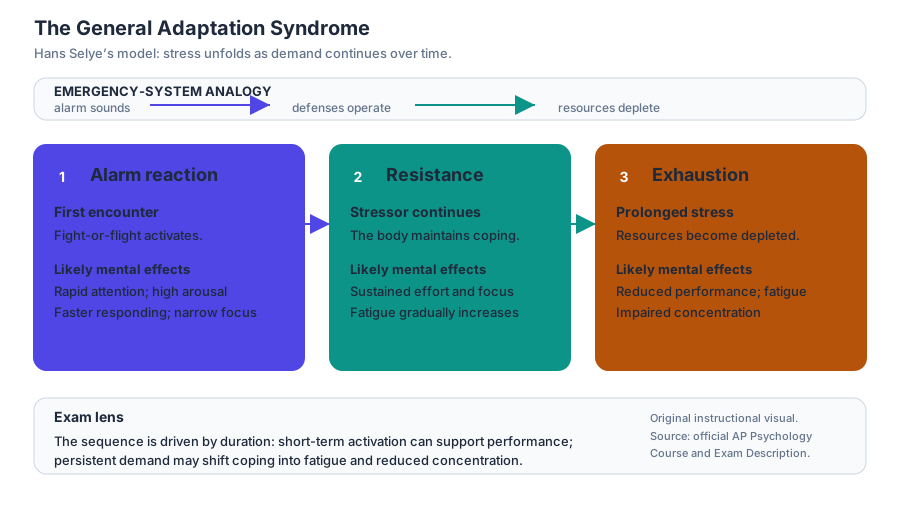
Hans Selye’s General Adaptation Syndrome (GAS) describes stress as a three-phase process. Imagine a building’s emergency system: it sounds an alarm first, maintains defensive operations while the threat continues, and eventually becomes depleted if the demand lasts too long.
| GAS phase | What happens | Likely effect on behavior and mental processes |
|---|---|---|
| Alarm reaction | You first encounter the stressor. The body activates the fight-or-flight response, increasing readiness to confront or escape the threat. | Rapid attention, heightened arousal, faster responding, and narrowed focus |
| Resistance | The stressor continues, and the body attempts to maintain functioning while actively coping with the demand. | Sustained effort and concentration, but increasing fatigue if the stressor persists |
| Exhaustion | Resources become depleted after prolonged stress. | Reduced performance, impaired concentration, fatigue, and greater susceptibility to illness |
[5.1.C.1] The alarm reaction is not the entire stress response; it is the initial phase. A common error is to label every stress reaction “fight or flight” and forget the later resistance and exhaustion phases.
Worked example: one stressor, three phases
Original instructional scenario: Maya learns that she must give an unplanned presentation in ten minutes. Her heart rate rises, her attention locks onto the task, and she prepares to speak. This is the alarm reaction: the stressor has just been encountered, and fight-or-flight arousal mobilizes her.
If Maya continues preparing and presenting through several difficult days, she may remain in resistance, using sustained effort to meet the demand. If the workload and stress continue without recovery, she may enter exhaustion, with fatigue, poorer concentration, and increased health risk. The same stressor can therefore produce different behavioral and mental effects over time.
The scenario also illustrates eustress versus distress. A manageable level of presentation stress may motivate Maya to prepare—eustress—whereas overwhelming or prolonged stress that disrupts functioning may become distress. The label depends on the stressor’s effect, not merely on whether stress is present.
Coping: solve the stressor or regulate the reaction?
Coping refers to the ways people respond to stress.
- Problem-focused coping treats stress as a problem to be solved. You identify the source, develop a plan, and work toward a solution until the problem is addressed. Maya might outline her presentation, rehearse, and ask for clarification. [5.1.D.1]
- Emotion-focused coping manages the emotional reaction to stress. Deep breathing, meditation, or medication aimed at reducing stressful emotional responses are examples. These strategies may be especially useful when the stressor cannot be immediately changed. [5.1.D.2]
The two approaches are not rivals. You might use problem-focused coping to create a study schedule and emotion-focused coping to reduce the anxiety that makes studying difficult.
Science-practice lens
Use Science Practice 1, Skill 1.D to apply psychological concepts to explain how stress affects behavior and mental processes: identify the stressor, name the relevant concept, and connect it explicitly to the observed response. Use Science Practice 3, Skill 3.C when interpreting evidence about stress—such as deciding whether a reported association supports a conclusion about health risk without claiming that correlation alone proves causation.
Misconception check: “All stress is bad” is incorrect. Eustress can motivate action, while distress can impair functioning. A second error is assuming that coping means eliminating every stressful feeling; emotion-focused coping can regulate the reaction even when the stressor remains.
Retrieval check: A student uses meditation to reduce anxiety before an exam, then creates a schedule to address incomplete preparation. Which coping strategies are being used?
Answer: Meditation is emotion-focused coping; creating a schedule is problem-focused coping.
Source Materials
- Ap Psychology Course And Exam Description
- Ap Psychology Course At A Glance
- AP Psychology CED: Student Responses and Scoring Commentary
- AP Psychology Exam Questions
- Free-Response Questions
- Free-Response Questions - Set 1
- Free-Response Questions - Set 2
- AP Psychology Course — AP Central
- AP Psychology — AP Students
- Khan Academy — AP Psychology
- AP Psychology Units — Save My Exams
- AP Psychology Study Guides — Fiveable