From the free course AP Psychology on Lykke
P.5 Timed Multiple-Choice Sets and Pacing Practice
Key concepts: Spaced versus massed information delivery · Information retention · Study participants · Secondary school students · Sample size and demographics · Urban school setting · England · Participant age range · Unreported race/ethnicity data
Information retention is the ability to recall or use learned material after a delay; it is not the same as performing well immediately after instruction.
P.5 Timed Multiple-Choice Sets and Pacing Practice
Information retention is the ability to recall or use learned material after a delay; it is not the same as performing well immediately after instruction. Spaced learning delivers information across separated sessions, whereas massed learning delivers it in one concentrated period. The central question is whether spacing produces stronger later retention than an equally focused burst of instruction.
A study designed to examine this question included 440 students from an urban secondary school in England. Participants were 13 to 15 years old. Researchers did not report the participants’ race or ethnicity, and the passage also states that gender identities were not reported. Because the participants came from one urban school, you should be cautious about generalizing the findings to students of different ages, locations, or educational settings.
Participants were randomly assigned to one of two conditions:
| Condition | Instruction pattern | Key feature |
|---|---|---|
| Spaced delivery | $23$ hours of biology instruction across multiple sessions over four months | Information was distributed over time |
| Massed delivery | $1$ hour of rapid instruction, divided into three $20$-minute learning periods | Ten-minute physical-activity distractor periods prevented mental rehearsal |
Random assignment helps create comparable groups before instruction begins, strengthening a causal comparison between delivery methods. However, the passage provided here does not report which group showed better retention. You may identify the research question and design, but you may not claim that spacing improved retention unless the results are supplied.
The study also illustrates why a timed question requires two separate judgments. First, identify the psychological concept or research method. Second, identify exactly what the evidence permits you to conclude. A tempting answer such as “the spaced group remembered more” confuses the researchers’ hypothesis with a reported result.
For pacing, use a four-step loop: read the question first, locate the tested concept, eliminate answers that overclaim, and verify the wording against the passage. If an item takes too long, mark your best answer, record the reason for uncertainty—content, misreading, or pacing—and move on. A pacing error is not automatically a content error.
Five-item timed set
Original, unofficial practice. Set a timer for approximately $6$ minutes, or about $72$ seconds per item. Do not consult the explanations until all five answers are recorded.
1. What is the primary outcome the researchers intended to compare?
A. Immediate enjoyment of biology instruction
B. Retention of information after learning
C. Physical coordination during distractor activities
D. Differences in intelligence between the two groups
Answer: B. Retention means recalling or using information after a delay. A is not the stated outcome, C describes the distractor activity rather than the central outcome, and D is not identified as a research question. Skill focus: 1.A, applying a psychological concept to a scenario.
2. Which feature most directly supports a causal inference about delivery method?
A. The participants attended an urban school
B. The participants were between 13 and 15 years old
C. The participants were randomly assigned to groups
D. The researchers did not report race or ethnicity
Answer: C. Random assignment helps distribute preexisting differences across conditions, making delivery method the intended independent variable. The other details describe the sample and its reporting limitations, not the basis for causal inference. Skill focus: 2.A, identifying research design features.
3. Which conclusion is justified from the passage alone?
A. Spaced instruction produced superior retention
B. Massed instruction produced superior retention
C. The researchers compared two delivery schedules, but the result is not reported
D. The study proves that physical activity improves memory
Answer: C. The passage establishes the comparison and method but gives no retention result. A and B invent an outcome; D mistakes the distractor activity for the independent variable. Skill focus: 3.A, interpreting what evidence does and does not show.
4. Which limitation most directly concerns generalizability?
A. The groups received different amounts of total instruction
B. The massed condition included physical-activity breaks
C. The sample came from one urban secondary school in England
D. Participants were randomly assigned
Answer: C. A single urban school and a narrow age range may not represent all learners. A and B concern differences between conditions that could affect interpretation, while D is a strength for causal inference rather than a generalizability limitation. Skill focus: 2.A, evaluating a study’s sample and design.
5. A learner chooses option A on Item 3 because “spacing is generally better for memory.” What is the most accurate diagnosis?
A. Content error: the learner does not know what retention means
B. Misreading error: the learner overlooked that the result was absent
C. Pacing error: the learner answered before reading any options
D. Sampling error: the learner confused age with ethnicity
Answer: B. The learner may know the general idea of spacing but failed to distinguish a research prediction from a reported finding. That is a passage-reading error, not necessarily a failure to understand retention. Skill focus: 3.A, distinguishing evidence from inference.
Error review
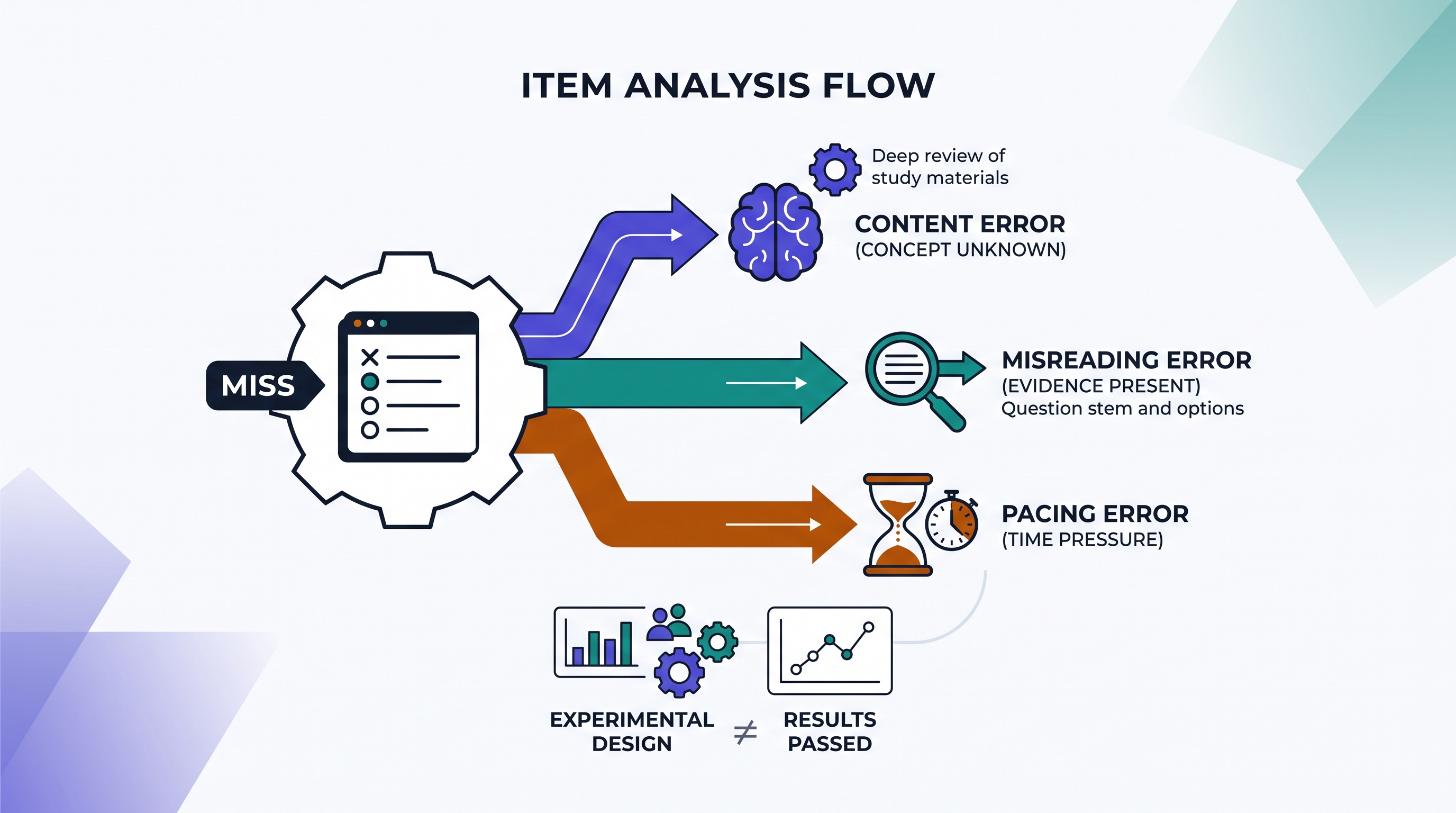
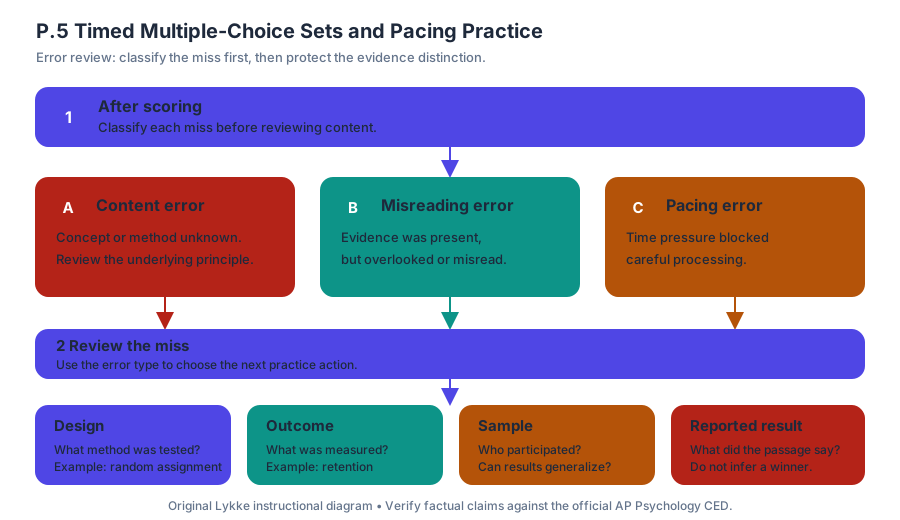
After scoring, classify each miss before reviewing the content. A content error means the psychological concept or method was unknown; a misreading error means the relevant evidence was present but overlooked; a pacing error means time pressure prevented careful processing. For Item 3, choosing A is usually a misreading error. For Item 4, choosing D is usually a research-method content error because random assignment and generalizability serve different purposes.
The essential distinction is simple but powerful: a study can test whether one method produces better retention without the supplied passage telling you which method won. On a timed question, protect that distinction by separating the design, the intended outcome, the sample, and the reported result before selecting an answer.
Source Materials
- Ap Psychology Course And Exam Description
- Ap Psychology Course At A Glance
- AP Psychology CED: Student Responses and Scoring Commentary
- AP Psychology Exam Questions
- Free-Response Questions
- Free-Response Questions - Set 1
- Free-Response Questions - Set 2
- Part A Professor Gonzalez hypothesizes that students will remember more information from his