From the free course AP Psychology on Lykke
1.2 Overview of the Nervous System
Trace a signal through the central and peripheral nervous systems and predict the behavioural consequence of activity in each division.
1.2 Overview of the Nervous System
When you pull your hand away from a hot surface, two coordinated systems make the behavior possible: the central nervous system interprets and organizes information, while the peripheral nervous system carries messages between that control center and the rest of your body.
The nervous system as a communication tree
The nervous system is the body’s integrated network for receiving information, processing it, and producing responses. Its major divisions are best understood as a branching tree: the central nervous system, or CNS, forms the control center; the peripheral nervous system, or PNS, forms the communication lines reaching the rest of the body.
1.2.A — Learning Objective: Differentiate among the subsystems of the human nervous system and their functions.
1.2.A.1: The central nervous system includes the brain and the spinal cord and interacts with all processes in the body.
1.2.A.2: The peripheral nervous system relays messages from the central nervous system to the rest of the body and includes the autonomic and somatic nervous systems.
The CNS is not simply a “brain department.” The brain and spinal cord work together: the brain coordinates interpretation and decision-making, while the spinal cord provides a major route for messages traveling to and from the brain and can coordinate rapid responses. The PNS connects this central system with muscles, skin, sensory receptors, and internal organs.
Voluntary and involuntary control
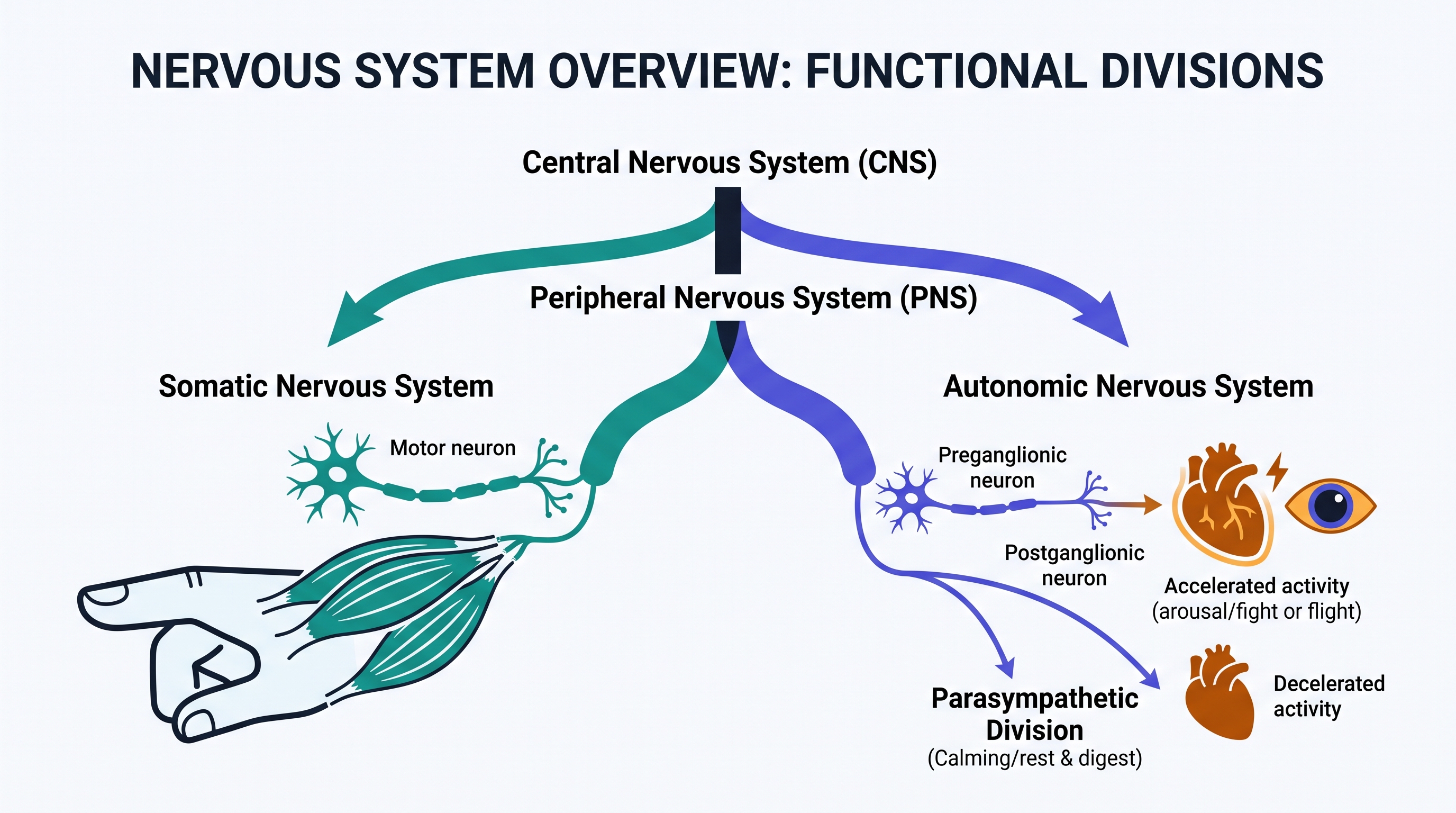
The PNS divides functionally into the somatic nervous system and the autonomic nervous system. The somatic nervous system governs processes that are generally voluntary, such as intentionally moving your fingers, walking toward a door, or turning your head to read a sign.
The autonomic nervous system, or ANS, governs processes that are involuntary—activities that continue without deliberate conscious control. Heart rate, digestion, breathing adjustments, and changes in pupil size are examples of functions influenced by this system.
1.2.A.2.i: The autonomic nervous system governs processes that are involuntary and includes the parasympathetic and sympathetic nervous systems.
The sympathetic nervous system prepares the body for action during challenge, threat, or intense activity. It can increase heart rate and redirect bodily resources toward immediate action. The parasympathetic nervous system supports calmer maintenance and recovery, including the return toward a resting state after the challenge has passed.
| Division | Main function | Concrete example |
|---|---|---|
| CNS | Brain and spinal cord process and coordinate information | The brain interprets a signal and organizes a response |
| PNS | Carries messages between the CNS and the rest of the body | A message travels between the spinal cord and a hand |
| Somatic | Governs voluntary processes | You intentionally move your finger |
| Autonomic | Governs involuntary processes | Your heart rate changes automatically |
| Sympathetic | Supports action during challenge or arousal | Heart rate rises before a race |
| Parasympathetic | Supports recovery and ongoing maintenance | Heart rate settles after the race |
Worked scenario: one event, several divisions
Imagine that you notice a cyclist suddenly enter your path. Your brain and spinal cord belong to the CNS, which coordinates the response. The PNS carries information between that central system and the rest of your body.
You deliberately step backward: that intentional movement uses the somatic nervous system. At the same time, your heart beats faster without your choosing it: that automatic change uses the autonomic nervous system. Because the situation demands rapid action, the sympathetic division is associated with the aroused response; once the danger passes, parasympathetic activity supports recovery.
Science-practice connection: 1.A
Science Practice 1.A — Apply psychological perspectives, theories, concepts, and research findings to an unfamiliar scenario means that you should not merely match a vocabulary word to a familiar definition. You should identify the relevant division from what the body is doing.
For example, if a vignette says that a person intentionally presses a button while their pupils widen automatically, separate the actions before choosing an answer. Pressing the button is voluntary and points to the somatic nervous system; pupil widening is involuntary and points to the autonomic nervous system. The question may describe one event, but it can test more than one subsystem.
Misconception check
Common error: “Sympathetic means voluntary, and parasympathetic means involuntary.” Both sympathetic and parasympathetic systems are subdivisions of the involuntary autonomic nervous system. The contrast is not voluntary versus involuntary; it is primarily action-oriented arousal versus calming and recovery within autonomic control.
A second error is treating the PNS as independent of the CNS. The PNS is the relay network: it carries messages to and from the brain and spinal cord rather than replacing them.
Retrieval check
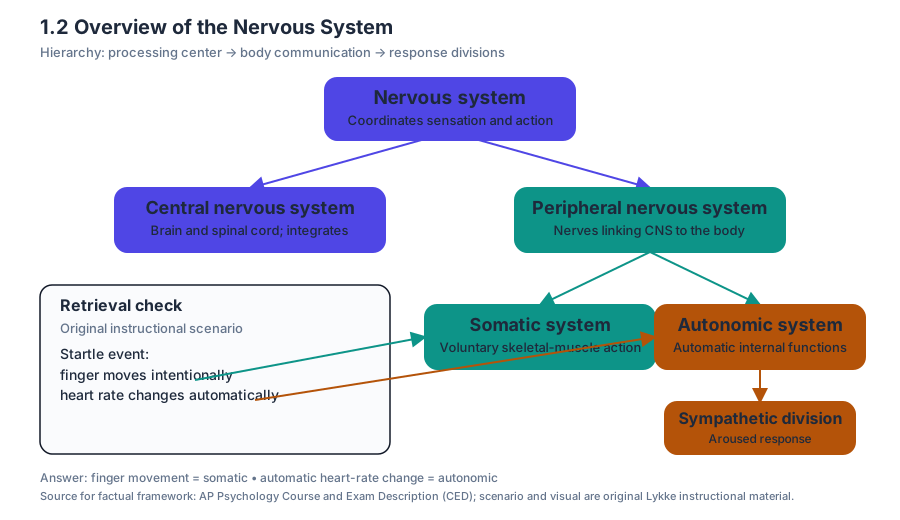
Question: A person intentionally moves a finger while their heart rate changes automatically during a startling event. Which nervous-system divisions are involved?
Answer: The intentional finger movement uses the somatic nervous system; the automatic heart-rate change uses the autonomic nervous system. The sympathetic division is associated with the body’s aroused response to the startling event, while the CNS coordinates the overall processing and response.
Source Materials
- Ap Psychology Course And Exam Description
- Ap Psychology Course At A Glance
- AP Psychology CED: Student Responses and Scoring Commentary
- AP Psychology Exam Questions
- Free-Response Questions
- Free-Response Questions - Set 1
- Free-Response Questions - Set 2
- Part A Mobile Gamer Central (MGC) is preparing to launch a new game app. The advertisements
- Part A Mobile Gamer Central (MGC) is preparing to launch a new game app. The advertisements