From the free course AP Psychology on Lykke
P.4 Guided Multiple-Choice Practice: Units 3, 4, and 5
Key concepts: AP Psychology course framework · Learning objectives and essential knowledge statements · Teacher-designed AP curriculum · Optional unit sequence · Progress Checks · Formative assessment · Multiple-choice questions with rationales · Immediate student feedback · AP Daily instructional support · AP Classroom assessment and feedback
A strong multiple-choice answer begins with the psychological mechanism, not with a familiar word in the vignette. The original practice below moves through Development and Learning, Social Psychology and Personality, and Mental and Physical Health while making the reasoning visible: identify the situation,…
P.4 Guided Multiple-Choice Practice: Units 3, 4, and 5
A child who suddenly refuses to sleep alone, a student who studies harder after seeing a classmate rewarded, and a patient whose panic returns in crowded places may appear unrelated. Multiple-choice reasoning connects them by identifying the psychological mechanism, then matching that mechanism to the AP Psychology course framework—its learning objectives, essential knowledge, and science-practice skills.
How the framework organizes the practice
The framework separates what students should understand from what they should be able to do. A learning objective (LO) states the performance students must demonstrate; an essential knowledge (EK) statement identifies the psychological content that makes that performance possible. The questions below are teacher-designed items aligned to representative Unit 3, 4, and 5 content and skills.
The sequence used here is:
- Unit 3 — Development and Learning: explain developmental changes and learning mechanisms.
- Unit 4 — Social Psychology and Personality: explain how social situations and personality-related processes influence behavior.
- Unit 5 — Mental and Physical Health: explain psychological disorders, treatment, stress, and health-related behavior.
The AP framework permits an optional unit sequence: teachers may organize instruction in the commonly taught order or select another coherent progression. This practice uses Units 3–5 consecutively because development and learning provide mechanisms for understanding social behavior, while those ideas support later reasoning about mental and physical health. A teacher-designed AP curriculum selects, sequences, and adapts framework content—using examples, pacing, and practice appropriate to the students—without dropping the required learning objectives or essential knowledge.
Guided questions
Question 1 — Development
A researcher observes that infants who consistently receive sensitive responses from caregivers are more likely to explore an unfamiliar room while periodically returning to the caregiver. Which concept best explains this behavior?
A. Assimilation
B. Secure attachment
C. Learned helplessness
D. Formal operational thought
LO focus: Explain how early relationships influence development.
EK focus: Attachment patterns are associated with the quality and consistency of caregiver responsiveness.
Answer: B. Secure attachment. The infant uses the caregiver as a secure base: the caregiver provides confidence for exploration while remaining a source of comfort. Assimilation concerns fitting new information into an existing cognitive schema; learned helplessness concerns passive behavior after perceived lack of control; formal operational thought concerns abstract reasoning, not infant-caregiver attachment.
This item tests concept selection in context, not simple recognition of the word “caregiver.” The decisive evidence is the combination of exploration and reliable return for reassurance.
Question 2 — Learning
Every time a dog sits after being asked, its owner gives it a small piece of food. After several repetitions, the dog sits more often when asked. Which process most directly accounts for the increase?
A. Positive reinforcement
B. Negative reinforcement
C. Positive punishment
D. Spontaneous recovery
LO focus: Explain how consequences influence future behavior.
EK focus: Reinforcement increases the likelihood of a behavior; positive reinforcement adds a desirable stimulus after the behavior.
Answer: A. Positive reinforcement. Food is added after sitting, and sitting becomes more frequent. “Positive” means adding, not necessarily good; “negative” means removing. Punishment decreases a behavior, whereas spontaneous recovery is the return of an extinguished conditioned response after a delay.
A common misconception is that reinforcement means praise and punishment means physical discipline. In operant conditioning, the functional test is simpler: did the consequence increase or decrease the behavior, and was a stimulus added or removed?
Question 3 — Social Psychology
A student privately believes that cheating is wrong but changes an answer after several confident classmates choose an incorrect option. Which process best explains the change?
A. Conformity
B. Self-serving bias
C. Group polarization
D. The fundamental attribution error
LO focus: Explain how the presence and judgments of others affect behavior.
EK focus: Conformity is a change in behavior or belief produced by real or imagined group pressure.
Answer: A. Conformity. The student changes behavior because the group appears unanimous, even though the student’s private belief differs. Group polarization involves attitudes becoming more extreme after group discussion; the self-serving bias protects self-esteem in explaining success and failure; the fundamental attribution error overemphasizes personality and underemphasizes situations when judging others.
The distinction between public compliance and private agreement matters: conformity can change an expressed answer without changing the person’s underlying belief.
Question 4 — Personality
A psychologist describes a person as sociable, energetic, talkative, and likely to seek stimulating activities. Which approach is the psychologist using?
A. Trait approach
B. Psychodynamic approach
C. Humanistic approach
D. Behavioral approach
LO focus: Explain how psychologists describe and assess personality.
EK focus: The trait approach characterizes personality through relatively enduring dimensions that describe patterns of thought, feeling, and behavior.
Answer: A. Trait approach. The description identifies stable characteristics rather than unconscious conflicts, self-actualization, or learned stimulus-response patterns. The item does not claim that a trait determines every action; traits describe tendencies whose expression can still depend on context.
Question 5 — Mental and Physical Health
After experiencing a panic attack in a crowded train station, a person begins avoiding stations, buses, and shopping centers. The avoidance briefly reduces anxiety but makes the person increasingly dependent on staying home. Which mechanism best explains why the avoidance persists?
A. Positive reinforcement
B. Negative reinforcement
C. Observational learning
D. General adaptation syndrome
LO focus: Explain how psychological factors and treatments relate to mental health.
EK focus: Negative reinforcement strengthens behavior by removing or reducing an aversive stimulus; avoidance can therefore maintain anxiety by preventing corrective learning.
Answer: B. Negative reinforcement. Leaving or avoiding the crowded setting removes the immediate anxiety, so avoidance becomes more likely the next time fear appears. The consequence is reinforcing even though it is harmful over time. Positive reinforcement adds a desirable stimulus; observational learning requires modeling; general adaptation syndrome describes physiological responses to prolonged stress rather than the learning mechanism maintaining avoidance.
This is a high-value distinction: avoidance may provide short-term relief while preserving the long-term fear. A rationale that merely labels the behavior “anxiety” misses the learning process the question asks students to identify.
Formative use: guided practice versus Progress Checks
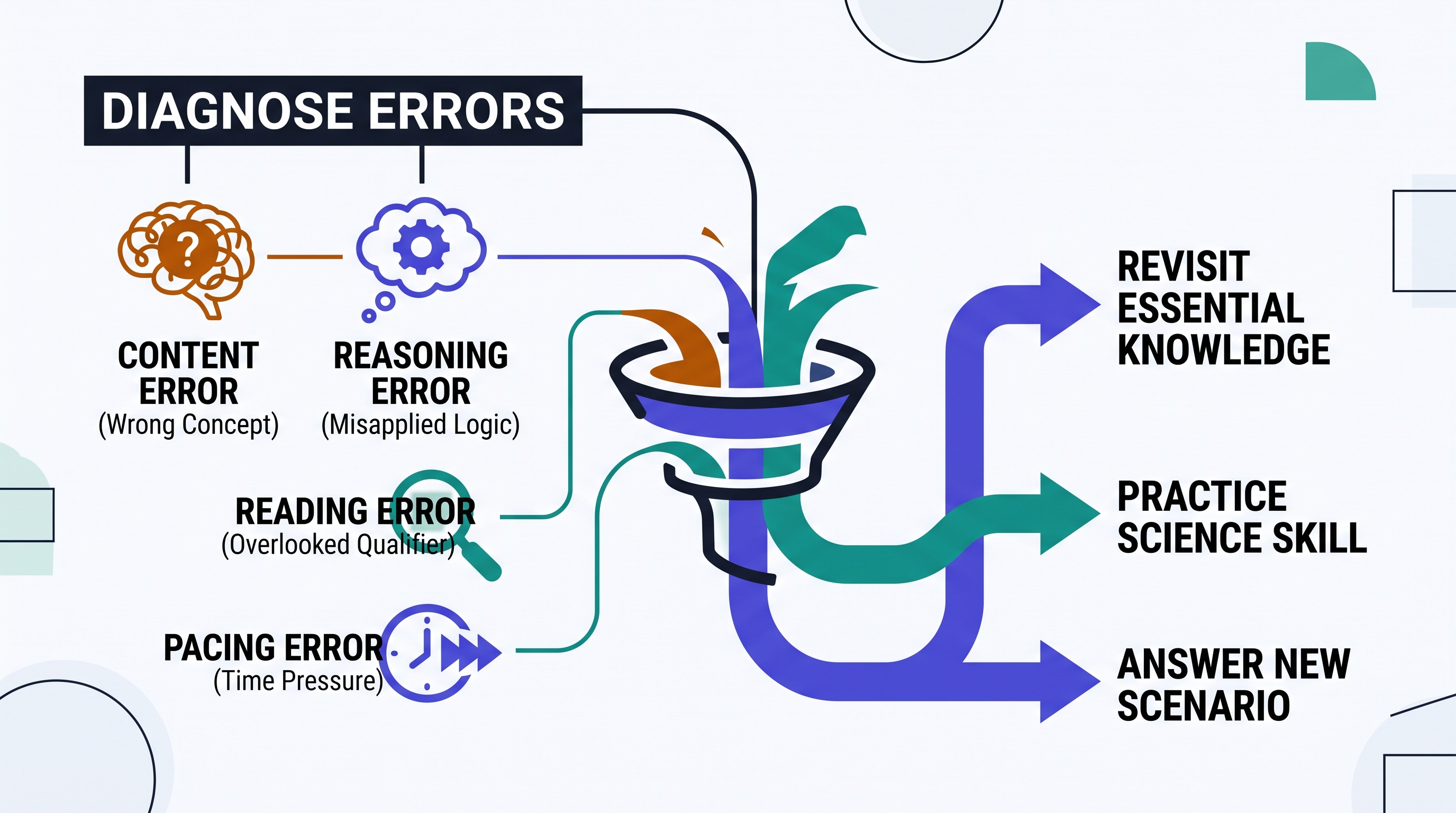
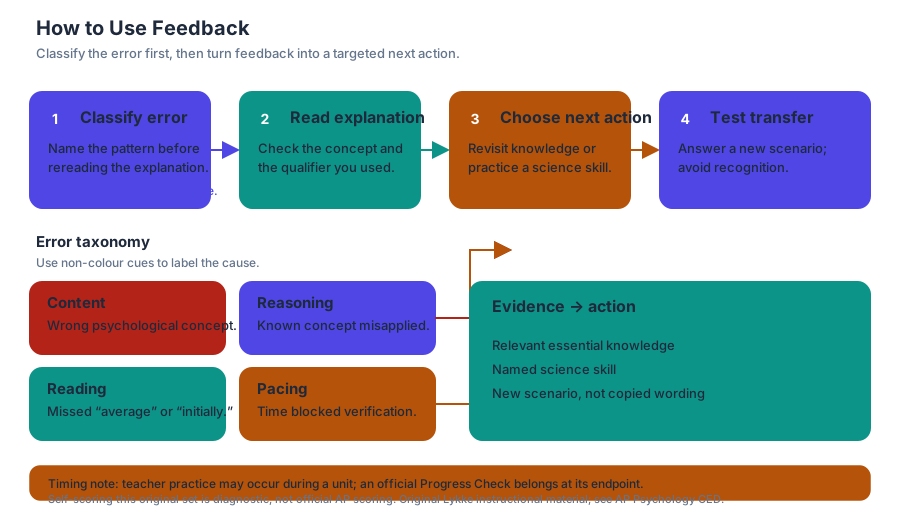
The questions, immediate answers, and rationales constitute formative assessment—assessment used during learning to reveal misconceptions and guide the next instructional decision, not to assign a letter grade. A teacher might reteach reinforcement after Questions 2 and 5, contrast conformity with obedience after Question 3, or ask students to justify each distractor.
These are teacher-created guided practice, designed to prepare students for official AP Classroom Progress Checks rather than duplicate them. Progress Checks are unit-level formative assessments containing multiple-choice questions and free-response questions, with rationales for correct and incorrect multiple-choice answers and scoring information for free responses. They may be assigned as homework or completed in class and provide feedback on the unit’s topics and skills; they are not intended for letter grades.
The alignment chain is therefore visible: framework content supplies the EK, the LO defines the performance, the question supplies a new context, and the rationale exposes the reasoning. That same disciplined process—especially identifying evidence and ruling out plausible alternatives—supports the full-length practice that follows.