From the free course AP Psychology on Lykke
2.5 Storing Memories
Key concepts: Sensory memory · Short-term memory · Working memory · Long-term memory · Memory storage duration, capacity, and content · Maintenance rehearsal · Elaborative rehearsal · Explicit memory · Implicit memory · Memory impairment, including amnesia and Alzheimer’s disease
Memory storage is not one mental “box”; it is a set of processes that differ in duration, capacity, and content. A phone number may briefly remain available as a sound, become an actively manipulated number while you dial, or become part of durable knowledge about someone you know.
2.5 Storing Memories
Memory storage is not one mental “box”; it is a set of processes that differ in duration, capacity, and content. A phone number may briefly remain available as a sound, become an actively manipulated number while you dial, or become part of durable knowledge about someone you know.
Essential Knowledge 2.5.A.1: Sensory memory, short-term memory, working memory, and long-term memory are processes that differ in storage duration, capacity, and content.
Four storage processes
| Memory process | What it holds | Duration and capacity | Example |
|---|---|---|---|
| Sensory memory | An immediate, raw trace of incoming sensory information | Extremely brief; large enough to preserve a rapidly changing scene for a moment | You still “see” the last instant of a sparkler after it moves |
| Short-term memory | Information currently held for brief use | Brief unless maintained; limited capacity | You keep a six-digit door code in mind long enough to enter it |
| Working memory | Information being actively held and manipulated | Brief and limited; supports mental operations | You hold intermediate steps while solving $27 + 18$ |
| Long-term memory | Relatively durable knowledge, skills, experiences, and information | Much longer-lasting; very large capacity | You remember your first day at a new school or how to ride a bicycle |
Sensory memory preserves incoming information before attention selects what matters. Visual sensory memory is often called iconic memory, while auditory sensory memory is called echoic memory. Because this trace fades quickly, unattended information usually disappears rather than becoming a lasting memory.
Short-term memory temporarily maintains information. Working memory is related but more active: instead of merely holding information, it coordinates mental work. Its central executive directs attention; the phonological loop briefly holds and rehearses speech-based or sound-based information; and the visuospatial sketchpad temporarily represents visual and spatial information.
A useful mental model is a small desk. The central executive decides what belongs on the desk, the phonological loop repeats words on a verbal “notepad,” and the visuospatial sketchpad rotates or tracks images and locations. The desk cannot hold or manipulate unlimited material at once, which is why grouping information into meaningful chunks helps.
In the comparator, notice the bottleneck: information can enter sensory memory without becoming a durable memory. Attention moves selected material toward short-term or working memory, while rehearsal can keep it active or help it reach long-term storage. The demonstration is an original instructional visual, not an official College Board simulation.
Rehearsal: keeping information alive versus making it meaningful
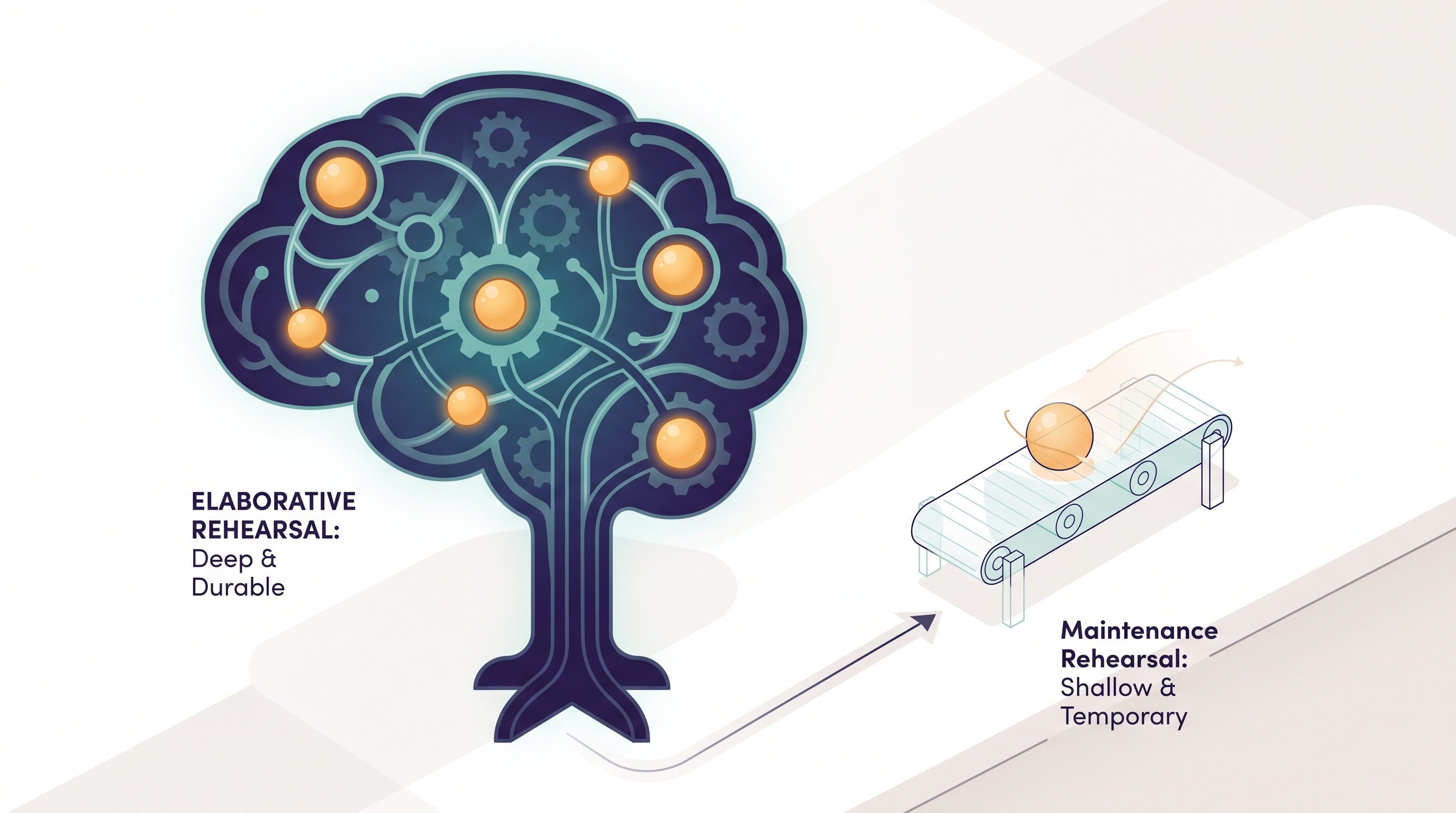
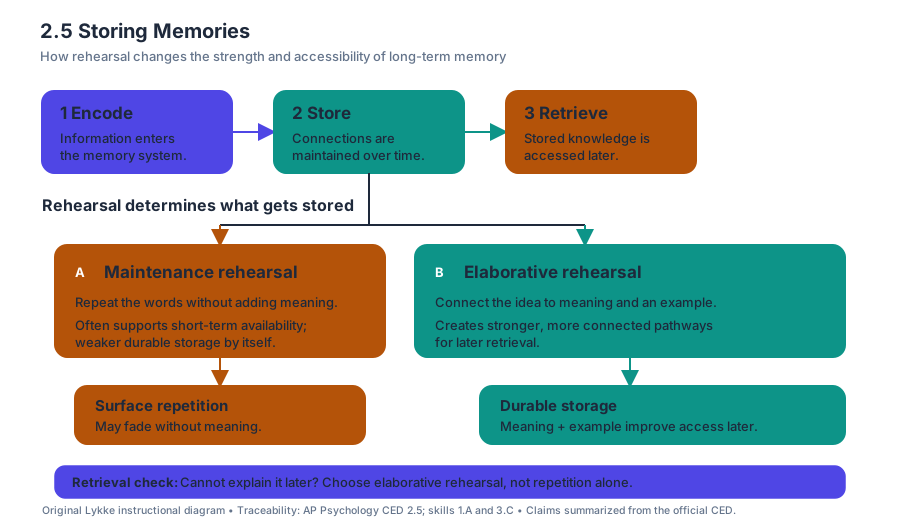
Maintenance rehearsal prolongs storage by repeating information over time. Repeating “4827, 4827, 4827” may keep a code active long enough to use it, but the information can still fade when repetition stops.
Elaborative rehearsal connects new information with meaning, examples, prior knowledge, or personal associations. If you remember amygdala by connecting it to detecting emotionally significant threats, you create more retrieval routes than you would by merely repeating the word. Elaborative rehearsal therefore supports longer-lasting retention.
Key distinction: Maintenance rehearsal keeps information available; elaborative rehearsal builds meaningful connections that support durable storage.
Worked example: You must remember the term visuospatial sketchpad. Repeating the phrase ten times is maintenance rehearsal. Imagining a small mental whiteboard that temporarily displays a map, then connecting that image to the word spatial, is elaborative rehearsal. If asked later which working-memory system helps you picture a route, the meaningful connection gives you a stronger path to the answer.
What gets stored: explicit and implicit memory
Long-term memory includes explicit memory, information you can consciously recall and describe. Episodic memory stores personally experienced events, such as your first concert; semantic memory stores facts and general knowledge, such as knowing that the Earth orbits the Sun.
Implicit memory influences behaviour without requiring conscious recollection. Procedural skills, such as typing a familiar password or balancing on a bicycle, can guide performance even when explaining every step is difficult. This is why implicit memories are often more challenging to consciously describe than explicit memories.
When storage is impaired
Storage can be disrupted by physical impairment or developmental limitations. Anterograde amnesia involves difficulty forming new long-term memories after an injury or illness; the person may hold a conversation briefly but fail to store the event durably. Retrograde amnesia involves loss of memories from before the impairment, so previously stored information is affected.
Alzheimer’s disease can progressively damage memory storage and related cognitive functioning. Infantile amnesia refers to the lack of explicit memories from the earliest years of life. These conditions do not simply mean “all memory disappears”: the affected duration, capacity, and content depend on which storage processes and brain systems are disrupted.
Misconception check
Common error: treating short-term memory and working memory as identical synonyms. Correction: short-term memory emphasizes temporary holding, whereas working memory emphasizes holding and manipulating information. A person repeating a code is using short-term maintenance; a person rearranging the code into a pattern while solving a task is using working memory.
Retrieval check
A learner repeats a definition aloud but cannot explain it later. Which strategy would most likely improve durable storage: more maintenance rehearsal alone, or elaborative rehearsal? Answer: elaborative rehearsal, because connecting the definition to meaning and an example creates stronger long-term memory pathways. This topic’s suggested science-practice links are 1.A: Apply psychological perspectives, theories, concepts, and research findings to a scenario and 3.C: Analyze psychological research studies and data to draw conclusions; use them to distinguish a memory process from a surface description and to interpret evidence about storage.