From the free course AP Psychology on Lykke
4.3 Psychology of Social Situations
Key concepts: Developmental psychology of peer relationships · Separation anxiety · Adolescent egocentrism and the imaginary audience · Conformity · Group dynamics · Relative deprivation · Foot-in-the-door technique · Door-in-the-face technique · Expectations, biases, and attitudes in social behavior
Predict how conformity, obedience, group polarisation, groupthink and bystander effects change behaviour, and judge the ethics of the classic studies.
4.3 Psychology of Social Situations
A group can change what you notice, what you believe is normal, and even what you do—sometimes without anyone giving you a direct command. Social psychology examines these effects, while developmental psychology traces how relationships and social expectations change across the lifespan.
Social relationships develop—and so do social fears
Peer relationships are relationships with people of similar age or social position. Developmental psychologists study how these relationships develop over time: young children gradually move from playing beside one another to cooperating, negotiating rules, forming friendships, and using peers as sources of identity and approval.
One early social fear is separation anxiety, heightened anxiety or fear when a child is away from a caregiver or encounters unfamiliar people. It can make a child cling to a caregiver at daycare, cry during a temporary separation, or hesitate around an unfamiliar adult. Separation anxiety is not the same as ordinary dislike of a particular person; the central feature is distress connected to separation or unfamiliarity.
Adolescence: the imaginary audience
Adolescents may show egocentrism, a tendency to interpret social situations primarily from their own viewpoint. One expression is the imaginary audience—the belief that other people are constantly observing and evaluating you.
A teenager who refuses to wear a shirt with a small stain because “everyone will notice” is responding to an imaginary audience. The teenager’s embarrassment is real, but the assumption that everyone is monitoring the stain is exaggerated. This does not mean adolescents are selfish or incapable of empathy; it describes a developmental pattern in how attention and evaluation are perceived.
Misconception check: The imaginary audience does not mean that other people literally follow or watch an adolescent. It means the adolescent perceives unusually intense public attention.
Norms, roles, and social influence
A social norm defines expectations for behavior in a situation, while a social role describes the expected behavior associated with a position. Waiting quietly in a library follows a norm; acting as a team captain involves a role. These expectations can guide behavior even when nobody states them aloud. This is 4.3.A.1.
Social influence theory distinguishes normative influence, pressure to fit in or gain acceptance, from informational influence, reliance on others because you believe they possess useful or accurate information. If you clap because everyone else is clapping, normative influence may be operating. If you follow a crowd out of a building because you assume they know where the exit is, informational influence may be operating. This distinction is 4.3.A.2 and directly develops Science Practice 1.B, applying expectations, circumstances, and biases to behavior.
Conformity and group dynamics
Conformity is changing behavior or expressed beliefs to match a group’s unspoken rules or expectations. Research on conformity shows that group pressure becomes more powerful when the group appears unanimous, the individual is uncertain, or the individual wants acceptance. A person may privately disagree but publicly give the group’s answer.
This research provides insight into group dynamics, the patterns of interaction that develop among group members. Group size, agreement, status, anonymity, and the presence of dissent can alter participation and judgment. For example, one teammate who confidently questions a popular but weak plan can reduce conformity by making disagreement socially acceptable.
Original instructional activity: Imagine that four friends unanimously choose an expensive restaurant, while one friend privately prefers a cheaper option. Predict whether the person will agree aloud. Now change one variable at a time: add a friend who disagrees, make the decision anonymous, or give the hesitant person expert knowledge about prices. The prediction should change because unanimity, accountability, and informational influence have changed—not because the person’s personality necessarily changed.
Relative deprivation
Relative deprivation is the perception of being deprived relative to other people. It depends on comparison, not simply on absolute hardship. A student may feel deprived after receiving a good score if close friends receive much higher scores; the same score may feel successful when compared with a lower earlier performance.
Relative deprivation can influence resentment, motivation, group identification, and judgments about fairness. The key reasoning move is to identify the comparison group: deprived compared with whom? This prevents the misconception that relative deprivation means a person objectively has the fewest resources.
Compliance: small-to-large versus large-to-small
Compliance means changing behavior in response to a request. The foot-in-the-door technique begins with a small request to increase compliance with a later, larger request. By contrast, the door-in-the-face technique begins with a large request likely to be rejected and then follows with a smaller target request.
Worked example: A club first asks Maya to volunteer every Saturday for six months—a request she rejects. It then asks her to staff one Saturday event, and she agrees. The second request may feel reasonable by comparison, and Maya may interpret accepting it as a compromise. The direction matters: foot-in-the-door moves small to large; door-in-the-face moves large to small. These techniques influence compliance with actions; they are not identical to changing a person’s underlying attitude.
Expectations, biases, and attitudes in social behavior
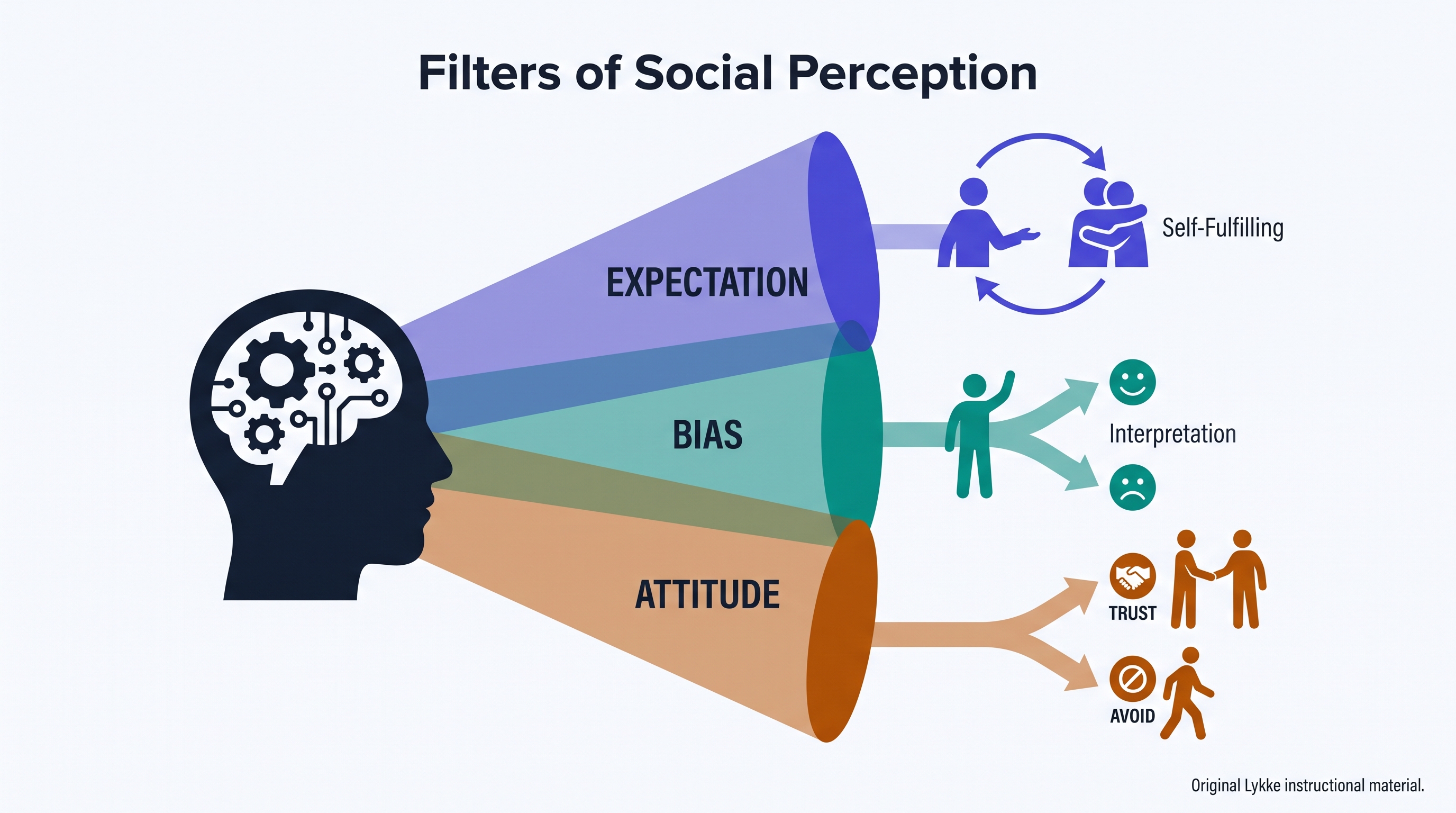
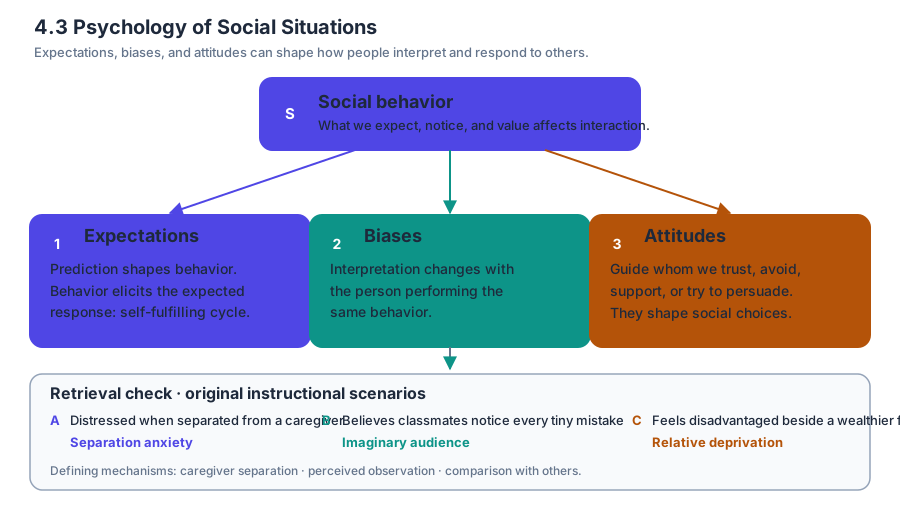
Social behavior can be shaped by expectations, biases, and attitudes. An expectation may become self-fulfilling when someone behaves toward another person in a way that elicits the expected response. A bias may cause a person to interpret the same behavior differently depending on who performs it. An attitude may guide whom someone trusts, avoids, supports, or persuades.
Retrieval check: A child becomes distressed specifically when separated from a caregiver; an adolescent believes classmates will notice a tiny mistake; a shopper feels unfairly disadvantaged after comparing their purchase with a wealthier friend. Which concepts fit these cases?
Answer: The cases illustrate separation anxiety, the imaginary audience, and relative deprivation, respectively. The comparison identifies the defining mechanism in each case: separation from a caregiver, perceived constant observation, and perceived disadvantage relative to others.