From the free course AP Psychology on Lykke
3.7 Classical Conditioning
Key concepts: Classical conditioning · Associative learning and acquisition · Unconditioned stimulus (UCS) and unconditioned response (UCR) · Conditioned stimulus (CS) and conditioned response (CR) · Timing and order of stimulus presentation · Extinction · Spontaneous recovery · Stimulus generalization · Stimulus discrimination · Behavioral perspective on learning
Label the US, UR, NS, CS and CR in any described procedure and predict acquisition, extinction, spontaneous recovery, generalisation and discrimination.
3.7 Classical Conditioning
A dog may begin salivating when it hears a can opener—not because the sound is food, but because the sound has become a signal for food. Classical conditioning is learning through the association of one stimulus with another stimulus so that the first stimulus eventually elicits a response.
The behavioral perspective traditionally focused on observable behavior rather than unobservable mental processes (3.7.A.1). Classical conditioning demonstrates how a previously neutral event can acquire behavioral meaning through repeated pairings.
The four essential components
Before conditioning, one stimulus naturally produces a response. During acquisition, another stimulus becomes connected to that natural trigger. The labels describe the function of each stimulus or response, not whether it is pleasant or unpleasant.
| Component | Precise meaning | Original example |
|---|---|---|
| Unconditioned stimulus (UCS) | A stimulus that naturally elicits a response without prior learning | A lemon taste |
| Unconditioned response (UCR) | The automatic response elicited by the UCS | Salivation after tasting lemon |
| Neutral stimulus (NS) | A stimulus that initially does not elicit the target response | A phone chime before learning |
| Conditioned stimulus (CS) | The formerly neutral stimulus after it has been paired with the UCS | The phone chime after repeated lemon pairings |
| Conditioned response (CR) | The learned response elicited by the CS | Salivation after hearing the chime |
The core relationship is:
$$ \text{UCS} \rightarrow \text{UCR} $$
After learning:
$$ \text{CS} \rightarrow \text{CR} $$
The UCR is naturally produced by the UCS. When a similar response occurs in response to the CS, it is called the conditioned response, because learning has made the CS meaningful (3.7.A.2.i).
Acquisition: learning the association
Acquisition is the process of learning an association through repeated pairings of the CS and UCS (3.7.A.2). Imagine that a café plays a short tone immediately before serving a strongly flavored sample. At first, the tone is an NS: it does not cause salivation. After many tone–sample pairings, the tone becomes a CS, and salivation to the tone becomes the CR.
The order and timing of presentation matter (3.7.A.2.ii). For acquisition to work well, the CS generally needs to occur before, and close in time to, the UCS. The learner must be able to use the CS as a predictor. If the tone occurs long after the sample, the tone provides little useful information about what is coming.
Worked application: label before you explain
A fictional clinic repeatedly gives a bitter-tasting vitamin immediately after a blue light flashes. Later, the blue light alone causes a person to grimace.
- The bitter taste is the UCS because it naturally produces the reaction.
- The grimace to the bitter taste is the UCR.
- The blue light begins as the NS.
- After repeated pairings, the blue light becomes the CS.
- The grimace to the blue light is the CR.
This is an application of Science Practice 1, Skill 1.A: Apply psychological perspectives, theories, concepts, and research findings to a scenario. On an exam, first identify what naturally causes the response; then identify what had to be learned.
Misconception check — “The UCS is always the thing that comes first.” Not necessarily. The UCS is defined by its natural ability to elicit the UCR, not by its position in a sentence or diagram. A stimulus presented first can still be the CS if it does not naturally produce the target response.
What happens after learning?
Extinction occurs when the CS is repeatedly presented without the UCS. The learned CR weakens and may disappear because the CS is no longer followed by the event it predicted (3.7.A.2.iii). If the blue light appears again and again without the bitter taste, the grimace should decline.
Extinction does not necessarily erase every trace of the original association. Spontaneous recovery occurs when a formerly extinguished CR returns after the CS is presented again following extinction. A brief return of the grimace after the blue light reappears therefore indicates spontaneous recovery, not that acquisition has started from nothing.
Generalization and discrimination
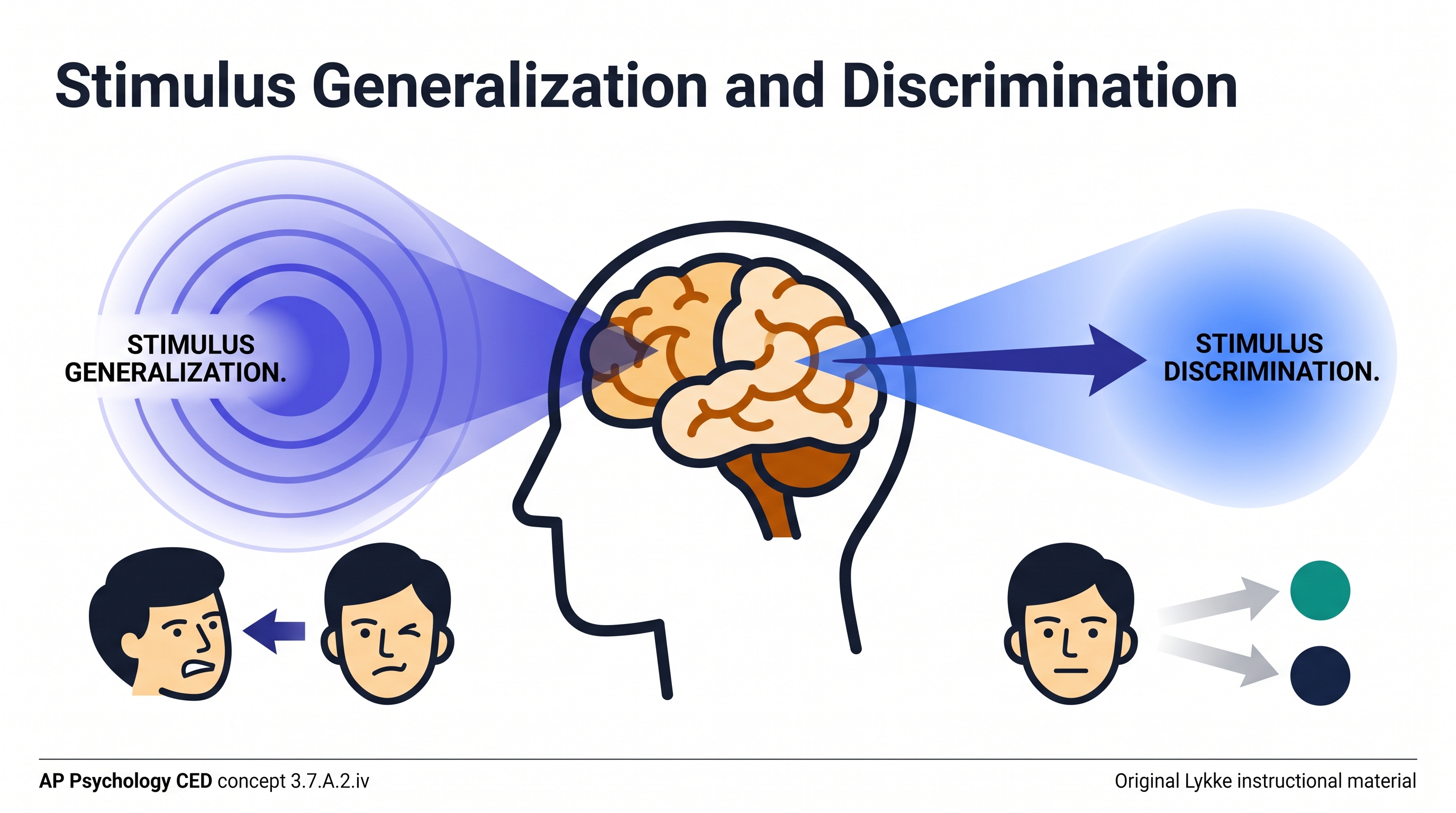
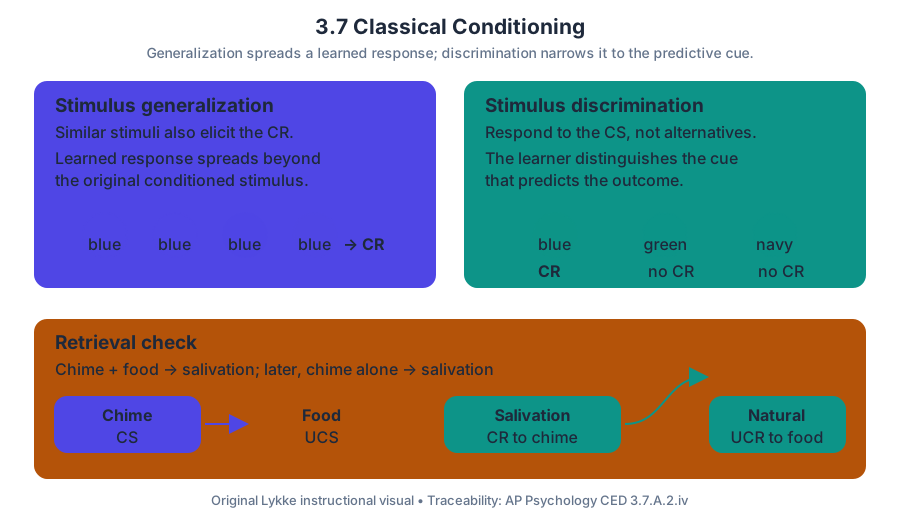
Stimulus generalization occurs when stimuli similar to the CS also elicit the CR. If several shades of blue cause the person to grimace, the learned response has generalized beyond the original blue light.
Stimulus discrimination occurs when the learner responds to the CS but not to similar stimuli. If only the exact blue light produces the grimace while green and navy lights do not, the learner has learned to distinguish the predictive stimulus from nearby alternatives (3.7.A.2.iv).
Retrieval check: A chime initially produces no response. It is repeatedly followed by food, and later the chime alone produces salivation. What are the chime and salivation after learning?
Answer: The chime is the CS, and salivation to the chime is the CR. The food is the UCS, and the natural salivation it produces is the UCR.