From the free course AP Psychology on Lykke
2.3 Introduction to Memory
Key concepts: Multi-store model of memory · Sensory memory · Iconic memory · Echoic memory · Short-term memory · Long-term memory · Encoding, storage, and retrieval · Automatic and effortful processing · Levels of processing model · Context-dependent memory
Memory is not a single mental “storage box.” It is a coordinated set of systems that briefly hold information, transform it, preserve it, and later make it available for use.
2.3 Introduction to Memory
Memory is not a single mental “storage box.” It is a coordinated set of systems that briefly hold information, transform it, preserve it, and later make it available for use. When you hear your name in a crowded hallway, remember a friend’s birthday, or automatically ride a familiar bicycle, different memory structures and processes are working together.
Learning Objective 2.3.A: Explain how the types, structures, and processes of memory work.
The multi-store model: a flow of information
The multi-store model proposes three interacting memory systems: sensory memory, short-term memory, and long-term memory. Information must pass through these interacting systems to be remembered, although attention and processing determine what continues moving through the system.
| Memory system | What it does | Everyday example |
|---|---|---|
| Sensory memory | Briefly holds incoming sensory information before it fades or receives attention | The visual trace of a sparkler remains for a moment after it moves |
| Iconic memory | Sensory memory for visual information | You can briefly “see” the arrangement of a sign after glancing away |
| Echoic memory | Sensory memory for auditory information | You can report the last few words of a sentence even after asking, “What did you say?” |
| Short-term memory | Temporarily holds information currently being attended to | You keep a phone number active long enough to dial it |
| Long-term memory | Stores information over an extended period for later retrieval | You remember your address, a learned skill, or an event from childhood |
The model is best understood as a sequence of opportunities rather than a rigid conveyor belt. Sensory input may disappear quickly if you do not attend to it; attended information can enter short-term memory; and information that is sufficiently processed can become available in long-term memory. Retrieval then brings stored information back into active use.
Three processes: encoding, storage, and retrieval
Encoding is the process of putting information into a memory system. Storage is the maintenance of that information over time. Retrieval is bringing stored information back into conscious use. A memory failure can occur at any of these points: you may never encode a person’s name, fail to maintain it, or know that you learned it but be unable to retrieve it when asked.
Processing can be automatic or effortful. Automatic processing occurs with little conscious effort, such as remembering the general location of a familiar landmark or noticing the order of events in your routine. Effortful processing requires attention and deliberate mental work, such as learning unfamiliar psychological terms or consciously rehearsing a new password.
The multi-store model therefore connects structures with processes: information enters through sensory memory, may receive attention in short-term memory, and may be retained in long-term memory through processing. Long-term memory is not limited to facts you can consciously state; it also includes explicit memory, conscious memory for facts and events, and implicit memory, memory expressed through skills or behaviors without deliberate recollection.
Explicit memory includes episodic memory for personally experienced events, semantic memory for facts and concepts, and prospective memory for remembering to perform a future action. Implicit memory includes procedural memory, such as knowing how to type or balance on a bicycle, even when you cannot describe every movement involved.
A brief preview of processing depth
The levels of processing model adds an important qualification: not all encoding is equally deep. Structural processing focuses on physical form, phonemic processing focuses on sound, and semantic processing focuses on meaning. These levels range from shallowest to deepest; meaning-based processing generally creates a stronger basis for later memory than noticing appearance alone.
For example, seeing that memory is written in lowercase uses structural processing. Noticing that it rhymes with summary uses phonemic processing. Connecting it to the process of encoding, storage, and retrieval uses semantic processing. The key point here is that the memory system’s route and the quality of processing both influence what can later be retrieved.
Worked example: what exactly was remembered?
Maya hears an announcement while walking through a busy gym. The sound briefly enters echoic memory. She attends to it, repeats the room number in short-term memory, and later remembers the room when she arrives at school. The announcement was encoded, maintained through rehearsal and stored, then brought back through retrieval.
A vague explanation would say, “Maya remembered because she paid attention.” The stronger explanation identifies the sequence: auditory sensory memory held the announcement briefly, attention moved it into short-term memory, effortful rehearsal supported its storage in long-term memory, and retrieval made the room number available later.
Misconception check
Common misconception: sensory memory is the same as short-term memory because both last only briefly. Correction: sensory memory preserves a very short trace of incoming sights or sounds, whereas short-term memory holds information you are actively attending to and using. Iconic memory is visual; echoic memory is auditory.
Retrieval check
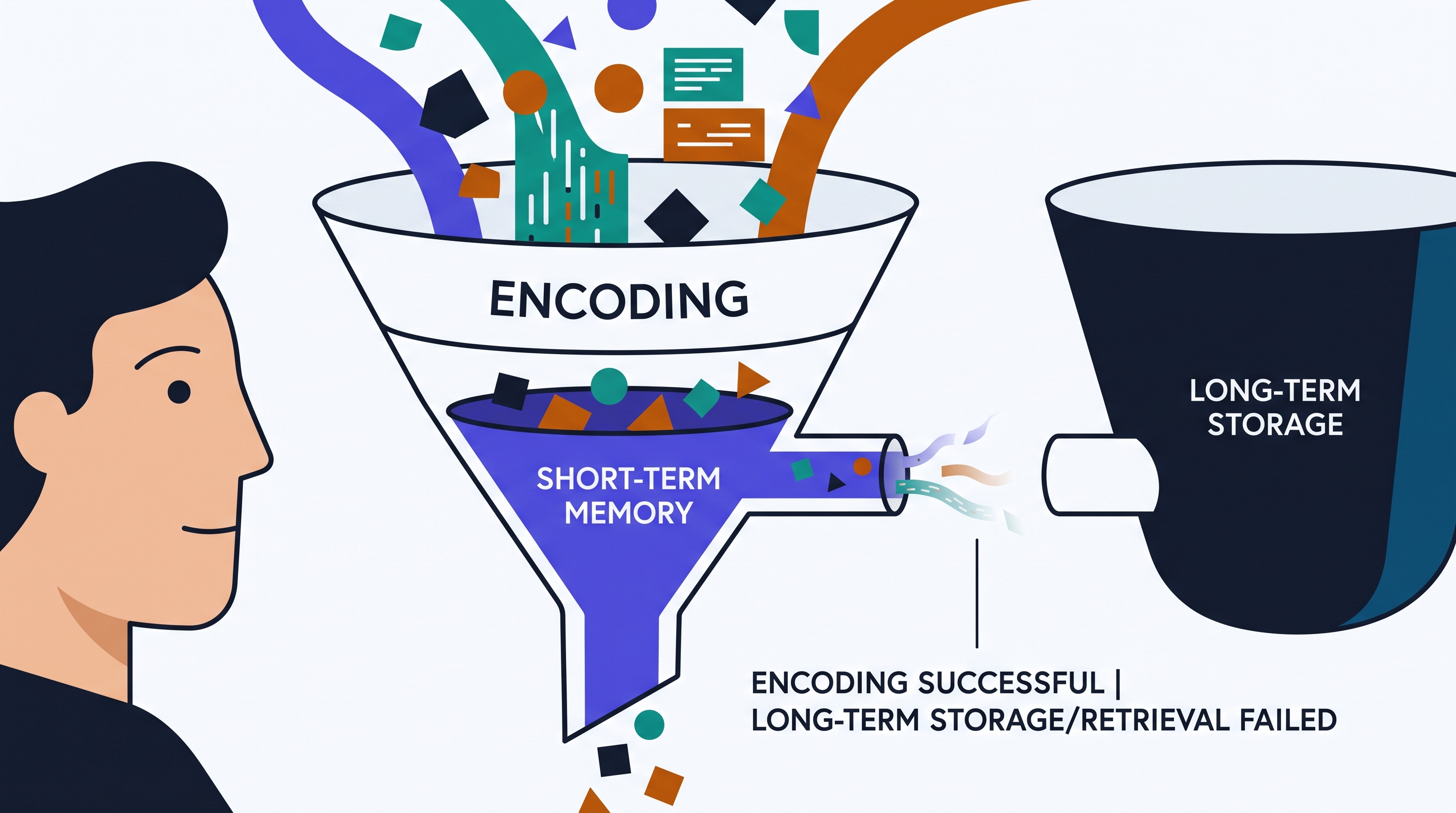
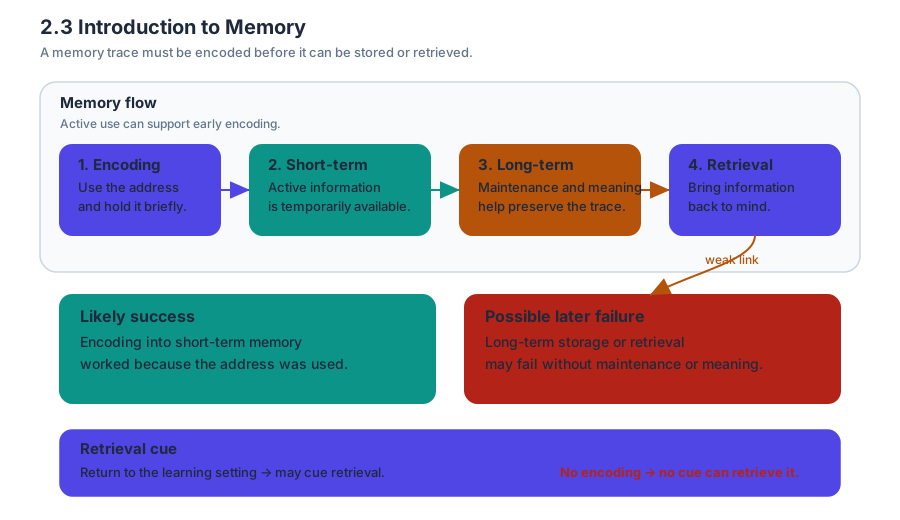
Question: You can repeat a new address long enough to enter it into a form, but you cannot recall it the next day. Which process was likely successful, and which later process may have failed?
Answer: Encoding into short-term memory was successful because you actively used the address. Long-term storage or later retrieval may have failed because the information was not maintained or sufficiently connected to meaning. Retrieval can also be supported by cues, such as returning to the setting where information was learned, but a cue cannot retrieve information that was never encoded.